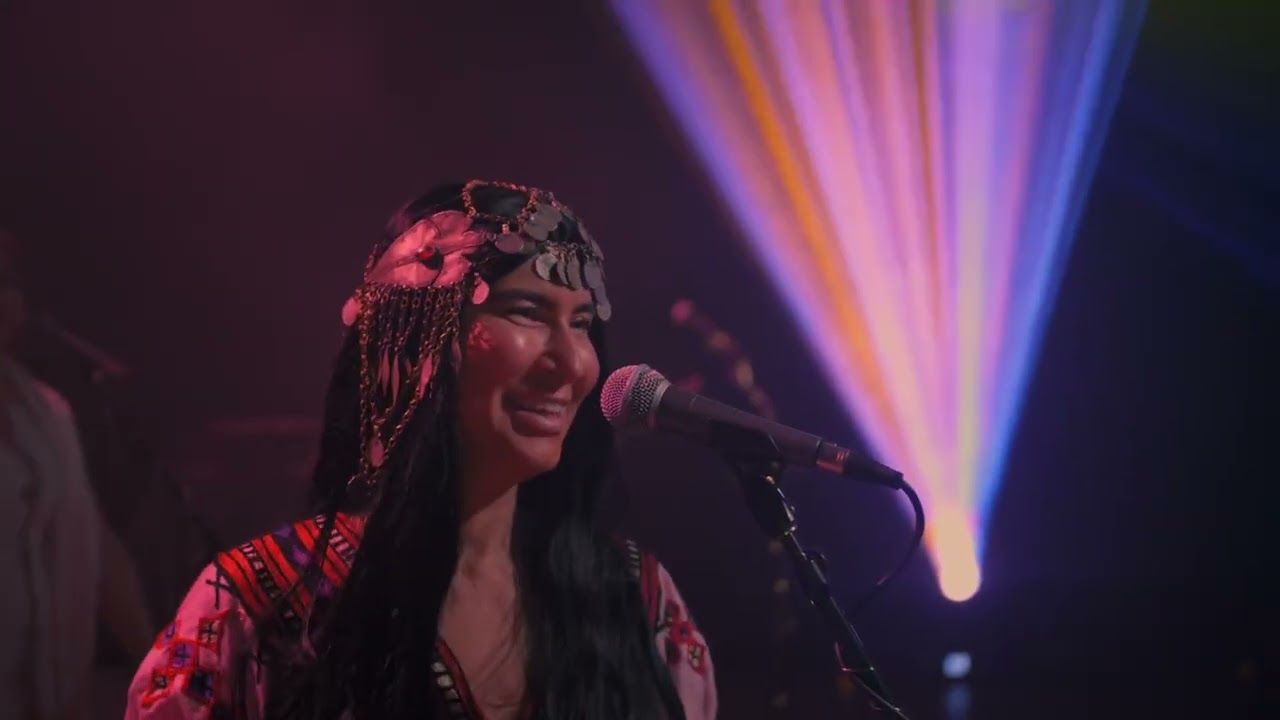
The stage holds heat. Not metaphorical—the word becomes an incantation, a breath falling like rain, falling like fire. This is the opening gesture of Holy River, a five-minute performance work directed by Todd Raviotta and created by Høly River with Natural Science Productions. Shot in Richmond, Virginia, in 2014 and released in 2015, it's a work that asks its viewers to step outside time itself, to journey backward past mind into something older, hotter, more essential. With nearly 50,000 views on YouTube, the piece has found an audience among those searching for spiritual expression beyond traditional teaching formats—a performance that functions simultaneously as meditation, ritual, and artistic statement.
The piece doesn't begin with exposition. There are no explanations, no framing devices. Instead, Raviotta and his ensemble—a cast including Laney Sullivan, Jameson Price, Parker Galore, Brinson Leigh Kresge, Marlowe Ren Kresge, Sahar Aha, Shawn Everett Jones, Julie Storey, Elysia Honey Houghton, Graham Hyphen, and Daniel Upshaw, alongside puppets and masks designed by All the Saints Theater Company—move directly into the work's central prayer: "Holy river, take me back in time / before the mind." What follows is neither quite theater, nor concert, nor dharma teaching, but a hybrid form that borrows the ritual intensity of all three.
The piece circulates obsessively around a single temporal gesture: reversal. "Take me back in time before the fire became the light," the voices ask near the work's close. This isn't nostalgia or escapism. Rather, it's an artistic meditation on consciousness itself—the question of what remains when the mind's categories fall away. The lyrics construct a landscape of paradox: a soul that is "just a paste you place upon your head," a body "tied up in among the earth," breaths numbered "a thousand times" in ritual succession. These aren't images meant to cohere into logical sense. They're meant to crack the surface of rational mind, to make space for something else to move through.
Many contemplative traditions point toward a consciousness prior to the mind's movement—a state before naming begins. The work doesn't present these teachings explicitly. Instead, it enacts the attempt through sound and movement, inviting viewers into the seeking itself rather than offering them a map. This is a crucial distinction: Holy River isn't interested in transmitting information about enlightenment or non-dual states. It's interested in creating the conditions for direct experience of those states.
The work uses physical theater and vocal layering to build this register. Heat becomes a touchstone—the word repeating, escalating, accumulating like breath practice or mantra. At the opening, "Heat. Heat." falls from the performers' mouths like a question, then a statement, then something closer to fever. Fire "burns" and "never stops." Water appears as sanctuary: "Wrap me in your quiet water side." These aren't simple opposites. They're states of transformation—forces that break the practitioner open to what lies beyond conventional thought.
"Holy river, take me back in time before the fire became the light. Wrap me in your quiet water side."
This elemental language echoes sacred traditions across cultures. What makes Holy River distinctive is how it strips these images of explanation—just the pure sensation, the pure frequency of the words themselves, sounding across the space between performer and witness. This is a methodology common to both avant-garde performance and spiritual practice: bypassing the rational mind through rhythm, through sensory intensification, through immersion in something larger than individual thought. The audience isn't asked to understand; it's asked to resonate.
What distinguishes Holy River among contemporary contemplative art is its insistence on the body as primary text. The puppets and masks—created by All the Saints Theater Company—are not decorative. They're part of the work's central claim: that consciousness isn't something confined to the individual mind, but distributed through the whole organism and between forms. "My body tied up in among the earth"—the line refuses the spirit/matter split. There's no escape upward here. The return to "before the mind" is simultaneously a return to the earth, to the physical ground from which consciousness emerges.
The masks transform the performers; they become vessels for something beyond individual personality. The puppets move with their own gravity, their own rhythm. Together, they propose that consciousness might be something that flows through form itself—that the boundary between self and other, animate and object, is more permeable than the rational mind typically assumes. This is radical because it challenges the entire apparatus of separation that the thinking mind relies upon.
This approach aligns with contemporary somatic practices in spirituality—methods that propose the body holds memory and wisdom that bypass conceptual thought. When the work commands "Breathe deeply now a thousand times," it isn't offering advice; it's offering an immediate, embodied practice. The instruction sits at the work's emotional center, a moment where performance and practice converge:
"Breathe deeply now a thousand times. The sun will rise before you die. But you already know that you are there."
That final line—"But you already know that you are there"—is a non-dual punchline. You're not trying to achieve something. You're already where you need to be. The practice isn't about becoming; it's about remembering, about returning to a presence that already exists, prior to and beyond the mind's attempts to grasp it. This is a teaching hidden within instruction, a paradox that dissolves the very seeking that brought the viewer to the work in the first place.
Breath work, the anchor of contemplative practice across cultures, becomes the bridge between past and present, death and life, forgetting and remembering. By centering breath in the work's architecture, Holy River treats respiration as a technology of consciousness itself—not metaphorically, but literally, as the instrument through which awareness can be recalibrated and returned to its source. Every breath is a return. Every exhalation is a small death. Every inhalation is resurrection.
Raviotta's direction holds all these elements in productive tension. The piece doesn't resolve. It doesn't conclude with revelation or climax in the conventional sense. Instead, it cycles—heat, fire, water, the refrain "Holy river" returning like a tide. The performance receives applause as it transitions back into ordinary time. It's a small but powerful gesture: the sacred work is done, and now we return. Not with answers, but with something shifted inside the witness.
This refusal to climax or resolve is itself a kind of teaching. Much contemporary spiritual artmaking tries to transport the viewer to transcendence, to provide a clear arc from confusion to clarity. Holy River is less interested in that redemptive narrative. It's interested in the state itself—the quality of presence available when you stop seeking resolution, when you stop requiring the mind to make logical sense of what's happening. The mind is given permission to rest.
The five-minute duration mirrors this philosophy precisely. It's long enough to establish a trance state, short enough that viewers can hold its entirety in mind—can feel its shape, like a poem or a musical piece. And like both those forms, it leaves interpretation open. Each viewer's "return" before the mind is their own. The work doesn't police meaning; it creates conditions for direct experience.
The piece's production at Stonehaven, a creative venue in Richmond, and its subsequent life as a recorded artifact on YouTube raises important questions about how spiritual art travels. Unlike a live ritual, which depends on presence in a specific time and place, this performance exists as a document. And yet, viewed in isolation, in a room with headphones, the piece retains its power to shift attention, to create intimacy, to ask the viewer to turn inward. This suggests something profound about the nature of transmission itself: it doesn't depend on institutional validation or hierarchical authority. It depends on the work's ability to create coherence between form and intention, sound and silence, the performer's commitment and the viewer's willingness to be present.
Viewers interested in Holy River might explore other works that blend spiritual practice with experimental theater—from vocal performance artists who treat the voice as an instrument of consciousness to participatory ritual artmaking that invites collective transformation. The questions the piece raises—about how consciousness changes when we step outside narrative time, about the relationship between body and mind, about what prayer can be in the contemporary moment—continue across spiritual artmaking and contemplative practice.
For those drawn to the work's emphasis on breath as gateway, formal breath practices in yoga, qigong, and Buddhist meditation offer their own sustained exploration. For those fascinated by the theatrical approach itself, the work of experimental theater companies exploring ritual and embodiment remains vital territory. And for those seeking to understand how sacred art functions outside institutional containers, the broader tradition of spiritual performance—from ancient mystery rites to contemporary site-specific ritual—offers a lineage in which Holy River finds its place: performance as a vehicle not for narrative entertainment, but for collective awakening and transformation.