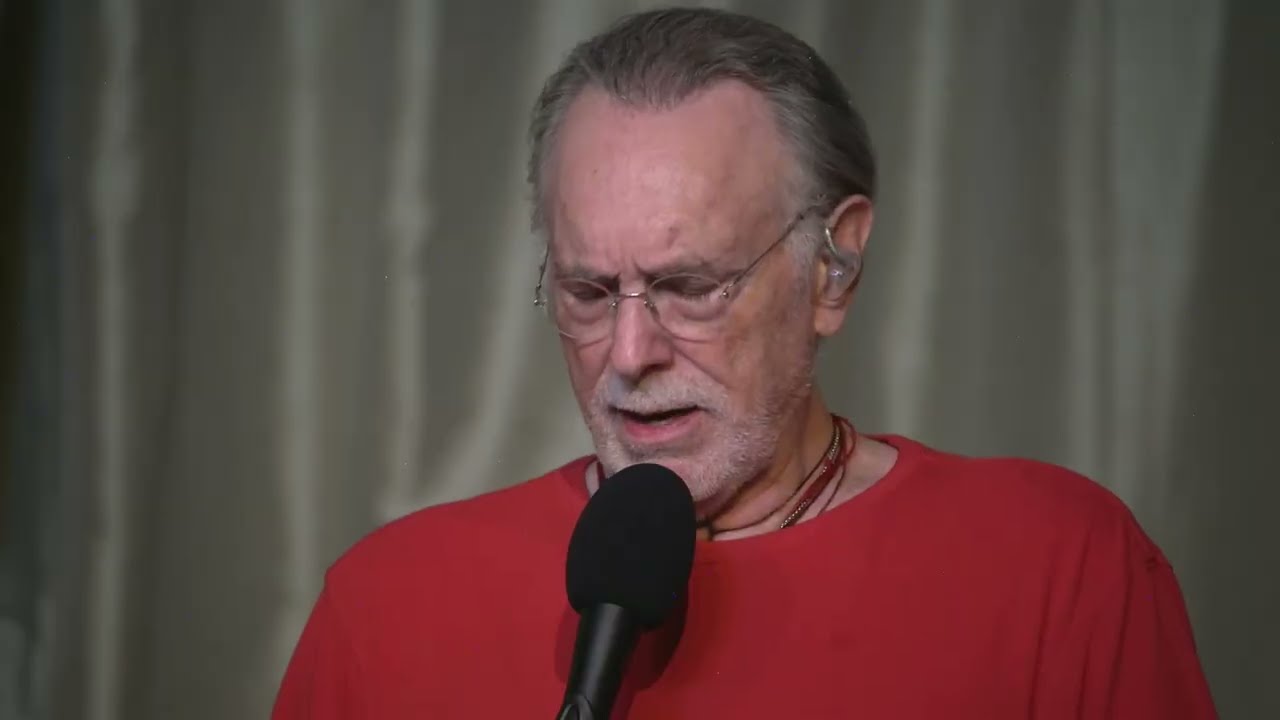
This live performance video captures Krishna Das — widely regarded as the West's foremost kirtan artist — leading a full ensemble in the ancient Shaivite mantra Om Namah Shivaya at the Church of St. Paul & St. Andrew in New York City, recorded in October 2013. The video includes on-screen Sanskrit lyrics so viewers can chant along, and it forms part of the larger concert release Krishna Das Live In New York, Vol. 1. The performance brings together harmonium, guitar, tabla, naal, cello, percussion, keyboards, bass, and choir vocals — illustrating how Western instruments and Indian classical percussion can hold a traditional mantra without diminishing its devotional weight.
What Is Om Namah Shivaya?
Om Namah Shivaya is one of the most widely chanted mantras in the Hindu tradition, originating in the Krishna Yajurveda within a hymn known as the Shri Rudram. It belongs to the Shaiva school of devotion — the path of Lord Shiva — and is sometimes called the Panchakshara mantra, meaning the "five-syllable" mantra, referring to the five core syllables: Na, Ma, Shi, Va, Ya. Each syllable corresponds to one of the five classical elements — earth, water, fire, air, and space (ether) — making the mantra a sonic map of creation itself.
The phrase translates broadly as "I bow to Shiva" or "I honor the auspicious one," but that translation captures only the surface. In the non-dual Shaiva Siddhanta and Kashmir Shaivism traditions, Shiva is not merely a deity to be worshipped from a distance — Shiva is the ground of consciousness, the substratum in which all phenomena arise and dissolve. To chant Om Namah Shivaya is therefore less an act of petition and more an act of recognition: a turning of attention back toward the source.
How Does Krishna Das Approach Kirtan?
Krishna Das — born Jeffrey Kagel — encountered the practice of kirtan through his time with the Indian saint Neem Karoli Baba (Maharaj-ji) in the early 1970s, an encounter that reoriented his life entirely. He has described kirtan not as performance but as practice — a form of Bhakti Yoga, the yoga of devotion, in which the repetition of divine names is the primary method of quieting the mind and opening the heart.
The structure of a kirtan session is call-and-response: the lead singer sings a line or phrase, and the congregation echoes it back. This back-and-forth is not merely musical convention; it is functional. The repetition gradually dissolves self-consciousness and analytical thinking, allowing participants to drop into a more receptive, present-moment state. Krishna Das has often noted that he himself is "doing the practice" while on stage — he is not performing for an audience so much as chanting alongside one.
For Om Namah Shivaya, the call-and-response structure is particularly natural. The mantra is short enough to memorize immediately and melodic enough to carry emotional resonance across dozens of repetitions without becoming mechanical. The on-screen lyrics included in this video serve precisely that invitation: you don't need to know Sanskrit, you don't need a background in yoga — you need only to open your mouth and follow along.
Who Are the Musicians in This Performance?
The ensemble on this recording is unusually rich for a kirtan setting, demonstrating how far the form has evolved from its origins in simple village gatherings with hand cymbals and a harmonium. The full lineup for this New York performance includes:
- Krishna Das — lead vocals and harmonium. The harmonium provides the drone foundation that anchors the melody and keeps the group in tune.
- David Nichtern — guitar. Nichtern is a veteran musician and Buddhist teacher whose melodic guitar lines add a distinctly Western harmonic color without disrupting the devotional atmosphere.
- Arjun Bruggeman — tabla and naal. The tabla is the classical North Indian hand drum; the naal is a double-headed barrel drum used in Punjabi folk music. Together they provide rhythmic momentum that builds over the course of the chant.
- Nina Rao — kartals. Kartals are small brass hand cymbals that mark the beat and keep the congregational chanting synchronized; Rao is herself a respected kirtan artist in her own right.
- Yaitza Jaya Sita Lopez — cello. The use of cello in kirtan is a relatively modern development; its deep, sustained tone blends with the harmonium drone in ways that Western audiences often find emotionally immediate.
- John McDowell — percussion and keyboards.
- Mark Gorman — bass.
- Kosmic Kirtan Posse — choir vocals, providing the congregational "response" element when the live audience needs support.
The recording was mixed and mastered by Jay Messina, with live sound by Kevin D. Reilly, and video production by Sandy Chase of Fluid Film — professional-grade production values that are part of why this video has reached tens of millions of views on YouTube.
Why Does Om Namah Shivaya Have Such Wide Appeal?
With nearly 60 million views on this single video alone, the question of why this particular mantra resonates so broadly is worth sitting with. Several factors converge:
- Melodic accessibility: The melody Krishna Das uses for Om Namah Shivaya is simple, singable, and emotionally open — it neither demands expertise nor collapses into monotony.
- Cross-traditional relevance: While Shaivite in origin, the mantra's gesture of "bowing to that which is greater than the ego-self" maps onto recognizable spiritual impulses across many traditions. Practitioners from Buddhist, Christian, Jewish, and secular backgrounds often report finding the chant accessible.
- The repetition effect: Modern neuroscience has begun to examine what yogic and contemplative traditions have always known: rhythmic, repetitive vocalization can downregulate the default mode network — the brain's "narrative self" circuitry — and produce states of calm, presence, and even mild euphoria. Kirtan is, in this sense, a technology as much as an art form.
- The setting: Filming at the Church of St. Paul & St. Andrew — a landmark Methodist church in Manhattan — places the chant in a context that visually signals sacred space without being sectarian. The choice is quietly ecumenical.
What Is the Role of Bhakti Yoga in Krishna Das's Teaching?
Bhakti Yoga — the path of loving devotion — is one of the four classical paths described in the Bhagavad Gita. Where Jnana Yoga works through intellectual discrimination and Raja Yoga works through meditative discipline, Bhakti works through the heart. The practitioner cultivates love for the divine — in whatever form resonates — as the primary vehicle for liberation from the habitual suffering caused by the conditioned mind.
Krishna Das has been consistent in positioning kirtan within this framework. He is not asking participants to adopt Hindu cosmology or to believe in a personal God named Shiva. He invites people to use the names — to let the sounds do their work — and to notice what happens. The doctrine, if there is one, is empirical: try it, pay attention, see what arises. This pragmatic framing has made his teachings accessible to the secular-spiritual audience that characterizes much of contemporary Western yoga culture.
The mantra Om Namah Shivaya fits this approach well because it is, at its root, a practice of surrender — not passive resignation, but the active softening of the grip of the small, defended self. In kirtan, this surrender is enacted collectively, in a room full of people all making the same sound at the same time. The social dimension amplifies the individual practice in ways that solo meditation does not always replicate.
How to Chant Along With Om Namah Shivaya
The pronunciation is straightforward once broken into syllables: Om (the primordial sound) — Na-mah (I bow / I honor) — Shi-va-ya (to Shiva). The "a" in Namah is short, as in "cup." The "i" in Shivaya is short, as in "give." The "ya" ending is soft, not stressed.
In practice, chanters do not need to parse the grammar in real time. The video provides on-screen lyrics precisely so that attention can stay with the sound and the feeling rather than the cognitive task of remembering words. Krishna Das typically begins a kirtan session slowly, allowing people to settle, then gradually builds tempo and intensity — a traditional structure that mirrors the arc of many meditative practices, from stillness through engagement to a kind of effortless flow.
Where to Go From Here
If this performance of Om Namah Shivaya opens a door, there are several natural next steps. The full concert — Krishna Das Live In New York, Vol. 1 — is available on DVD and offers more than three hours of chanting from the same evening. Krishna Das's studio albums, including Pilgrim of the Heart, Live on Earth, and Heart as Wide as the World, present the same repertoire in more polished, varied arrangements. For those drawn to the philosophical underpinnings, the writings of Swami Muktananda (who popularized this mantra in the West) and the teachings of Neem Karoli Baba provide important context. For a contemporary scholarly treatment of the mantra's origins in the Shri Rudram, Georg Feuerstein's work on Shaiva traditions is a reliable starting point. And for those who want to experience kirtan in person, Krishna Das continues to tour internationally — the live, room-filling experience of collective chanting is qualitatively different from even the finest recording.