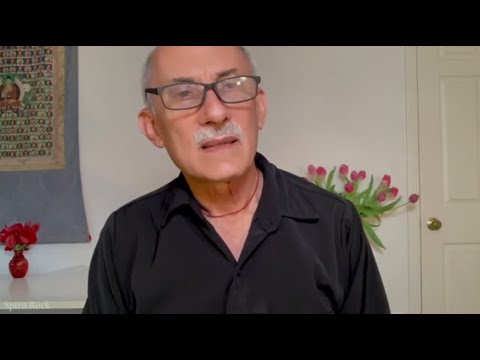
Jack Kornfield presents letting go not as an abstract spiritual concept but as a practical public health measure essential for mental wellbeing and freedom from suffering. Drawing on decades of Buddhist monastic training and Western meditation teaching, he illustrates how the simple practice of releasing—repeatedly letting go of thoughts, attachments, and the urge to understand or control—can become a foundational tool for addressing collective psychological distress. This talk reframes a core Buddhist principle as a concrete, teachable skill available to anyone, regardless of religious background.
Kornfield begins not with philosophy but with direct practice. "Just let go, let go, let go," he explains, describing his own meditation experience: "I did nothing but this in my practice for years. Every time I tried to understand or figure things out, I'd say, 'Let go, let go,' until that desire would fade away." This is not the mystical floating sensation sometimes romanticized in spiritual circles. Rather, it is a mechanical, moment-to-moment releasing of mental contractions—the habitual grasping that accompanies ordinary consciousness.
The practice becomes almost comical in its simplicity. Kornfield offers an image: "Just be an earthworm who knows only two words, 'Let go, let go…'" This reduction to elemental action strips away the need for elaborate theology or deep understanding. The earthworm does not contemplate what letting go means; it simply loosens its grip on what it holds. The metaphor suggests that the capacity for release is not reserved for philosophers or advanced practitioners but is available to anyone with basic awareness.
Letting go, in this context, refers to the gradual softening of the mind's compulsive need to cling, defend, and control. Each time a thought arises—a worry, an interpretation, a demand—the practitioner notices the impulse to hold it and instead practices release. Over time, this repeated action transforms the nervous system's baseline orientation toward experience.
Framing letting go as a public health measure is deliberately unconventional. Public health typically concerns disease prevention, vaccination, clean water, and epidemiology—the machinery of collective wellbeing. Kornfield's inclusion of a Buddhist practice in this framework signals a recognition that mental suffering, anxiety, and the compulsive clinging that drives reactive behavior are widespread harms affecting millions.
The COVID-era and post-pandemic landscape have exposed a crisis not primarily of infectious disease but of psychological overwhelm. People are chronically contracted around fears, narratives, and outcomes they cannot control. The compulsive need to understand, predict, and manage produces exhaustion and despair. Letting go, taught at scale as a public skill, addresses this underlying condition.
By calling it a public health measure, Kornfield positions the practice not as a luxury for spiritual seekers but as foundational medicine—as necessary as sleep or nutrition. When collective anxiety tightens around political division, economic uncertainty, or health crises, a population that knows how to let go has a resilience that those caught in perpetual grasping cannot access.
The elegance of Kornfield's approach lies in its portability. Letting go requires no altar, incense, or special clothing. It can happen while washing dishes, sitting in traffic, or lying awake at night. The structure is always the same: notice the contraction, the grasping, the attempt to understand or fix; then release it.
This is distinct from dissociation or avoidance. Letting go does not mean pretending problems do not exist or becoming numb to experience. Rather, it means releasing the habitual mental struggle around those problems—the loop of rumination, blame, and desperate strategizing that often amplifies suffering without solving its cause.
Kornfield describes his own years of sitting meditation practice dedicated almost entirely to this one instruction: let go. This is not lack of progress toward something more advanced; it is the practice itself. As the years accumulated, the nervous system learned. The desire to grasp, to figure things out, to defend the self would arise, and there would be a moment of recognition—a moment of space—in which release became possible. That space, repeated ten thousand times, becomes the foundation of a different way of being.
The talk does not offer rapid transformation narratives. Instead, it suggests gradual rewiring. When the instruction "let go, let go" is repeated with genuine intention, something shifts in how the mind relates to its own contents. Thoughts still arise; emotions still move through the body. But the compulsive identity with them loosens.
Kornfield's use of the earthworm image is instructive here. The earthworm does not aspire to be something other than it is. It simply loosens and releases. Over time, this becomes its nature. Similarly, with repeated practice, the ability to release becomes less effortful. It becomes a reflex, a baseline way the mind and body can organize themselves.
This has measurable effects on wellbeing. The person who has developed the capacity to let go experiences less rumination, less defensive reactivity, less of the identity-based suffering that comes from over-identification with thoughts and emotional states. They do not become passive or uncaring; rather, they act from a place of clarity rather than contraction, which tends to make those actions more effective and compassionate.
Meditation, therapy, and mindfulness have become mainstream enough that their absence of a specific spiritual vocabulary makes them culturally acceptable. Kornfield's reframing of letting go as public health draws on this legitimacy while remaining honest about its origins in Buddhist psychology. The practice is not merely symptom management—reducing anxiety through breathing exercises—but a fundamental shift in how the mind operates.
Where therapy might explore why you grasp or what you are defending against, this practice simply teaches the mechanics of release. It is not uninterested in understanding; it is just teaching that understanding often comes after the contraction has loosened, not before. The mind that is clenched around a problem cannot see clearly. The mind that has released its demand for immediate resolution can sometimes see what was obscured.
For those wanting to experiment with this practice, the entry point is remarkably low. Sit or stand, notice what you are holding—a thought, an emotion, a narrative about yourself or the world—and gently say "let go." Not with force, but with gentle intention. Let the holding dissolve. When contraction returns (which it will, immediately), repeat. This is not failure; this is the practice.
Kornfield's decades of teaching in the West have honed his ability to translate monastic practice into something available to householders—people with jobs, families, and ordinary complications. His books and online courses (available through Jack Kornfield's website and the Spirit Rock Center, which he co-founded) offer deeper exploration for those interested in sustained engagement. The Insight Meditation Society in Barre, Massachusetts, and Spirit Rock Meditation Center in California also offer retreats where this practice can be explored with community support and expert guidance.
The framing of letting go as public health is both a challenge and an invitation. It asks: What if a generation grew up learning not just to acquire and achieve, but to release and soften? What if the cultural default shifted from "figure it out and fix it" to "let go and see what becomes possible"? The video suggests that this shift is not a luxury—it is a necessity for collective flourishing.