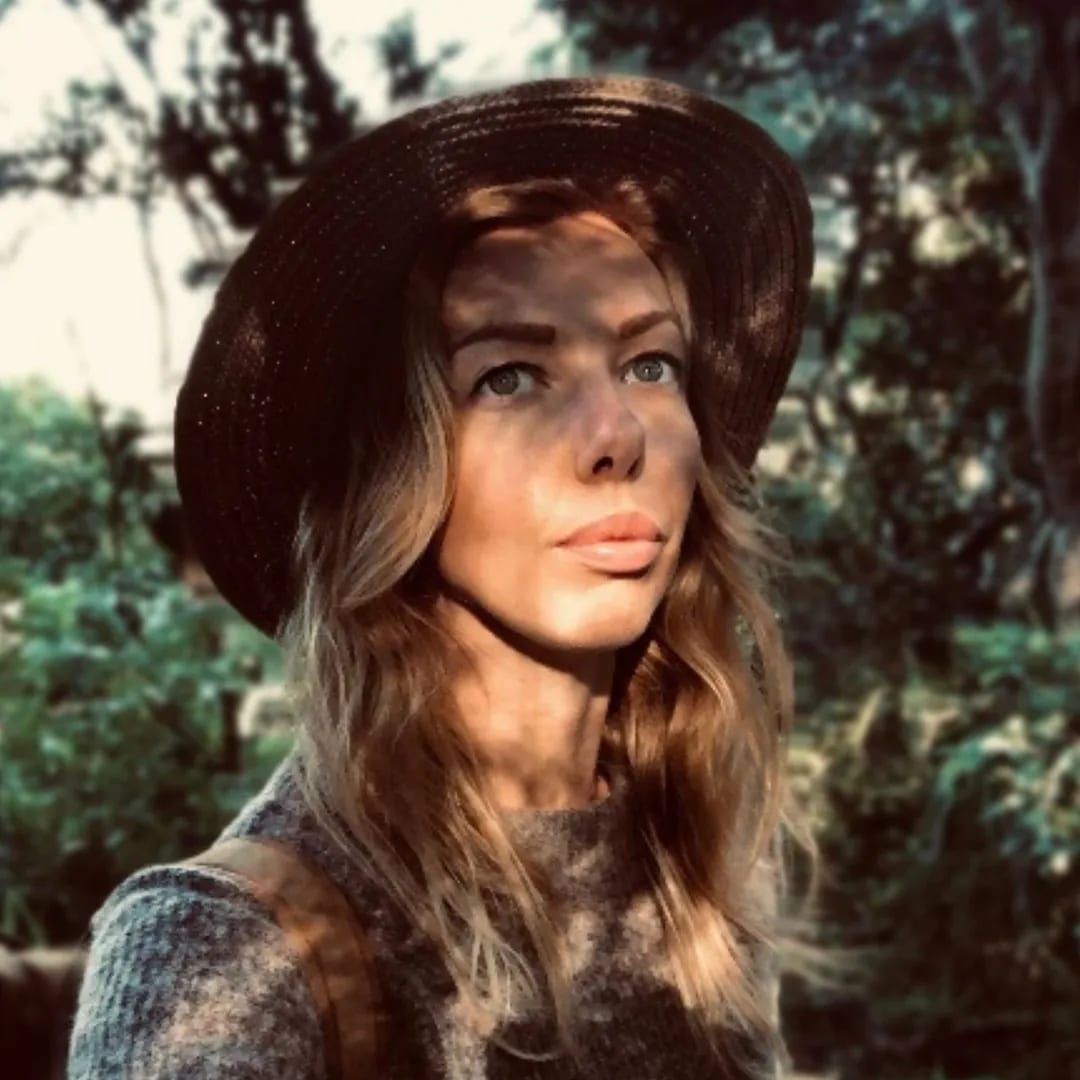

Sez Kristiansen is a poet, meditation guide and writer whose work sits where embodied nonduality, deep ecology and recovery overlap. Her teaching is easiest to understand through its refusals: it declines to promise a better self, a peak state or a finished authority at the front of the room. What remains is quiet, and it asks more of the listener than it first appears to.
Her most direct format is the guided meditation. Her recordings on Insight Timer have been listened to more than 500,000 times, and they are the clearest picture of how she works. They are spare and unhurried, often grounded in the body or in nature. They are not built to lift anyone into bliss. The aim is to return the listener to their own presence, and the pacing reflects that: little instruction, little escalation, and no sense of a climb toward a goal.
The written work follows the same logic. Her books, essays, poetry and Substack newsletter read as reflections on her own inquiry rather than as conclusions handed down. The posture is invitational. She does not tell people what to believe. She points to what may already be here beneath striving and self-judgment and leaves the checking to them. No retreat schedule or event programme is currently publicised, so the recorded and written work is where the teaching can actually be met.
Wholeness and embodiment run through everything, framed as recognitions rather than achievements. Recovery sits beside them. Her own experience of addiction, trauma and depersonalisation is treated as part of the inquiry, not as a prelude to it. She did not turn those experiences into a before-and-after story. They led her, in her words as the bio puts it, beyond traditional self-improvement and into a lived exploration of wholeness.
Belonging is the third strand: to oneself, to life, to the natural world. Born and raised in Southern Africa with Nordic roots, and a lifelong wanderer, she writes about belonging with some specificity of place. Deep ecology is not decoration here. Nature is named as her greatest teacher, and forests and rivers appear alongside recovery and awakening as subjects that point to the same understanding. That understanding is stated plainly: healing is often less about becoming someone new and more about remembering what has never been missing.
The teaching circles a few questions without ever settling them into doctrine. What is left when striving and self-judgment quiet down? What does it mean to belong, when so much teaches disconnection? Can healing be something other than self-construction? And, more uncomfortably, what happens when you stop trying to become someone else and stay with what is actually present, including difficult material from the body and the past?
That last question is where the work gets demanding. Because her approach is embodied rather than abstract, the sitting is not an escape from difficulty. It asks the listener to stay with not-knowing instead of reaching for quick answers.
The voice is restrained. There is humility in it, a sense of someone working things out alongside the listener rather than lecturing from a finished position. Poetry is the natural register, so image and place carry much of the weight that argument carries in other teachers' work. Silence and spaciousness do real work in the meditations. Nature supplies the main imagery. Her stories are drawn from her own life and from landscape, and the bio does not describe her building her teaching around scripture or comic performance, so it would be a mistake to expect either. The effect is closer to a long quiet walk than to a talk.
It lands most readily for people who are wary of spiritual marketing, who have been worn out by self-improvement culture, or who come from recovery and trauma backgrounds and want a contemplative path that does not ask them to leave the body or the past behind. Beginners are not shut out. The meditations are free and assume no prior practice, and Healing HER, which has reached more than 80,000 readers, does not require specialist knowledge, though some familiarity with addiction, trauma or depersonalisation will deepen the reading.
Others may bounce off it. Anyone wanting a transformation narrative, a charismatic guide or a clear programme of improvement will likely find the invitation to return to wholeness oblique or insufficient. Readers seeking dense philosophical frameworks about consciousness may find the work too grounded in poetry, body and nature. People drawn to devotional chanting, high-energy breathwork or ecstatic experience may find it too quiet. Because it engages hard material without rushing to resolve it, it can feel like the opposite of relief to someone hoping for pure comfort. None of this is a flaw. It is a matter of fit.
The bio places her work in the territory of embodied nonduality, and nondual meditation is the tradition she is most directly associated with. It understands wholeness as recognition of what is already so rather than a future state to be reached. She combines it with recovery and trauma-informed perspectives and with deep ecology, a mix that is less common than either a purely contemplative or purely psychological orientation. The bio names no lineage, teacher or guru, and none should be supplied for her. Her authority rests on lived experience, sustained writing and practice, and a stated apprenticeship to the natural world, not on an inherited line of transmission.
She is based in New South Wales, Australia. Her books include Healing HER, Story Medicine and Whole In The Body. For anyone deciding where to begin, the Insight Timer meditations are the most direct way to hear how she teaches, and the Substack is the most direct way to follow her thinking over time.