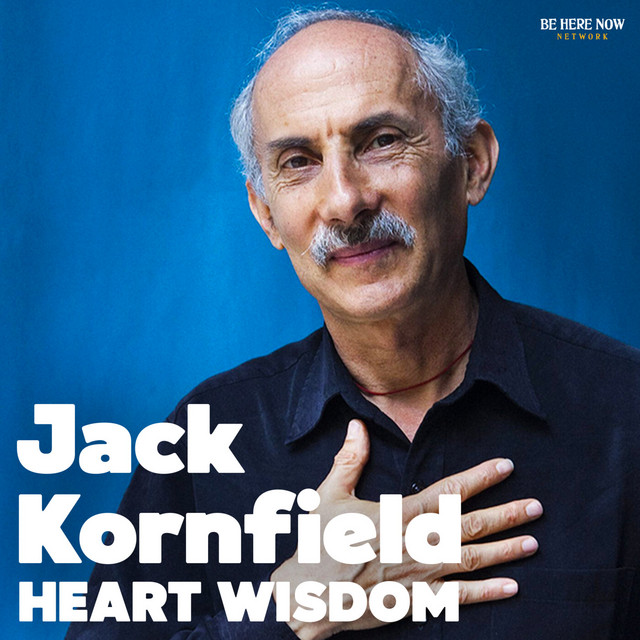
Jack Kornfield and Thomas Hübl explore the integration of spiritual practice with grounded psychological healing, centering on how practitioners navigate disillusionment, develop spiritual discernment instead of blind faith, reframe trauma through Buddha's understanding of suffering, heal nervous system triggers, and cultivate the Bodhisattva vow—all while honoring the particular identity and role each person inhabits in the world. The conversation moves beyond idealism to show how genuine transformation happens when we dissolve the cosmos into love while remaining fully present to our humanity and insecurity.
What does spiritual discernment mean in practice?
Jack Kornfield distinguishes spiritual discernment from blind faith, arguing that mature spiritual practice requires the ability to see clearly rather than surrender uncritically to authority or ideology. Blind faith assumes the teacher or tradition is beyond question; discernment, by contrast, means developing the capacity to sense truth directly through embodied awareness, questioning, and verification. This is not cynicism or rebellion—it is the Buddha's own teaching: practitioners are invited to "come and see" (ehi passiko) rather than accept doctrine on authority alone.
Kornfield illustrates this with his own experience of "pressure testing" his teacher Ajahn Chah, the legendary Thai Forest monk. Rather than demanding unquestioning obedience, Ajahn Chah welcomed the inquiry. This kind of teacher creates space for students to develop discernment by testing their own understanding against lived experience. Discernment allows practitioners to receive teachings from multiple sources—psychology, neuroscience, dharma, embodied practice—and integrate them authentically rather than compartmentalizing or dogmatizing.
How does disillusionment relate to the spiritual path?
Kornfield addresses a critical point often glossed over in spiritual culture: disillusionment is not a failure or detour on the path—it is the path itself. When practitioners encounter teachers with clay feet, discover corruption in spiritual communities, or recognize that spiritual practice does not exempt them from suffering, disillusionment arises. Many practitioners then conclude the teaching is false or that they have been deceived. Kornfield reframes disillusionment as the Buddha's own invitation: to "see with the eyes of the Buddha" the truth of greed, hatred, and delusion—not as a nihilistic dead end, but as the gateway to wisdom.
The Buddha taught that suffering (dukkha) is pervasive, and this is not despair—it is the beginning of awakening. To see greed and hatred clearly, particularly in spiritual institutions, is to see the unvarnished human condition. The point is not to reject spiritual practice or to become cynical, but to continue practicing with clear eyes, recognizing that transformation happens not through idealism but through radical acceptance of what is true. Kornfield emphasizes that healing from spiritual injury—betrayal or abuse within spiritual communities—is itself a spiritual path when undertaken with honesty.
What is "central casting" and identity in spiritual practice?
Drawing on teachings from Ram Dass and deeper Buddhist philosophy, Kornfield introduces the concept of "central casting"—the particular role, personality, and social position each person has been assigned or inherited in this life. A teacher, a parent, a healer, a builder, a troublemaker—these are the roles we inhabit. The spiritual error is to mistake the role for the self, to become so identified with the identity that we forget our true nature. But the equally important error is to transcend or reject the role in the name of spiritual awakening.
Kornfield's teaching is that genuine spiritual practice holds both simultaneously: remembering your "true divine nature" while also honoring your "social security number, your particular role which central casting has placed you in at this time." This is not about acting; it is about seeing clearly that you are not limited to your role, yet remaining committed to playing it with integrity and love. A doctor can serve fully as a doctor, a parent fully as a parent, without forgetting that beneath the role is boundless consciousness. This dissolves the false dichotomy between transcendence and engagement.
How can we reframe trauma through the Buddha's lens?
Rather than treating trauma as a pathology to be "fixed" or a story to be processed endlessly, Kornfield and Hübl suggest reframing it through the Buddha's fundamental teaching of suffering (dukkha). Dukkha is not just physical or emotional pain; it is the unsatisfactory nature of all conditioned things, the friction that arises when what is actual does not match what we demand or expect. Trauma is one extreme form of this fundamental condition.
When we reframe trauma this way, the work shifts from "getting it right" or "resolving" the past to developing a wise relationship with suffering itself. This does not mean passivity or acceptance of ongoing harm; it means understanding that the Buddha taught a path not of avoiding suffering but of ceasing to generate suffering through clinging, denial, or rigid identity. A trauma survivor may have experienced genuine harm, and that harm matters. But the additional suffering created by identification with being "traumatized" or broken can be gradually loosened through mindfulness, compassion, and the recognition that consciousness is not bound by history.
What role does nervous system healing play in spiritual practice?
Thomas Hübl brings contemporary neuroscience and somatic practice into the conversation, emphasizing that triggers—reactive patterns lodged in the nervous system—are not merely psychological; they are embodied. When a person encounters a stimulus that resembles a past threat, the nervous system can activate without conscious deliberation. The healing of trauma therefore requires not just insight or belief change, but nervous system recalibration.
This is where spiritual practice meets somatic therapy. Meditation, breathwork, and mindful movement can help regulate the nervous system, creating safety and stability from which the triggered person can observe their reactions rather than be consumed by them. By gradually exposing the nervous system to triggers in a supported context—with breathing, grounding, and compassionate awareness—practitioners can update their threat assessment and expand their window of tolerance. The goal is not to eliminate triggers but to relate to them with awareness rather than reactivity, to sense the impulse to contract or fight and choose a response that is more aligned with wisdom and compassion.
How does loving kindness relate to healing and transformation?
Kornfield and Hübl explore the Bodhisattva vow—the commitment to awakening not for oneself alone but for all beings—as a framework for expanding loving kindness (metta) beyond the personal. When a person has healed from trauma or developed spiritual discernment, a natural movement arises: to turn that healing and clarity toward others. This is not obligation or guilt; it is the spontaneous expression of a heart that has opened and recognized its connection to all suffering.
Expanding loving kindness to encompass all beings does not erase the particular bonds of family, friends, or community. Rather, it contextualizes them within a larger field of care. The teaching is not to sacrifice yourself or to bypass healthy boundaries, but to recognize that your healing and awakening naturally include the healing and awakening of others. As Kornfield teaches, we "reach out and heal the part of the world we can touch"—fully present, fully engaged, without grandiosity or expectation of results.
What is the "wisdom of insecurity"?
Kornfield articulates a teaching that cuts against the grain of both spiritual culture and consumer culture: the "wisdom of insecurity" is to learn that it is okay to feel insecure—that insecurity is part of our human law, not a flaw to be overcome or a sign of spiritual immaturity. The human condition includes uncertainty, impermanence, and the reality that we cannot control outcomes. Most spiritual seeking arises from the desire to escape this basic insecurity through attainment, achievement, or transcendence.
The wisdom teaching invites the opposite movement: to make friends with insecurity, to recognize it as part of the texture of being alive, and to "love anyway." This is not resignation or passivity; it is the freedom that comes when you stop demanding certainty as a precondition for engagement. A parent can love a child fully while knowing they cannot protect that child from all suffering. A practitioner can commit to the spiritual path while acknowledging that awakening is not guaranteed and that the effort itself is what matters. This paradoxically creates greater stability and ease than the endless pursuit of security.
How do we walk through the doorway of transformation?
Kornfield and Hübl frame transformation not as an achievement but as a doorway—a passage that requires willingness and courage but not perfection. The doorway opens when a practitioner has developed enough discernment to see their condition clearly, enough compassion to hold themselves and others in that seeing, and enough commitment to the awakening of the heart to keep walking forward despite fear.
Walking through this doorway involves several movements: releasing identification with trauma while honoring its truth; recognizing the role assigned by central casting while remembering your divine nature; developing nervous system resilience without denying legitimate harm; expanding loving kindness without losing discernment about boundaries. The description "dissolving the cosmos into love" suggests that as practices deepen, the sense of separation between self and world, practitioner and world, gradually loosens, and consciousness expands to recognize love as both the ground of being and the fruit of awakening.
Where to go from here
Kornfield offers a year-long program, "The Year of Awakening: A Monthly Journey with Jack Kornfield," beginning January 2025, designed to support practitioners in integrating these teachings. For those interested in the relationship between trauma healing and spiritual practice, the work of Thomas Hübl and contemporary teachers bridging somatic therapy and dharma practice offers practical frameworks. The core invitation is to develop discernment, to make friends with the human condition in its full complexity, and to allow the awakening of the heart to move through your particular role in the world—not as an escape from life, but as the fullest expression of what it means to be alive.