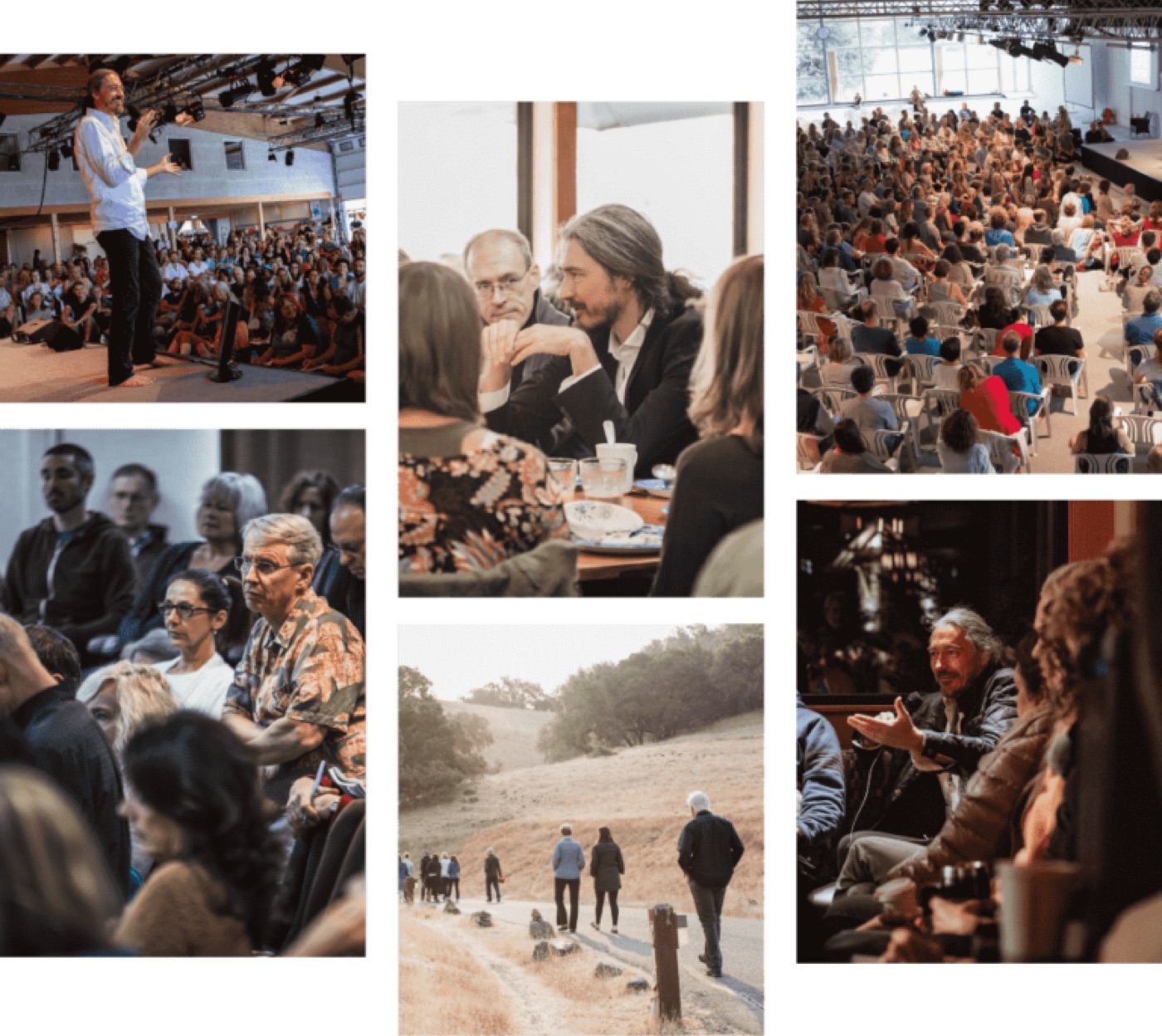

Thomas Hübl occupies an unusual position in contemporary spirituality: he's neither a traditional lineage holder nor a purely secular facilitator, but something more elusive—a teacher who attempts to make the invisible mechanics of collective trauma legible. Over two decades, he has built a body of work that sits at the crossroads of mysticism, neuroscience, and systems theory, attracting tens of thousands of students drawn to his particular synthesis of inner development and social healing.
His work asks a deceptively simple question: What happens when entire communities carry wounds they cannot name? And more provocatively: Can contemplative practice become a technology for addressing intergenerational suffering?
The biographical details of Hübl's early life remain largely undocumented in public sources, but what is known centers on a formative period of intensive solitary meditation practice. This extended retreat—years spent in relative isolation—became the crucible for what would later emerge as his teaching methodology. Unlike many Western spiritual teachers who apprentice within established Buddhist or Hindu traditions, Hübl's approach was forged outside conventional lineage structures, drawing instead from mystical Christianity and Kabbalistic principles.
The turning point came when he began translating his contemplative insights into a framework he could teach. Rather than remaining a solitary practitioner, he moved toward what he calls "relational field dynamics"—the idea that consciousness doesn't just develop in isolation but through synchronized connection with others. This shift from the hermitage to the group process would become the defining characteristic of his work.
By 2004, he had begun teaching publicly, initially in Europe before expanding to North American audiences. His methodology crystallized around what he terms the "transparent self," a developmental map that traces stages of inner maturation alongside the capacity to perceive and integrate collective shadow material.
Hübl's core contribution lies in his attempt to create a bridge between two typically separate domains: the interior work of mysticism and the exterior reality of systemic trauma. Where traditional meditation practices emphasize individual introspection—the refinement of attention, the cultivation of equanimity—his work introduces something more ambitious: group processes designed to activate what he describes as synchronization across nervous systems.
This isn't mindfulness-based stress reduction transplanted into a group setting. Hübl's methodology involves guided experiences where participants attune to subtle relational fields, attempting to sense and metabolize collective patterns of dissociation, numbness, or fragmentation. The theoretical framework draws from developmental psychology, neuroscience, and somatic practices, but the actual experience is closer to participatory mysticism—a kind of distributed awareness that he suggests can illuminate inherited trauma.
His notion of "mystical principles" functions as an operating system: not a set of beliefs but a way of perceiving the architecture of consciousness itself. It's an ambitious synthesis, one that risks collapsing under its own conceptual weight, yet it has attracted serious attention from those working at the intersection of contemplative practice and trauma research.
The most visible expression of Hübl's methodology is the Pocket Project, an initiative specifically dedicated to collective trauma integration. Founded to address inherited wounds from events like the Holocaust and colonial violence, it represents his clearest articulation of how contemplative practice might serve social healing.
The project's premise is that massive historical traumas don't simply disappear when survivors die—they persist as patterns in families, communities, and cultures, creating what Hübl calls "pockets" of frozen experience. Through facilitated group processes, participants engage with these collective fragments, attempting to bring awareness to what has been dissociated or denied.
Complementing this public-facing work is the Academy of Inner Science, Hübl's multi-year training program. Here, he certifies facilitators in his methods, ensuring that his particular synthesis can be transmitted beyond his direct teaching. Since 2004, he has taught more than 100,000 students across continents and digital platforms, building what amounts to a distributed network of practitioners working with his framework.
His book Healing Collective Trauma: A Process for Integrating serves as both theoretical foundation and practical guide, though the work itself resists easy categorization—part developmental psychology, part mystical phenomenology, part social theory.
Hübl now operates in that liminal space between contemplative teacher and institutional partner. His work has found audiences not just among spiritual seekers but also among therapists, organizational consultants, and academics interested in intergenerational trauma. This crossover appeal speaks to a broader cultural moment: a growing recognition that individual healing practices may be insufficient for addressing collective wounds.
His cultural significance lies less in the size of his following than in the territory he's attempting to map. At a time when conversations about historical trauma, systemic racism, and inherited grief are increasingly urgent, Hübl offers something resembling a praxis—a way to engage with these realities through embodied, relational practice rather than purely intellectual analysis.
Whether his methodology will gain traction beyond its current practitioners remains uncertain. Mystical synthesis has always been difficult to institutionalize, and the line between profound insight and elaborate self-conception can be thin. But for those drawn to his work, Hübl represents something necessary: an attempt to make contemplative practice accountable to the actual suffering of the world, and to imagine that collective healing might be more than metaphor.