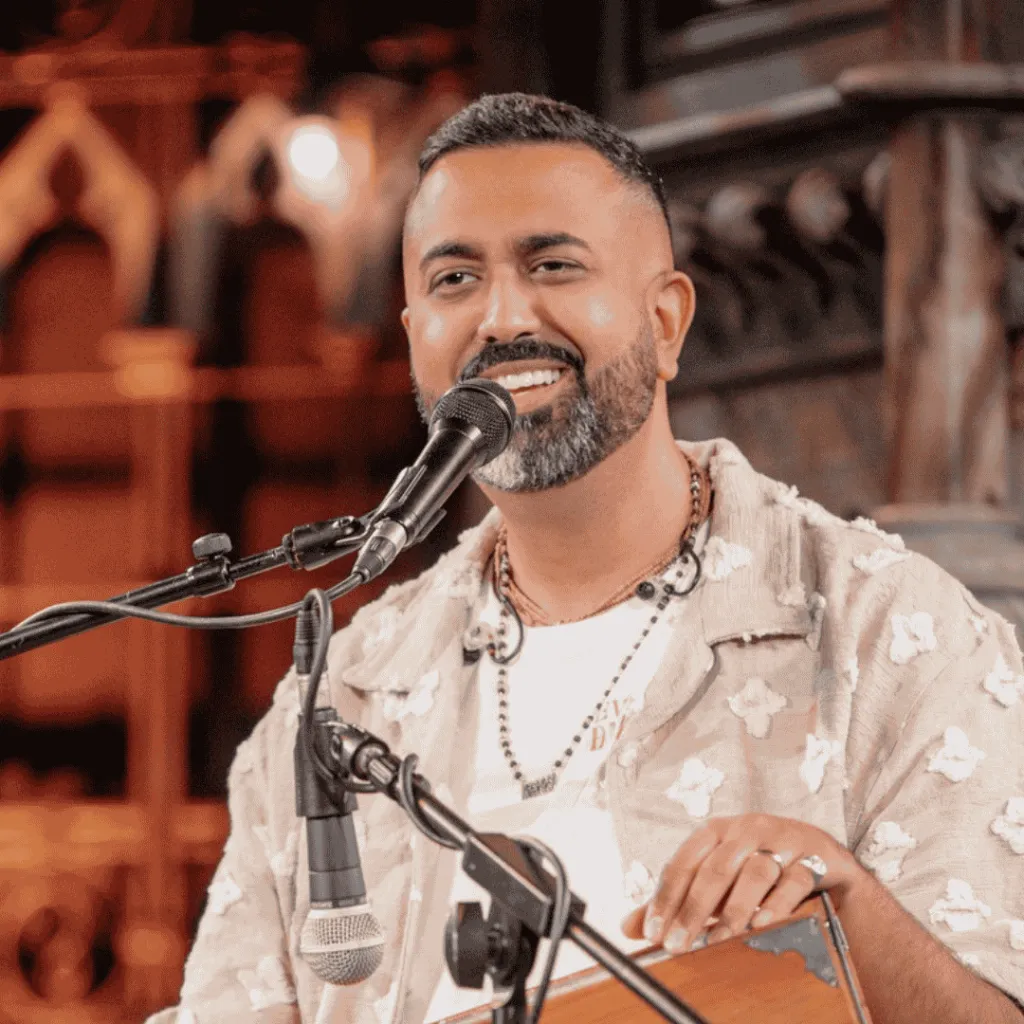

When Radhika Das begins a kirtan, the opening is almost always bare. A single voice—warm, unhurried—sings out a Sanskrit phrase. No production, no reverb sweetening the tone. This is deliberate. The listener encounters first the person, then the permission to join. The voice itself is neither operatic nor deliberately "spiritual"—it's conversational, grounded in the body, with the slight rasp of someone who has spent thousands of hours chanting, whose vocal cords carry the work like an instrument aged into its particular timbre.
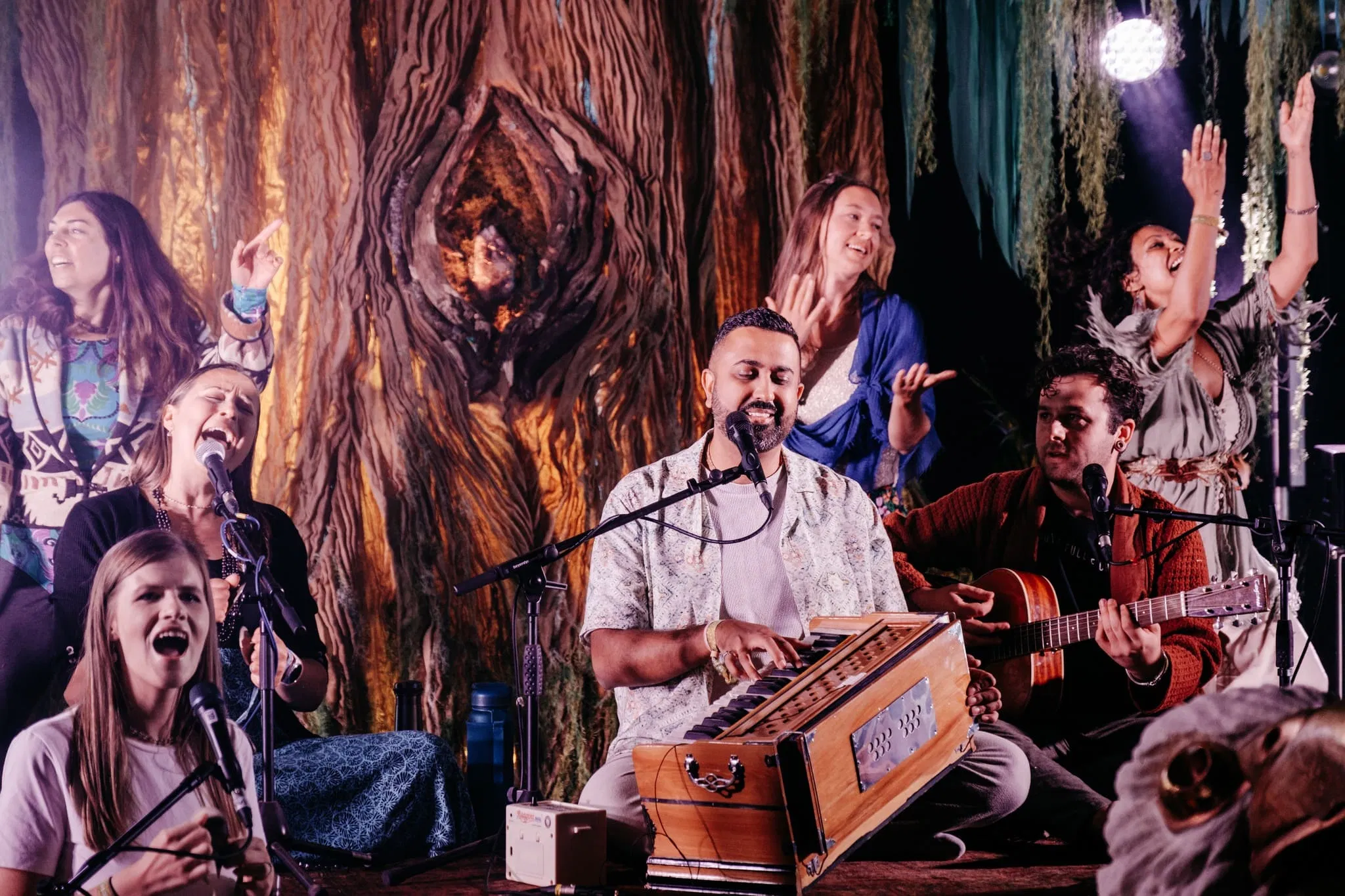
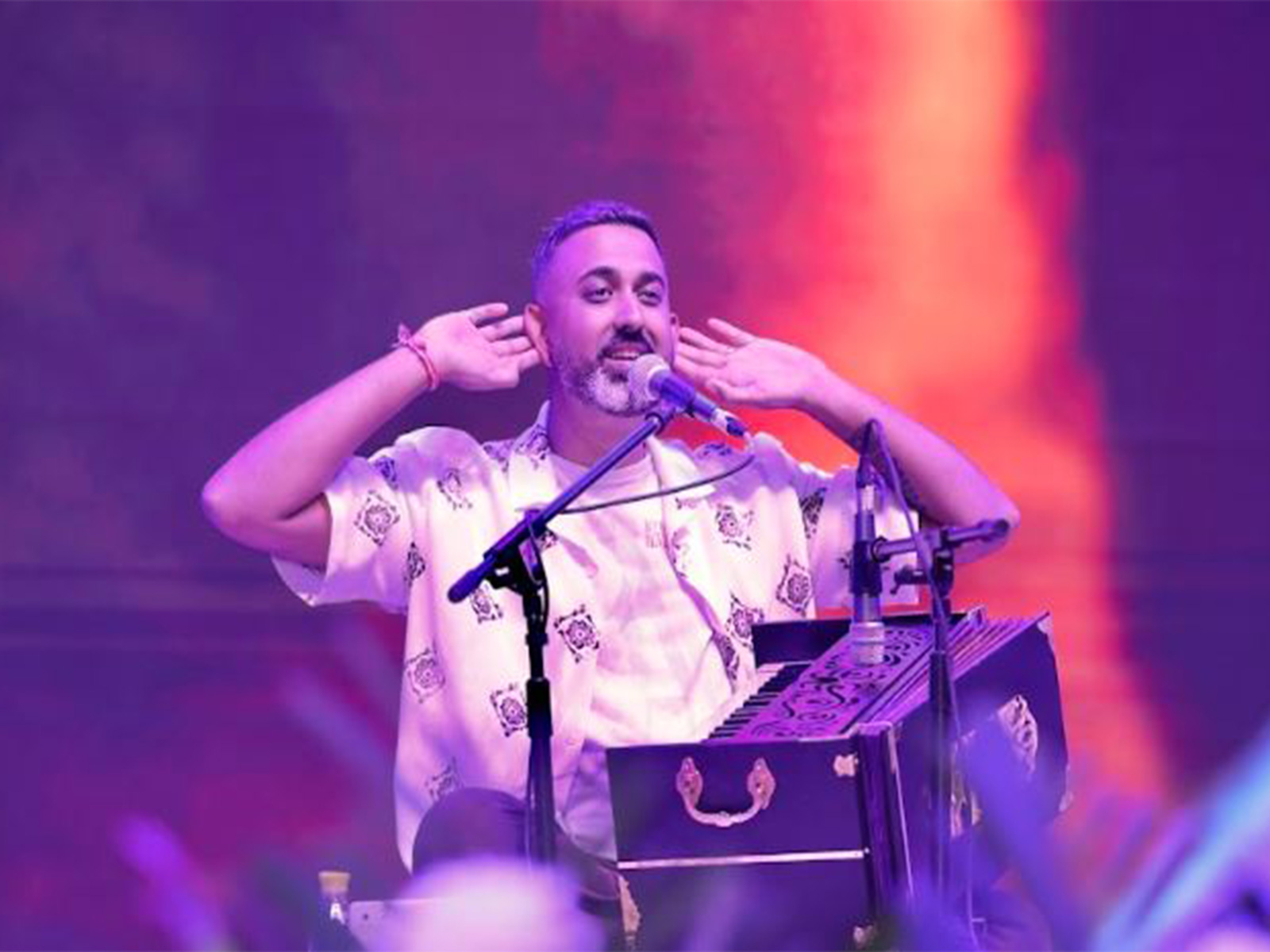
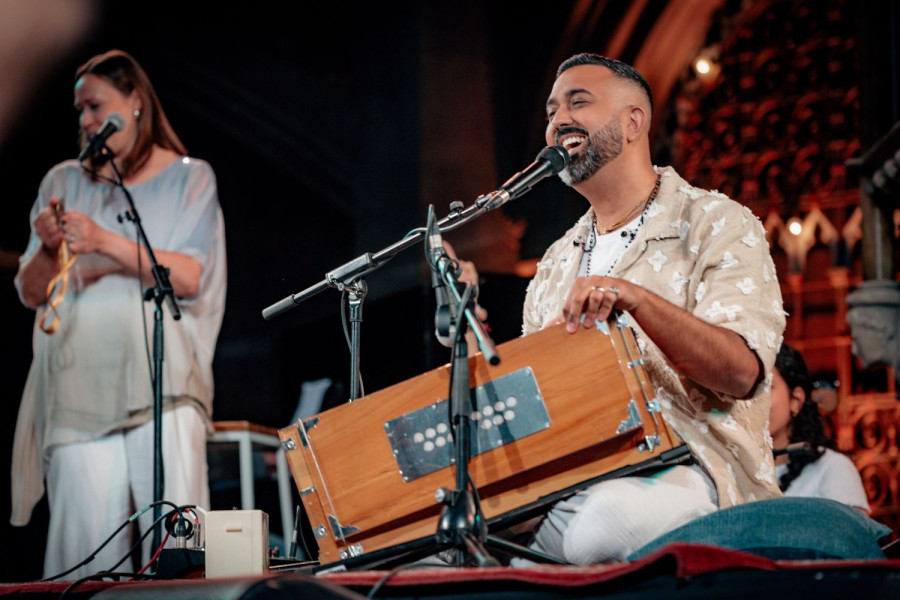
The instrumentation builds around this steadiness. Harmonium—that pump-organ brought by Sufi musicians into Indian devotional spaces—provides the harmonic anchor, its reedy tone immediately placing the listener in a specific sacred geography: ashrams, temple courtyards, interfaith meditation halls. The harmonium's repetitive drones create what feels like architectural support, something to lean into. Alongside it, tabla and mridangam enter—not driving with flashy technique, but establishing a walking pulse that invites participation. The rhythm is often simple enough that a newcomer can find the beat within two minutes, yet sophisticated enough to sustain attention across twenty-minute chants.
What distinguishes Das's approach sonically is the space between notes. Many kirtan leaders fill silence with ornamentation or rapid call-and-response passages. Das leaves air. These gaps become active listening space—a place where the chanter's own voice finds room to enter, where the mind settles because there is no assault of sound to absorb. The tempo rarely rushes. Even as a chant gathers momentum and bodies begin to sway, the pace stays tethered to breath—the actual breath of human beings gathered in a room. This pacing is the difference between music that entertains and music that invites participation rather than spectatorship.
Radhika Das stands within the Bhakti tradition—specifically the devotional path that emphasizes direct, emotional communion with the divine through sound, chanting, and emotional surrender. Bhakti emerged in medieval India as a democratizing force: it required no priesthood, no Sanskrit literacy, no elaborate ritual apparatus. It asked only for sincere feeling and a willing voice. This is crucial to understanding Das's practice.
His mantra work draws from multiple streams within this lineage: the Krishna-centered bhajans of north Indian devotion, the call-and-response kirtans adapted from Gaudiya Vaishnava traditions, and the universal mantras—"Om," "Gayatri," names of the divine in their most portable forms—that can be sung by practitioners of any faith or none. The harmonium itself arrives via Sufi chanting traditions, carrying with it centuries of Muslim-Hindu musical exchange. Thus, Das's sound is syncretic not by accident but by lineage inheritance.
He carries this inheritance through a guru-lineage relationship—a formal spiritual education transmitted person-to-person, not through books or apps. This apprenticeship shows in his restraint. He doesn't use music to impress; he uses it to transmit. The practice of chanting itself, in the Bhakti understanding, is the point—not the beauty of the voice, but the sincerity of the devotion audible within it.
What Das has done is make this ancient technology accessible to post-secular London, New York, and Mumbai audiences without neutering it. He doesn't explain mantras to death. He doesn't apologize for Sanskrit or theology. Instead, he invites people into the experience—"follow along, don't worry about pronunciation"—and trusts the music itself to communicate what the words mean.
His signature move is structural: the long chant, often 15-25 minutes, that builds in waves. The first repetitions are quiet, almost intimate. By the middle section, voices have joined—sometimes dozens, sometimes hundreds. By the final phase, the sound is communal, the individual voice absorbed into something larger. This architecture mirrors the actual phenomenology of meditation: mind settling, sense of self dissolving, return to a kind of simplicity. It's not designed to move people emotionally in a dramatic arc; it's designed to move them inward, toward silence.
Expect slowness. Expect repetition—the same eight-bar phrase sung perhaps forty times, with harmonic and rhythmic variations beneath it. Expect your mind to wander for the first five minutes, then gradually find the pulse. Expect the harmonium to sound slightly out-of-tune (it's not; the tuning system is just different from Western equal temperament).
What may surprise you: how quickly the chanting becomes less about "listening to music" and more about participation. There is no performance wall. Das doesn't perform at audiences; he holds space for chanting with people. Second surprise: how physical it becomes. Kirtan isn't sitting in silence; it's often accompanied by gentle hand movements, rocking, even dancing. Bodies participate.
Radhika Das occupies a precise position in contemporary spiritual music: he's neither a New Age synthesizer artist nor a traditionalist locked in temple practice. He stands alongside artists like Krishna Das and Jai Uttal who have brought kirtan into Western secular spaces, but Das's approach is notably more restrained, more suspicious of emotional catharsis as an end in itself.
Where ambient music seeks to create atmosphere, and contemporary spiritual music often targets transcendence as a product, Das's sound offers something simpler and more difficult: presence. The texture of his music—spare, repetitive, grounded—asks only that you show up and pay attention. In an age of infinite streaming and customized playlists, this is perhaps the most radical gesture a sacred-music artist can make: the insistence that depth requires duration, and that some things cannot be optimized.