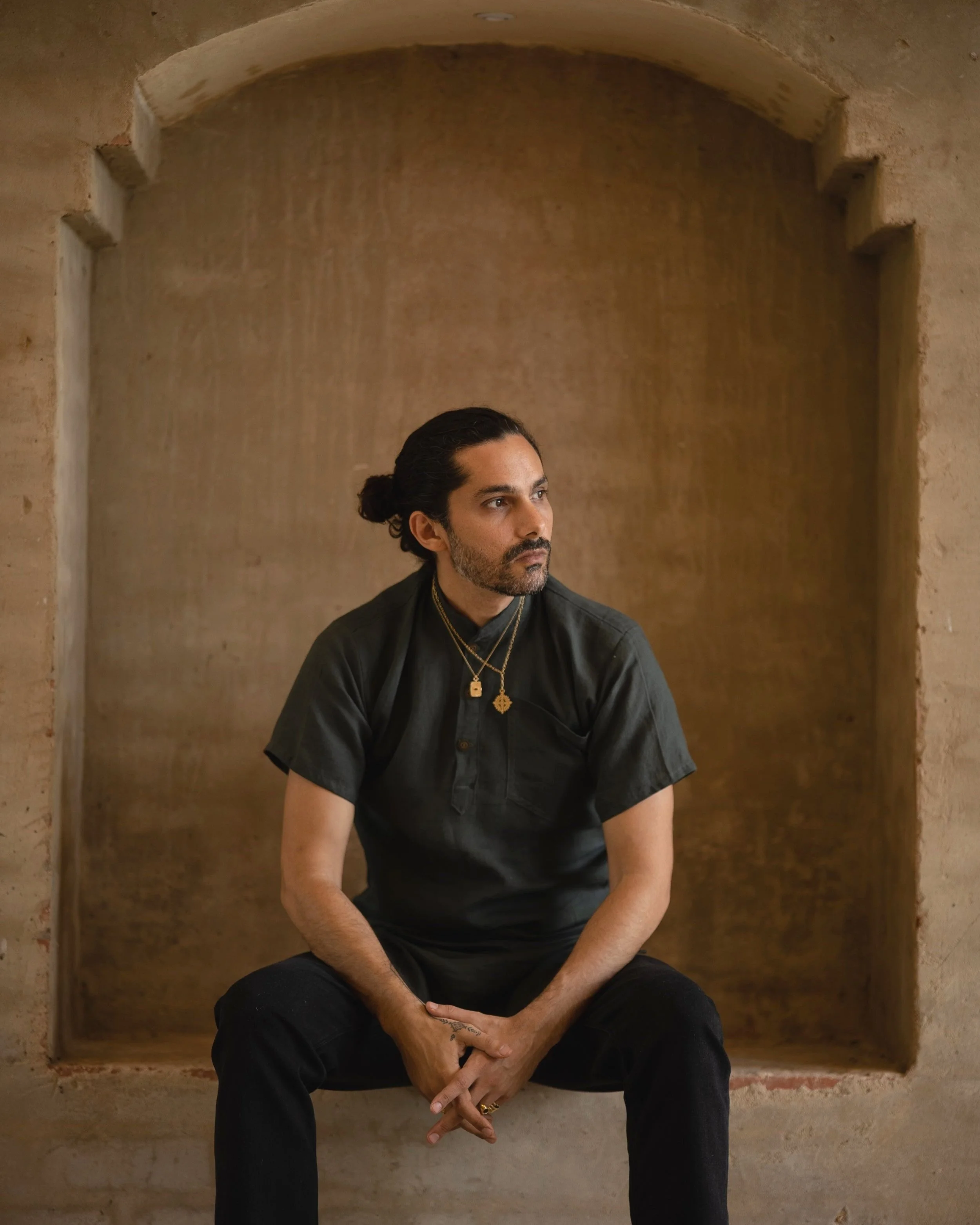

Luka Lesson's Teaching: Approach, Method, and Voice
A Luka Lesson session doesn't begin with technique. It begins with permission—to speak, to stumble, to reach for language that hasn't yet found its shape. Whether in a workshop room in Australia or beneath the Greek sun during one of his annual retreats, Lesson creates spaces where poetry becomes less about the page and more about what needs to be said. The atmosphere is one of charged openness: participants arrive as students of craft and leave as practitioners of something closer to necessity.
His sessions characteristically move between instruction and excavation. He'll introduce a Greek myth—Persephone's descent, perhaps, or Orpheus turning back—not as literary reference but as live wire. The stories become frameworks for personal inquiry, scaffolding that allows participants to approach their own narratives obliquely. Then comes the writing, often timed and embodied, designed to bypass the editorial mind. Lesson pushes for voice over polish, urgency over perfection. What emerges is frequently raw, sometimes barely formed, and almost always more honest than what careful revision would produce. This is intentional. He treats first drafts as diagnostic tools, revealing not just what people write about but how they permit themselves to speak.
Recurring Ground
Certain territories appear again and again in Lesson's teaching. Lineage and inheritance—what we carry from those who came before, whether we chose it or not. The relationship between personal story and political moment, the insistence that intimate experience is never separate from larger forces. Greek mythology functions not as decoration but as technology, ancient patterns that illuminate contemporary struggle. He returns often to the question of transformation: what it costs, what it yields, what remains unchanged at the core.
The retreats in Greece literalize this methodology. Participants aren't simply writing about myth; they're walking the landscape where these stories originated, letting terrain and temperature inform their work. Lesson understands that poetry isn't only cognitive. It's sensory, historical, tied to place. The annual return to his family's homeland isn't romantic pilgrimage—it's pedagogical choice. The physical experience of Greece becomes another text to read.
The Questions He Won't Let Go
Lesson doesn't ask comfortable questions. He pushes students to sit with: What are you protecting by staying quiet? Where does your silence serve power that isn't yours? What voice haven't you given yourself permission to use? These aren't rhetorical prompts; they're intended to unsettle. He positions poetry as both personal practice and political act, insisting that finding one's voice is never merely therapeutic—it's a form of resistance, of presence, of claiming space.
He also probes the gap between felt experience and spoken expression. What gets lost in translation from body to language? Where does the poem want to go that you're not willing to follow? The work is about closing that distance, learning to articulate what has been unsayable.
Delivery and Aesthetic
Lesson's delivery combines performance instinct with pedagogical clarity. He employs story extensively—personal anecdote, mythic narrative, moments from nineteen years of teaching—but never indulgently. Stories function as entry points, making abstract concepts tangible. His background in spoken word and stage work means he understands rhythm, timing, the power of well-placed silence. He can be funny, cutting through workshop preciousness with humor, but it's humor that serves the work, not the teacher's charisma.
Greek myth provides the recurring aesthetic architecture: cyclical rather than linear, comfortable with paradox, unafraid of darkness. He doesn't sanitize the stories or extract tidy lessons. Transformation is violent; gods are capricious; outcomes remain ambiguous. This aesthetic pervades his teaching—poetry isn't about resolution but about bearing witness to complexity.
Who It's For
This work lands for those willing to be uncomfortable, who understand that creative practice can be rigorous without being rigid. It suits people seeking poetry as practice rather than product, those hungry for connection between art and life, personal and political. Students drawn to embodied learning, to myth as living framework, to the idea that voice is something cultivated rather than discovered—these find traction here.
It likely bounces off those seeking primarily technical instruction, workshopping toward publication, or poetry as elevated craft divorced from personal stakes. Lesson's insistence on vulnerability and political consciousness won't suit everyone. Those uncomfortable with myth, resistant to embodied practice, or skeptical of poetry's broader purpose beyond aesthetic achievement may find the approach too weighted, too insistent on meaning.
Lineage and Tradition
Lesson belongs to a teaching lineage that treats poetry as transformative practice: connected to the oral traditions of slam and spoken word, the therapeutic applications of writing pedagogy, and the deeper wells of mythopoeic work. He sits at the intersection of performance poetry's democratic impulse and ancient storytelling's archetypal power, bringing both contemporary urgency and timeless pattern to the work of finding voice.