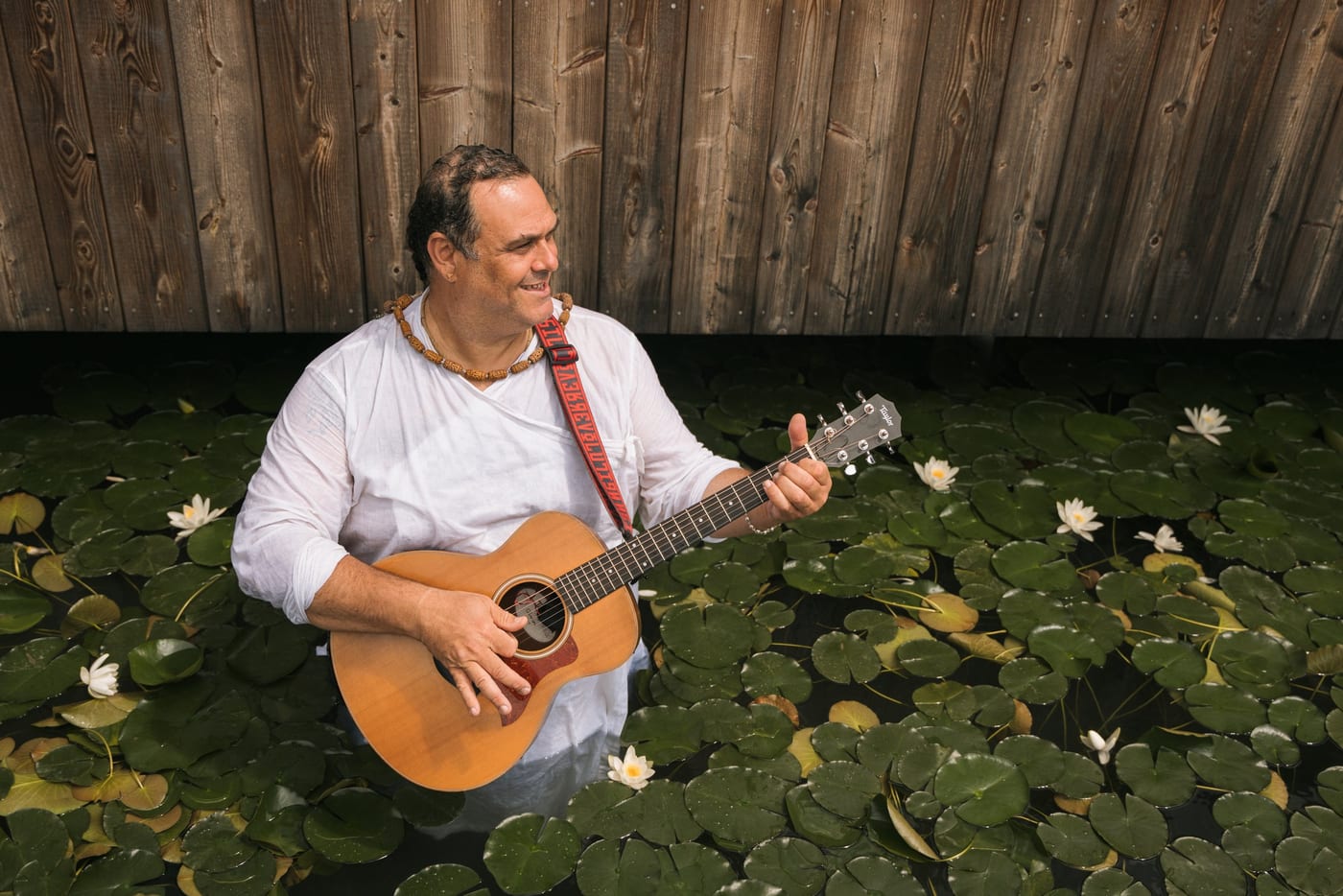

Unlimited is a single, one track released on July 15, 2026, and the way to approach it is as a single devotional statement rather than a full album. The facts on record are modest: the release carries no label credit, and the track-level details beyond the title are not documented here. This guide stays within what can be said honestly and spends its words on context and listening.
Gaura Vani has spent roughly two decades touring and recording. His path is non-linear: raised by monks in temples from the age of four, immersed in mantra and ritual as daily life, then a teenage rebellion and a run of Hollywood acting work before the music took over. His catalog since has moved between studio albums such as Like a River to the Sea, Nine Islands, Love, and Meditation & Mantra, compilations, and a steady run of singles.
Unlimited belongs to that last strand. Its 2026 arrival follows two other singles from the same year: Wade in the Water from the Royal Opera House Mumbai in January, and the live Bhaja Govindam (We All Bleed Blood) in April. Singles now come far more often than full albums, so Unlimited reads as one entry in an ongoing sequence rather than a capstone.
Here caution matters. The catalog data does not itemize instrumentation track by track, and nothing in the record specifies what is played on Unlimited. Rather than guess at a harmonium or a drum, it is more useful to describe what his work generally rests on: the human voice carrying mantra and devotional lines, repetition over melodic showmanship, and pacing that ranges from sustained, meditative studio chant to driving, crowd-built kirtan.
The useful listening question is which of those modes the single occupies. Check the Spotify credits for the personnel and instruments. His ensembles offer clues to his palette: As Kindred Spirits includes Shyam Kishore on tabla and sarod, Acyuta Gopi on vocals, and Ananta Govinda on mrdanga (khol), while The Hanumen combines world percussion, chant, and harmony. Whether any of them appear here is not established, so treat these as context rather than a track listing.
There is only one: "Unlimited." What makes a single like this land is the thing his work always asks of a listener: patience with repetition. Newcomers often find a first listen slower than expected, and the repetition is part of the design rather than a flaw. Giving one track your full attention, instead of treating it as a playlist filler, is exactly the kind of attention his live recordings reward. The title itself suggests expansiveness, but what the song does with that idea is best discovered by listening rather than by a guide's speculation.
The work sits in the bhakti tradition, the devotional path within Hinduism centered on love for the divine expressed through song. Kirtan, the call-and-response chanting of names and mantras, and bhajan, the devotional song form, are his two working vocabularies, with Sanskrit lyrics as the default language. His formation came from inside temple life, so the practice predates any career decision. The public record names no specific guru lineage or sampradaya, and this guide assigns none.
What distinguishes him within that tradition is range. He moves between solo devotional recording, the East-West fusion of As Kindred Spirits, and festival kirtan with The Juggernauts, and he has shared stages with Jai Uttal and Krishna Das. A single like Unlimited is best placed as a small, current-day piece of that wider practice.
This suits a listener curious about bhakti who is willing to hear chant as a sung, communal, performed practice. It is a good fit for someone already following his 2026 releases, or for a newcomer who wants a short, low-commitment entry before the longer records. It is less suited to anyone wanting high-BPM electronic sound or club-style remixes, since even his energetic material rests on call-and-response rather than programmed beats. Listeners unfamiliar with Hindu names or Sanskrit may face a learning curve if the lyrics lean that way. And a single is a thin sample: anyone wanting a full picture should move on to Meditation & Mantra or the compilation Kirtan: The Bhakti Yoga of Chanting Mantras.
Give it undivided attention. Use headphones, in the evening or at a quiet point in the day, and play it through at least twice: once to take in the overall mood, and once to follow the voice and the repetition more closely. If you use it as part of a sitting practice, let it open or close the session rather than fill it, since a single track is brief. Afterward, look at the Spotify credits and the official site, gauravani.com, to confirm who played what, and let that sharpen the third listen.