
The shape of a session
A session with Rodney Yee is slow by design. The Iyengar foundation sets the pace: poses are organized from the feet upward, cued carefully in words, and held long enough for the student to notice what is happening rather than simply complete the shape. Blocks, straps, and bolsters are part of the furniture, not a concession. The atmosphere is studious and unhurried. Nobody is performing, and the room is not built for emotional catharsis. What accumulates is working knowledge of the body.
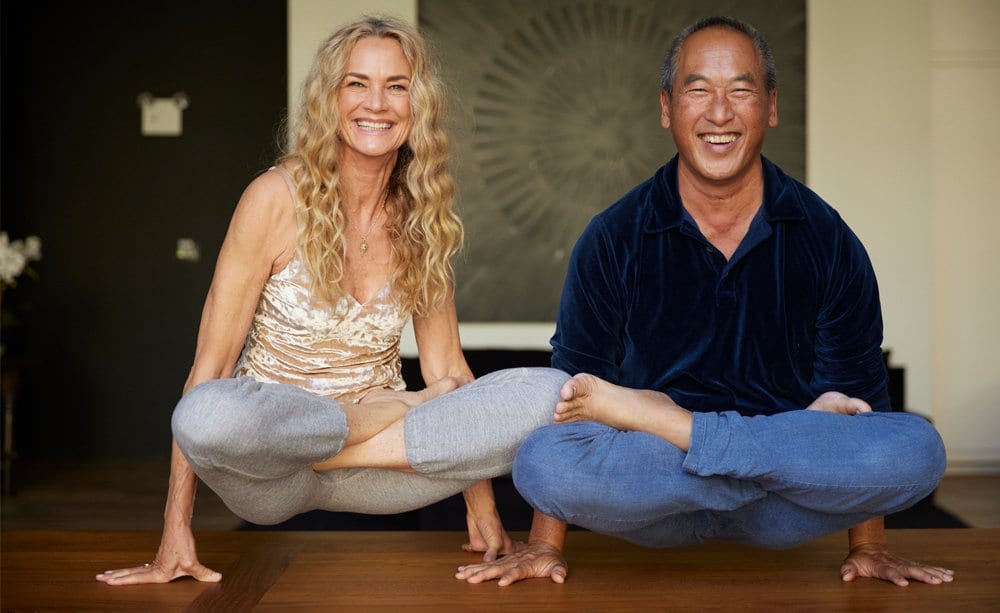
Workshops and retreats stretch that structure across longer blocks. Material moves from standing foundations toward restorative work, pranayama, and yoga nidra. In a residential setting, such as the Menla Retreat and Dewa Spa in Phoenicia, New York, where Rodney Yee is scheduled to teach on October 30, 2026, the time between sessions matters as much as the sessions: there is room to digest what was taught. Rodney Yee teaches regularly with partner Colleen Saidman Yee, with whom workshops, retreats, and teacher trainings are co-led. The two bring different emphases to the same practice, so students meet two voices rather than one.
Recurring themes
The central theme is the body as an object of ongoing inquiry. The bio describes a continuing investigation into the complexities of human experience and a commitment to unearthing deeper insight about the body. Alignment and skeletal organization run through everything, a legacy of the Iyengar training built in Berkeley and San Francisco.
A second thread is the widening from body to mind. Rodney Yee's own path started with gymnastics, moved through philosophy and physical therapy studies, then through professional dance, and arrived at yoga as the point where those interests converged. The teaching reflects that arc: pranayama, meditation, and mindfulness extend the physical work without replacing it. Restorative yoga and yoga nidra recur as ways of teaching receptivity rather than effort. The stated aim is peace, pursued through practical tools instead of doctrine.
The questions asked of students
The record contains no transcribed talks, so what follows is inference from the method rather than quotation. The teaching seems to ask: What do you actually feel in this pose, as opposed to what you believe you are doing? What changes when a small adjustment is made? Can you stay with stillness without reaching for effort or distraction? And how does attention to the body alter the state of the mind? These are questions of self-study, and the work rewards patience and repetition more than novelty.
The aesthetic of delivery
Here the evidence is thin, and it is better to say so than to embroider. The documented voice is precise, anatomical, and somewhat secular. Nothing in the record establishes humor, storytelling, or scriptural citation as hallmarks. Students seeking chanting, mantra, or ritual may find the mindfulness material more physical and practical than they expected. Silence, however, is built into the format: restorative holds, nidra, and breath practice all require it. The delivery is closer to a clinician's or a dancer's attention to detail than to a preacher's cadence, which fits a background spanning physical therapy studies and the Oakland Ballet Company and the Matsuyama Dance Company of Tokyo.
Who it lands for, and who may bounce off
It lands for students who want to understand a pose rather than merely finish it, and for people who value a body-mechanics vocabulary that many yoga teachers lack. Restorative and yoga nidra sessions suit those dealing with stress or poor sleep. Beginners can enter without formal background, though the instruction assumes willingness to slow down and notice small differences.
It will likely frustrate those who want a fast, sweaty, music-driven flow; the holds and prop work can feel glacial to anyone who came for cardio or quick strength. Students seeking a devotional framework may find it too anatomical. Advanced Iyengar practitioners may want more challenge than an introductory video library provides. Restorative and nidra sessions are not a workout and will disappoint anyone expecting exertion. The tradeoff is real: this is a practice that builds through repetition, not variety.
The wider tradition
By the bio's account, Rodney Yee has practiced yoga for over 40 years with particular emphasis on the Iyengar tradition. That foundation was built at The Yoga Room in Berkeley and the Iyengar Institute of San Francisco, studying with Donald Moyer, Manouso Manos, and Ramanand Patel. In 1987 Rodney Yee co-founded The Piedmont Yoga studio with Richard Rosen and Claire Finn.
What distinguishes the teaching is less the lineage, which many teachers share, than how Rodney Yee carried it into public life. Appearances in the Yoga Journal calendar in 1989 and 1991 led to a video career under Healing Arts and later Gaiam, and a 2000 appearance on Oprah helped bring yoga into the mainstream. Since 2003 Rodney Yee has lived in Sag Harbor, New York, teaching with Colleen Saidman Yee. The upcoming calendar includes the Menla retreat and a Kripalu Center for Yoga & Health engagement in Stockbridge, Massachusetts, on January 29, 2027.
The result is a serious, somewhat austere teaching voice: technically grounded, widening carefully toward the contemplative, and unconcerned with entertaining anyone.