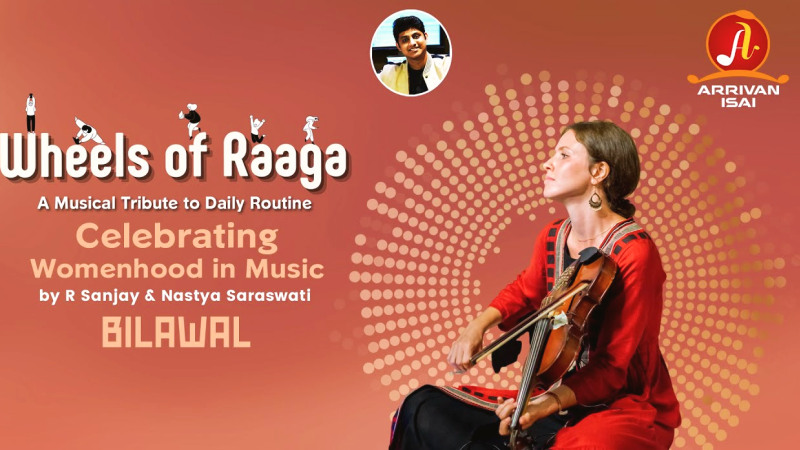
Nastya Saraswati is a violinist and vocalist whose work bridges the classical traditions of Russia and India. Based between St. Petersburg and Mumbai, she performs and records music that draws on Hindustani classical forms, devotional kirtan, and the European string repertoire she trained in from childhood. Her stage name references the Hindu goddess of knowledge and the arts, a nod to the synthesis that defines her sound.
Saraswati's approach to the violin is rooted in bel canto phrasing and the microtonal ornaments of raga performance. She adapts her instrument to Indian classical music by integrating slides, gamakas, and drone-based improvisation, techniques more commonly associated with the sarangi or esraj. Her performances often include vocal work in Sanskrit, Hindi, and Russian, and she collaborates with tabla players, sitar accompanists, and electronic producers working in ambient and world fusion genres.
In 2017, Saraswati appeared as a finalist on Dil Hai Hindustani, a televised singing competition on Star Plus that drew millions of viewers across India. The program, judged by playback singers Badshah, Shalmali Kholgade, and Shekhar Ravjiani, showcased her ability to perform Bollywood repertoire alongside devotional bhajans. Her performances on the show introduced her work to a mainstream Indian audience and expanded her following beyond the classical and spiritual music circuits.
Saraswati was trained in classical violin in Russia before relocating to India to study Hindustani music and immerse herself in the country's devotional traditions. She has spent extended periods in ashrams and pilgrimage sites across India, studying with traditional vocal and instrumental teachers. Her time in Varanasi, Rishikesh, and rural Maharashtra has informed both her musical vocabulary and her understanding of the spiritual contexts in which ragas and mantras are performed.
She has performed at venues and festivals across India and Russia, including kirtan gatherings, classical recitals, and fusion concerts that pair traditional Indian instruments with Western strings. Her work has been covered by Indian lifestyle and music media, and she maintains an active presence on social platforms where she shares performance videos, studio sessions, and recordings from live events. She teaches violin and vocal technique to students interested in cross-cultural improvisation and devotional music.
Saraswati continues to tour between Russia and India, performing solo concerts and collaborating with musicians in both countries. She records regularly, releasing singles and session work that blend Indian ragas with ambient and neoclassical production. Her current projects include live kirtan performances in Mumbai and St. Petersburg, and she is developing new material that explores the overlap between Russian Orthodox chant and Vedic recitation.
For listeners encountering her work today, Saraswati offers a model of how classical training can be adapted to serve devotional and cross-cultural expression without flattening either tradition.