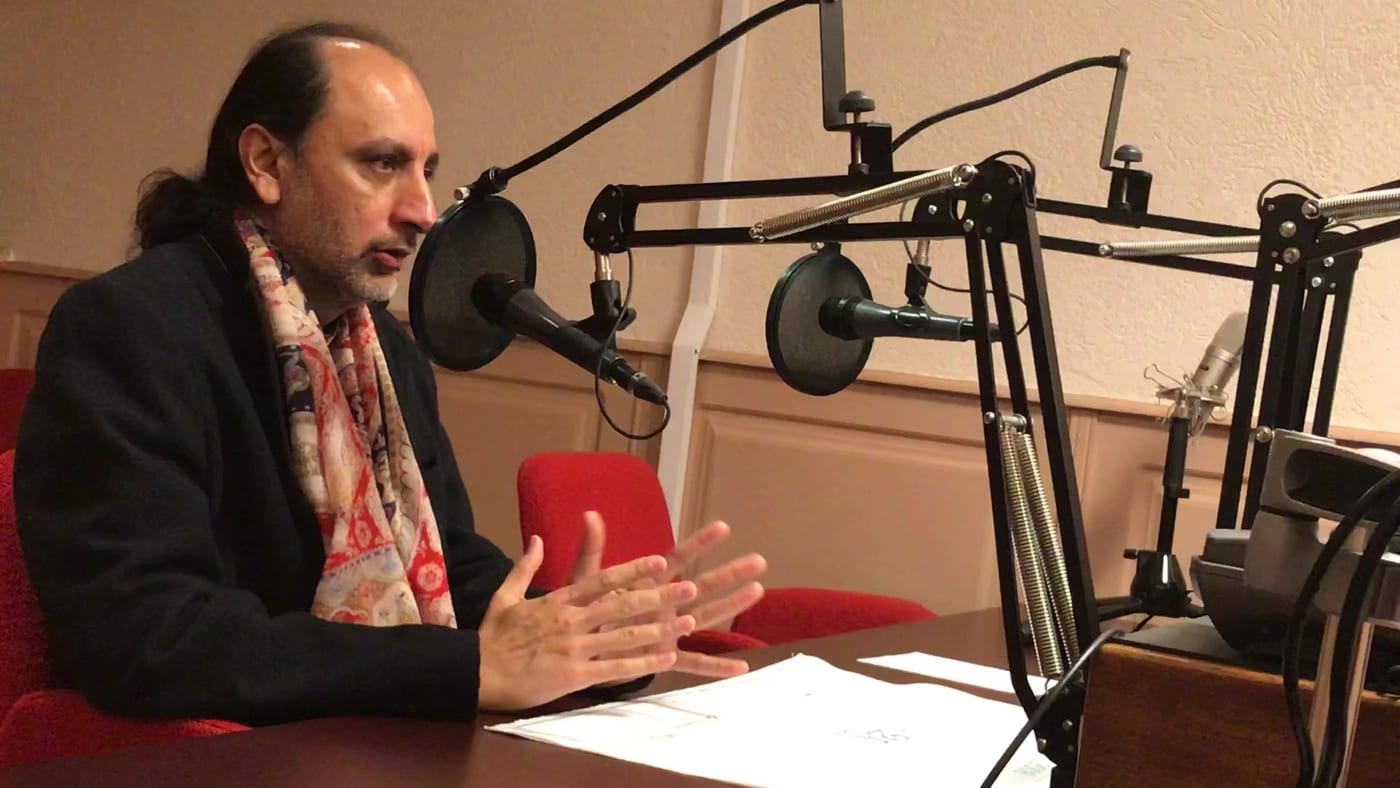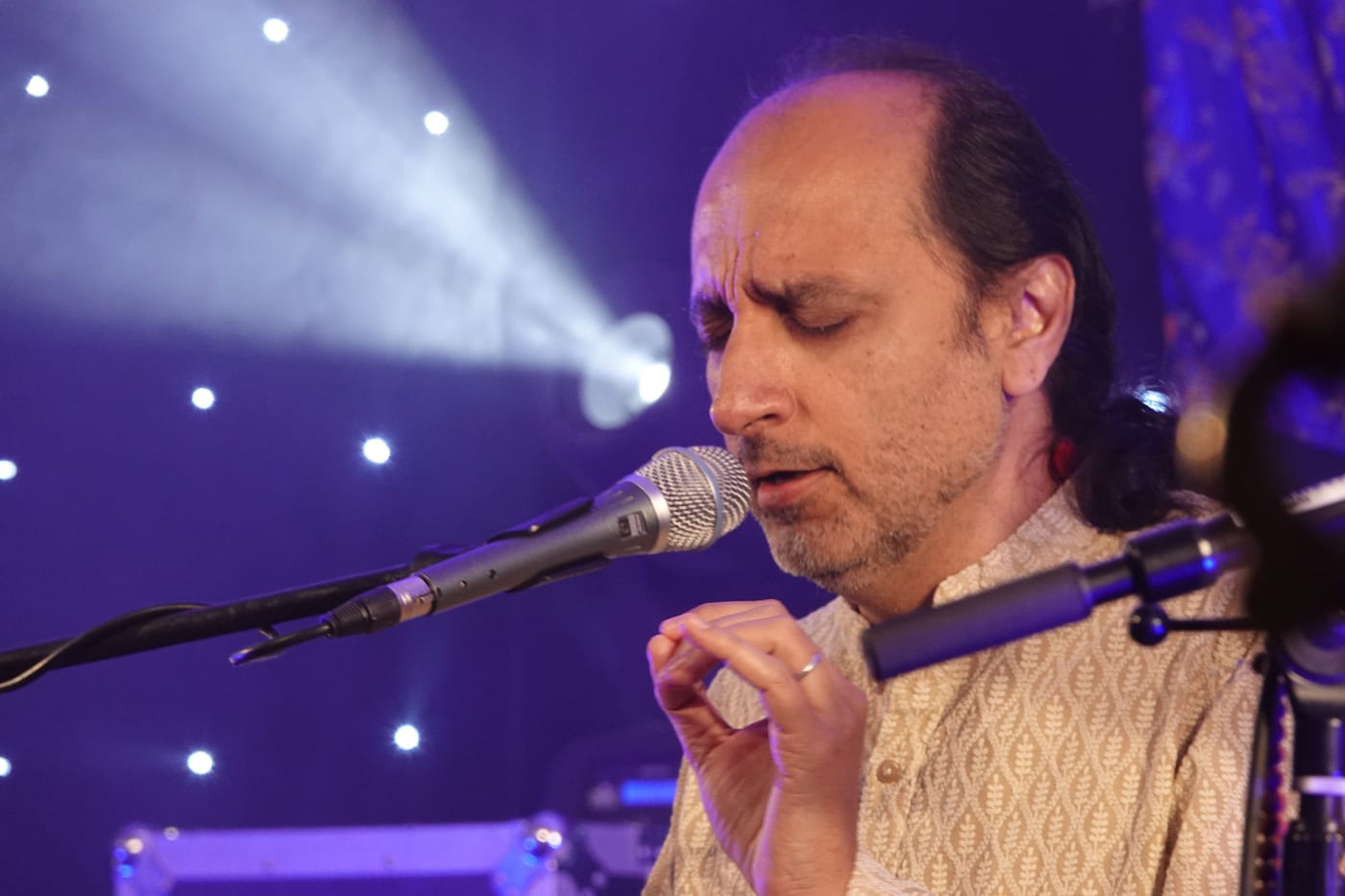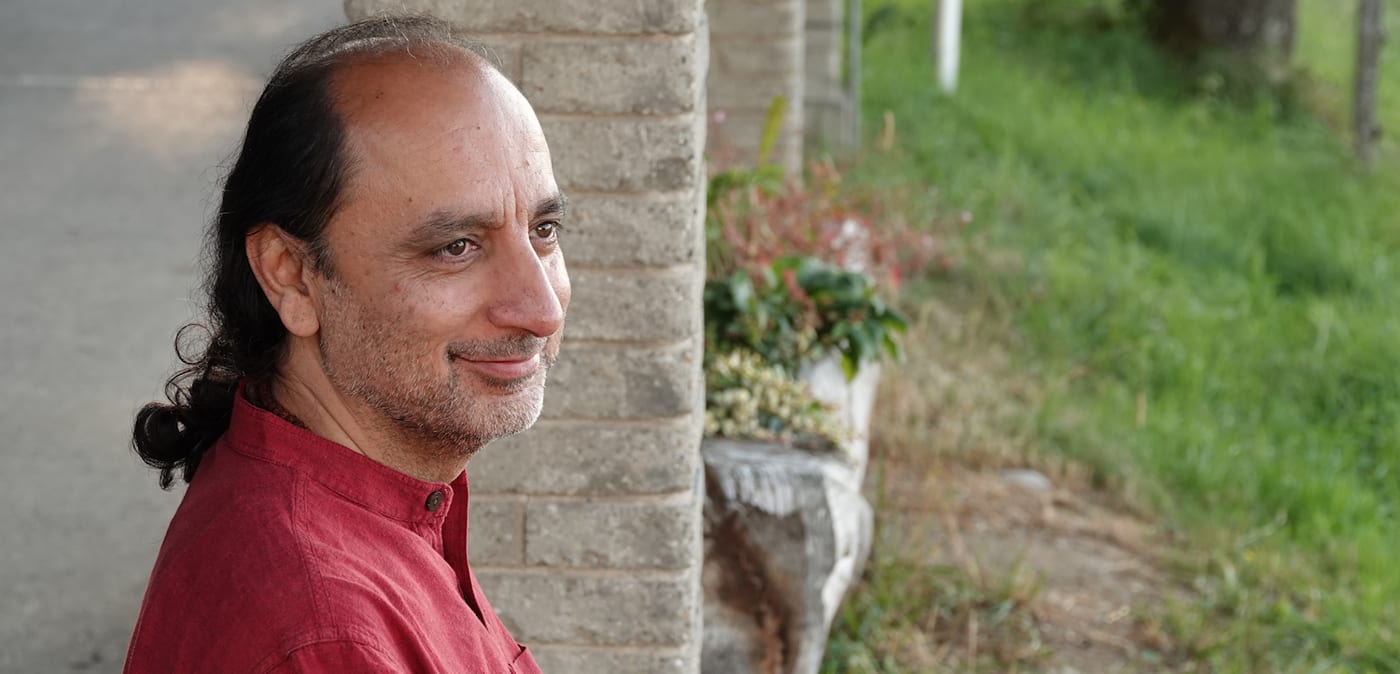

A retreat with Manish Vyas is not a course. The bio is explicit on this point: his retreats give no certificates and make no promise of credentialed mastery. What they offer is a braided practice. Mantra, kirtan, pranayama, meditation and stories from India are woven together, with light yoga also mentioned in his own descriptions of the format. Sound is the spine, and the other elements are ways of entering it: breath prepares the body, chanting occupies the voice, meditation holds what remains afterward, and the stories supply context.
His instruments are those of the devotional tradition: voice, harmonium and tabla. The arrangements he is known for are lean. Expect space rather than momentum. A session built on this model is more likely to ask for attention than to build ecstatic release, though his recorded range, which reviewers say stretches from dance-floor beats to relaxation, suggests he can move between registers.
He teaches in several formats: concerts, workshops, private and online lessons, yoga-festival appearances and multi-day retreats. A confirmed upcoming date is at Sindhi Community House in London on May 14, 2027. His past retreat locations include Switzerland, France, Holland, Spain, the UK and the Sivananda Yoga Ashram in the Bahamas.
The central idea is naad yoga, the intrinsic power of sound. Everything else orbits it. Mantra is treated as sound with effect, not as decorative spirituality. Kirtan is a shared practice. Pranayama links the breath to the voice. His catalogue reflects the same concerns: Vedic Invocations, Yoga of Chanting, Healing Ragas Collection, Shivoham, Sattva, and, reaching toward Islamic devotional song, Salaam e Sufi and Sufi Splendor. The 2026 album Devas and Devis continues the devotional line.
A second theme is transmission. He calls himself a "humble postman," a phrase that presents the teacher as a carrier, not an originator. He says he began leading retreats after 20 years of following his Master, who told him he was ready to share what had been passed to him. The bio does not name that Master, and this profile will not guess.
A third is cultural presentation. He lists himself as a presenter of Indian culture, as well as a podcaster, publisher, blogger, film-maker and producer. The stories told on retreat belong to this project: the music is meant to arrive with its surroundings.
The sources do not record specific questions he poses to students, and none will be invented here. What the structure of the work implies is a set of problems students are left to carry. What happens to attention when the voice is the instrument and the text is not in your language? What changes when breath and sound are coordinated, and what do you notice when you are not performing for anyone? Is sound something you consume or something you do? And for students used to taking only what suits them from a tradition, what does it mean to receive something that was handed down as a whole? These are inferences from the format, not reported teachings.
Sources point to a delivery that favors restraint, spaciousness and silence over spectacle. His voice is described as clean and unadorned, serving text and raga rather than showing off. Beneath that simplicity, reviewers hear skill: Prem Joshua of Germany praises his rhythm and melody, and Spuren Magazine in Switzerland notes his voice, mantras and tabla playing.
Scripture and story are part of the method. Sanskrit hymn traditions inform Vedic Invocations, and stories from India are a named component of the retreats. The sources do not describe his humor, so it is left unclaimed here. What can be said is that his self-description as a humble postman suggests an understated manner, with authority located in the tradition rather than in personality.
It is likely to land for people who want sound treated as practice: yoga and meditation students, those already curious about Sanskrit and Indian classical music, and listeners wary of "world music" as flavoring. Patience helps. The sparse arrangements tend to reward repeated listening rather than a single hit of emotion.
It may not suit those seeking high-energy, call-and-response kirtan that builds communal ecstasy, since his approach leans toward the introspective. People uneasy with devotional content, Sanskrit or Sufi texts, or the guru-disciple framing he openly invokes will find little neutral ground; the work is rooted in those traditions, not in secular mindfulness. Anyone wanting certification or a structured curriculum should look elsewhere, because he says plainly that the retreats are neither. And listeners who prize polished, layered Western production may find the recordings austere.
By the bio's account, Vyas comes from Gujarat and has played Indian music since childhood, later focusing on sacred and devotional music from the ancient Indian tradition: mantras, kirtan and related expressions. His work sits in the Vedic and Hindu devotional stream, while his Sufi albums show a willingness to cross into Islamic devotional music. His standing as a teacher rests on a relationship with a Master he describes but does not name, and a period of 20 years of following that Master. That is the whole of the lineage the record supports. No school, line of succession or named teacher can be added without inventing it, and for a teacher whose self-image is a carrier of something received, that silence is worth noting rather than filling.