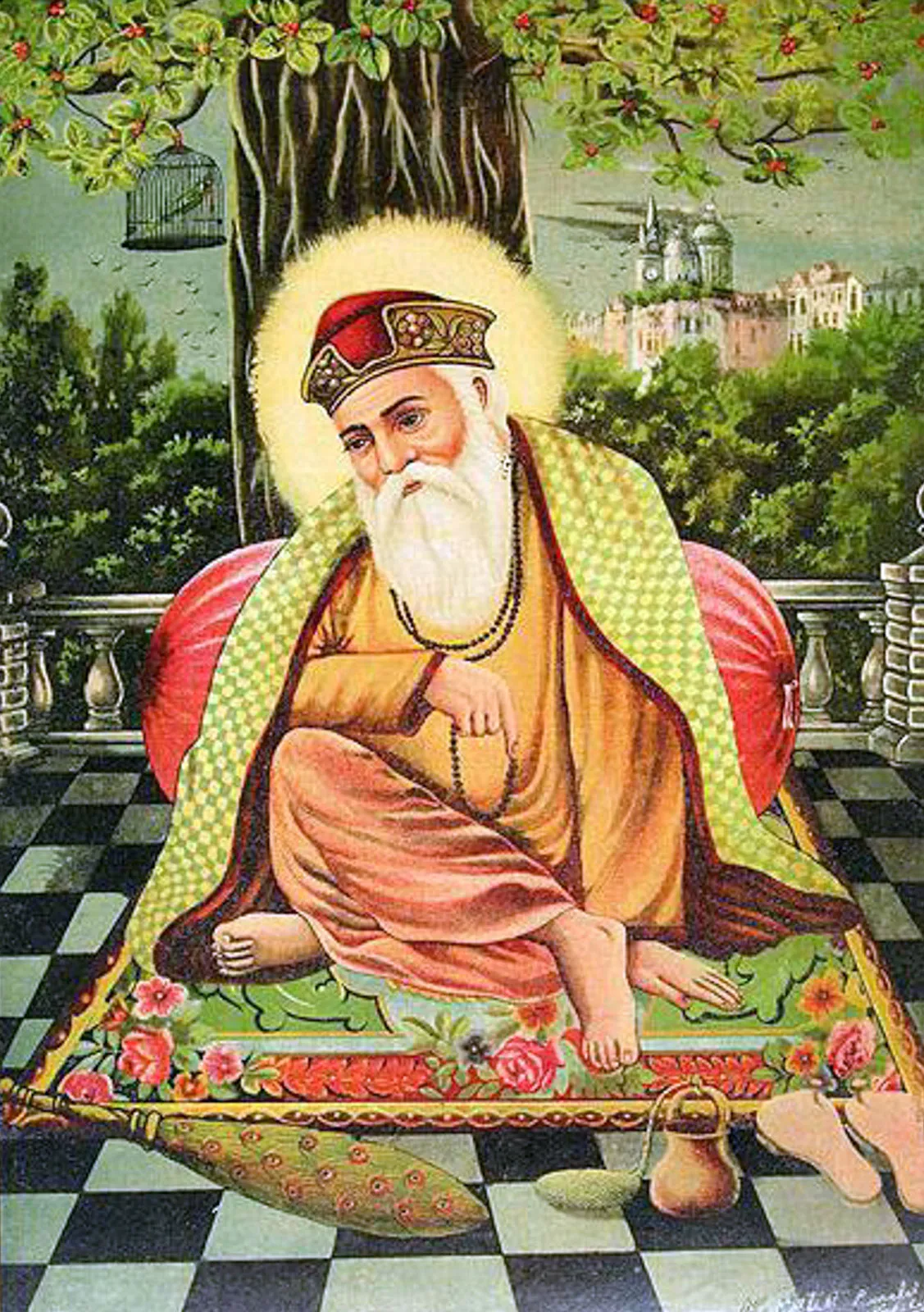
The Sovereignty of Praise: A Path to Inner Kingship
Guru Nanak's assertion that "One who is blessed with the gift of praising Him is the king of kings" invites us to explore the profound relationship between praise and spiritual sovereignty. In this statement, the act of praising transcends mere words; it becomes a transformative practice that elevates the individual to a position of spiritual authority. This perspective challenges our conventional understanding of power and leadership, suggesting that true kingship lies not in dominion over others but in the depth of one's devotion and the sincerity of one's praise.
At its core, this quote encapsulates the essence of Sikh spirituality, where the act of praising the Divine is not just an expression of gratitude but a means of aligning oneself with the universal truth. The blessing of being able to praise is portrayed as a divine gift, one that bestows upon the individual a sense of purpose and connection to the greater cosmos. In a world often preoccupied with material success and external validation, Guru Nanak's words serve as a gentle reminder that the highest form of achievement is found in the humble act of devotion.
The image / the metaphor
The imagery within Guru Nanak's quote evokes a sense of majesty and reverence. The phrase "king of kings" conjures visions of a ruler who embodies wisdom, compassion, and authority, yet this kingship is not derived from power over others but from a deep, abiding relationship with the Divine. The act of praising becomes a royal decree, a declaration of one's allegiance to a higher truth. In this context, the verbs chosen—"blessed" and "praising"—suggest an active engagement with the Divine, where the individual is both a recipient of grace and a participant in the cosmic dance of creation.
Diving deeper into the metaphor, we find that the "gift of praising" signifies an awakening of the soul. It is not merely about vocalizing admiration; it is an invitation to experience the Divine presence in every aspect of life. This act of praise transforms the mundane into the sacred, allowing the individual to see themselves as part of a larger tapestry woven by the Creator. Thus, the metaphor of kingship becomes a reflection of inner sovereignty, where the true ruler resides within, guided by the light of devotion.
In the speaker's tradition
Guru Nanak's teachings are deeply rooted in the Sikh tradition, which emphasizes the importance of devotion (bhakti) as a pathway to spiritual realization. The concept of dharma, or righteous living, is intricately linked to the practice of praise, as it encourages individuals to align their actions with their spiritual beliefs. In this context, the act of praising the Divine can be seen as a form of kenosis, or self-emptying, where the ego is surrendered in favor of a greater connection to the universe. This aligns with the Sikh understanding of the Divine as both immanent and transcendent, inviting practitioners to recognize the sacred in all aspects of life.
Moreover, the Japji Sahib, from which this quote is derived, serves as a foundational text in Sikhism, encapsulating the essence of Guru Nanak's teachings. The verses emphasize the importance of remembrance and praise of the Divine as a means to attain spiritual liberation. In this light, the act of praising becomes a transformative practice that not only elevates the individual but also contributes to the collective spiritual awakening of humanity.
Living the teaching
In our modern lives, the teaching of praising the Divine can manifest in various ways, particularly in moments of gratitude. Consider a scenario where one faces a challenging day at work. Instead of succumbing to frustration, one might pause to reflect on the blessings inherent in the situation—perhaps the opportunity for growth or the support of colleagues. By consciously choosing to praise the Divine for these small gifts, the individual reclaims their inner sovereignty, transforming a mundane experience into a moment of spiritual connection.
Another application of this teaching can be found in interpersonal relationships. In times of conflict, it is easy to focus on grievances and misunderstandings. However, by shifting the perspective to one of praise—acknowledging the strengths and positive qualities of the other person—one can foster an environment of compassion and understanding. This practice not only nurtures the relationship but also reinforces the individual's own spiritual growth, as they embody the qualities of a true "king" through their capacity to uplift others.
A reflection
As we contemplate Guru Nanak's profound words, we are invited to consider the nature of our own praise. What does it mean to you to be blessed with the gift of praising the Divine? In what ways can you cultivate this practice in your daily life, transforming ordinary moments into opportunities for spiritual connection? Reflecting on these questions can lead to a deeper understanding of your own spiritual journey and the ways in which you can embody the essence of true kingship.


