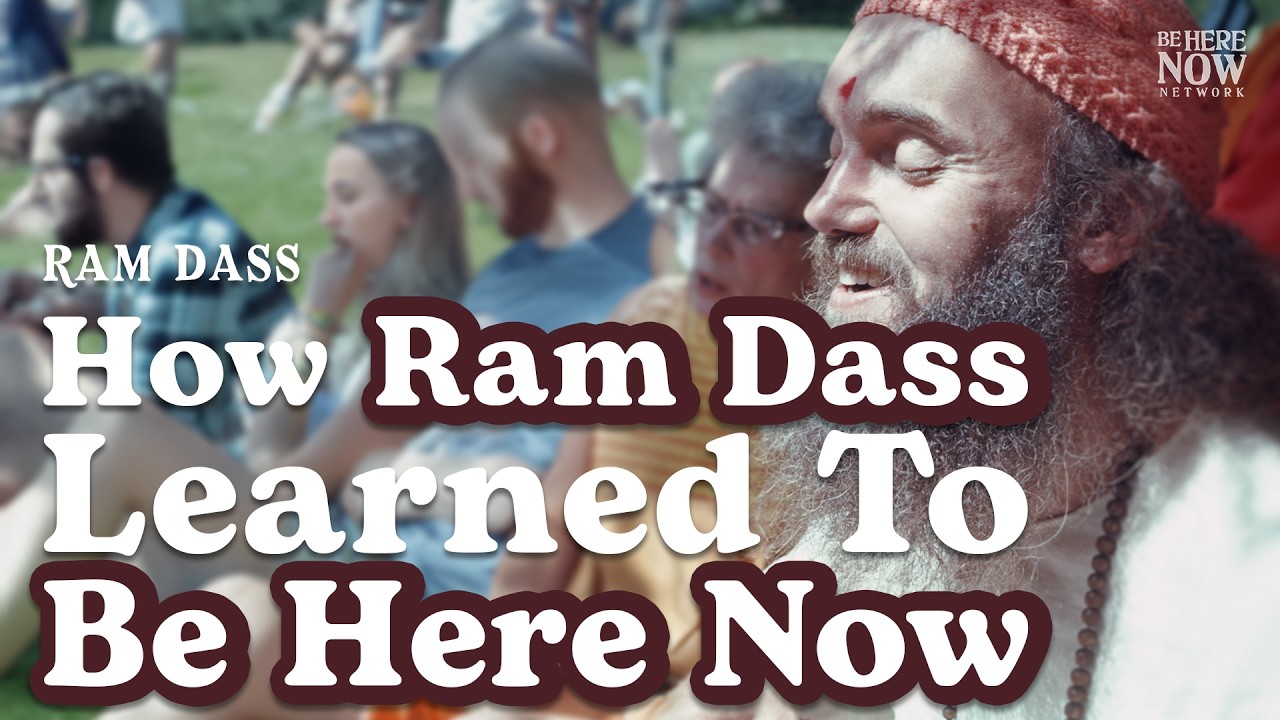
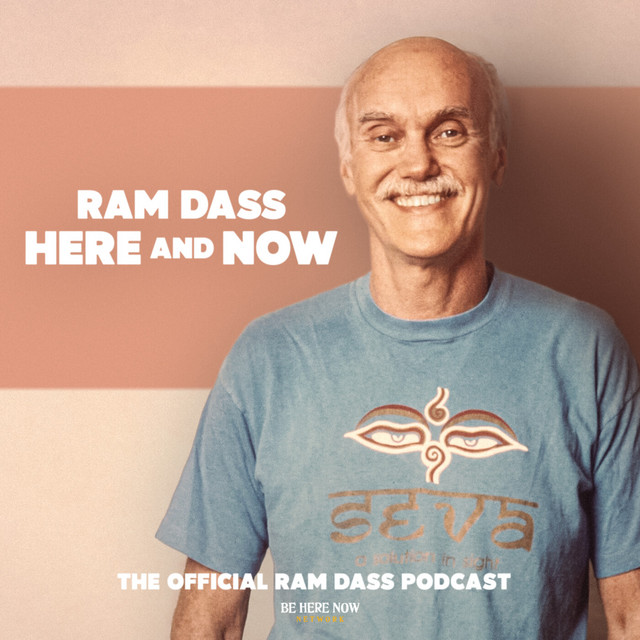
In this 1980s Sydney talk, Ram Dass uses stories of miracles from his teacher Maharaj-ji to illustrate how mind-bending experiences can break our attachment to rational thinking. He then pivots to the practical challenges of living truthfully in relationships—a domain where the gap between chaos (raw animal/unconscious impulses) and cosmos (order and transcendence) becomes visceral. He argues that dualistic methods like devotional yoga and relationships themselves, when pursued with integrity, can paradoxically carry us toward non-dual realization while helping us "straddle the thin line between chaos and cosmos."
Ram Dass begins by recounting tales from Miracle of Love, specifically experiences involving Dr. Larry Brilliant and their shared teacher Maharaj-ji. The conventional assumption is that miracles prove something—that they're evidence of supernatural power or divine favor. But Ram Dass reframes their utility in a more subtle direction: the real work miracles do is cognitive disruption. When you encounter a story that contradicts your model of how reality works, it creates a crack in the fortress of your thinking mind.
This is not about blind belief. Rather, miraculous accounts—whether you accept them literally or not—serve as tools to loosen the tyranny of rational certainty. The mind wants to build walls, to categorize, to control experience through concepts. Stories that refuse to fit neatly into those categories act like a crowbar, prying open space for something beyond the mind's jurisdiction. Ram Dass emphasizes that the value lies in the *liberation from the thinking mind itself*, not in credulous acceptance of the impossible.
Ram Dass shares a striking example from his own life: Maharaj-ji demanded changes to the manuscript of Be Here Now, the foundational spiritual text Ram Dass co-created. The story illustrates a principle Maharaj-ji articulated plainly: "Money and truth have nothing to do with one another." This is radical in a culture that often assumes financial success validates our ideas or that a profitable project must be sound.
What Maharaj-ji was saying is that truth operates on a different axis entirely from commercial viability. You can have a profitable lie; you can have a true statement that earns nothing. The revision demand wasn't about making the book more marketable—it was about aligning the work with truth, consequences be damned. This reflects a non-negotiable principle in spiritual practice: the priority of authenticity over outcome, and the willingness to dismantle something valuable if it carries corruption.
Ram Dass makes a blunt observation: "The truth is scary. Truth keeps shattering your models of how you think it ought to be." This is where the abstract becomes personal and visceral. He gives an example that many will recognize—looking at your intimate partner and, in an unguarded moment, seeing something other than the beloved face you've constructed. "You might look at your partner and suddenly they look like a skeleton. 'Good morning dear, you look absolutely ghastly.'"
This isn't morbidity for its own sake. It points to the raw, unfiltered perception that lives beneath our social overlays. In everyday relationships, we perform a kind of psychic diplomacy: we soften truth, repackage it, hide it behind courtesy and strategic silence. But what does it cost? We fracture ourselves. We train ourselves not to see, not to speak, not to be present to what is actually happening.
Ram Dass acknowledges the genuine dilemma: can you live in a relationship where truth operates without that filtering? Where you don't censor based on what will soothe the other person or preserve the image of the partnership? The answer is not simple, and that's his point. A relationship based on truth is not a feel-good paradise—it requires tremendous maturity and spiritual groundedness.
This is perhaps Ram Dass's most delicate and important insight. He frames relationships as existing on a razor's edge. On one side is chaos—the raw, unconscious, animal impulses that humans carry: aggression, lust, fear, primitive reactivity. On the other is cosmos—order, transcendence, the orderly unfolding of divine intelligence. Most relationships collapse into one or the other: either they become so sanitized and rule-governed that they lose authenticity and juice, or they devolve into emotional and behavioral chaos.
The narrow path between them is the path of truth-based relationship. It requires you to acknowledge your animal nature—the skeleton you see, the rage, the selfish impulse—without either acting it out compulsively or repressing it into shadow. Simultaneously, you orient toward something higher: the cosmos, the divine intelligence, the transcendent love that sees beyond the particularity of the personality.
This balance is not achievable through willpower alone. It requires the support of spiritual practice and often of a teacher who embodies the possibility. It requires accepting that relationships will constantly shatter your models of how things "ought to be." The cosmos keeps intruding on the chaos, and the chaos keeps erupting beneath the cosmos—and the work is to stay present to both without collapsing into either.
Near the end of the talk, Ram Dass makes a counter-intuitive claim: dualistic methods—relationship, devotional yoga, guru-disciple work, any practice that involves you and something other than you—can be a pathway to non-duality. This seems paradoxical. If non-duality is the direct recognition that subject and object are One, how can a dualistic practice get you there?
The answer lies in the *orientation* and *intensity* of the practice. When you approach a relationship, a guru, or a deity with total devotion and surrender, you are engaging in dualism—there is clearly a "me" and a "you." But the quality of that engagement—the purity of intention, the willingness to be dissolved, the persistence of love—can create conditions where the apparent separation begins to dissolve from within. The practice of devotion doesn't intellectually prove non-duality; it *enacts* it, makes it real in the body and heart.
Devotional yoga, in particular, is designed to kindle this. You sing to the divine, you bow to the guru, you serve your partner's highest good—all dualistic gestures. But done with full presence and surrender, these acts of devotion begin to erase the boundary between lover and beloved. The cosmos—the non-dual awareness—begins to permeate the dualistic form. This is what Ram Dass means by "dualistic methods" helping us "straddle the thin line": they give us a practical bridge, a lived experience of how chaos and cosmos, separation and unity, can coexist.
Ram Dass notes that being truthful is profoundly difficult "around other human beings." This is not an abstract complaint. When you are alone, you can acknowledge your full interior experience—the contradictions, the shadows, the parts of yourself that don't fit a coherent narrative. But the moment another person is present, a new variable enters: you become aware of *their* experience of you, their vulnerability, their potential pain. Truthfulness then becomes a question not just of honesty but of responsibility and compassion.
This is where many spiritual seekers get confused. They think enlightenment or spiritual maturity means always saying exactly what you think. But Ram Dass implies something more nuanced: it means bringing full presence and consciousness to the decision of what to speak and what to hold. Sometimes the truest response is silence. Sometimes it is a carefully chosen word that honors both the truth and the capacity of the other person to receive it.
The human animal is also a spiritual being, and the interaction of the two creates genuine complexity. You cannot simply override one for the other. The practice is to hold both—to be fully human and fully conscious of the trans-human cosmos—and to let that holding inform how you meet another person.
If you recognize yourself in the dilemma Ram Dass describes—the pull toward truth-telling offset by the risk of harm, the simultaneous reality of being both animal and cosmos—you might ask: What would happen if I brought more consciousness to my relationships? Not perfection, not always speaking every thought, but a deepening awareness of where I'm contracting away from truth and where I'm using truth as a weapon.
The practices that support this work are not exotic. They include meditation and self-inquiry (to access your own inner chaos and cosmos), devotional practices (which attune you to something beyond your small self), and the willingness to stay present in relationships even when they shatter your models. Ram Dass's teaching here is that the relationship itself—messy, contradictory, ongoing—is the ashram, the spiritual laboratory. There is no need to retreat from it. The thin line between chaos and cosmos runs right through the middle of love.