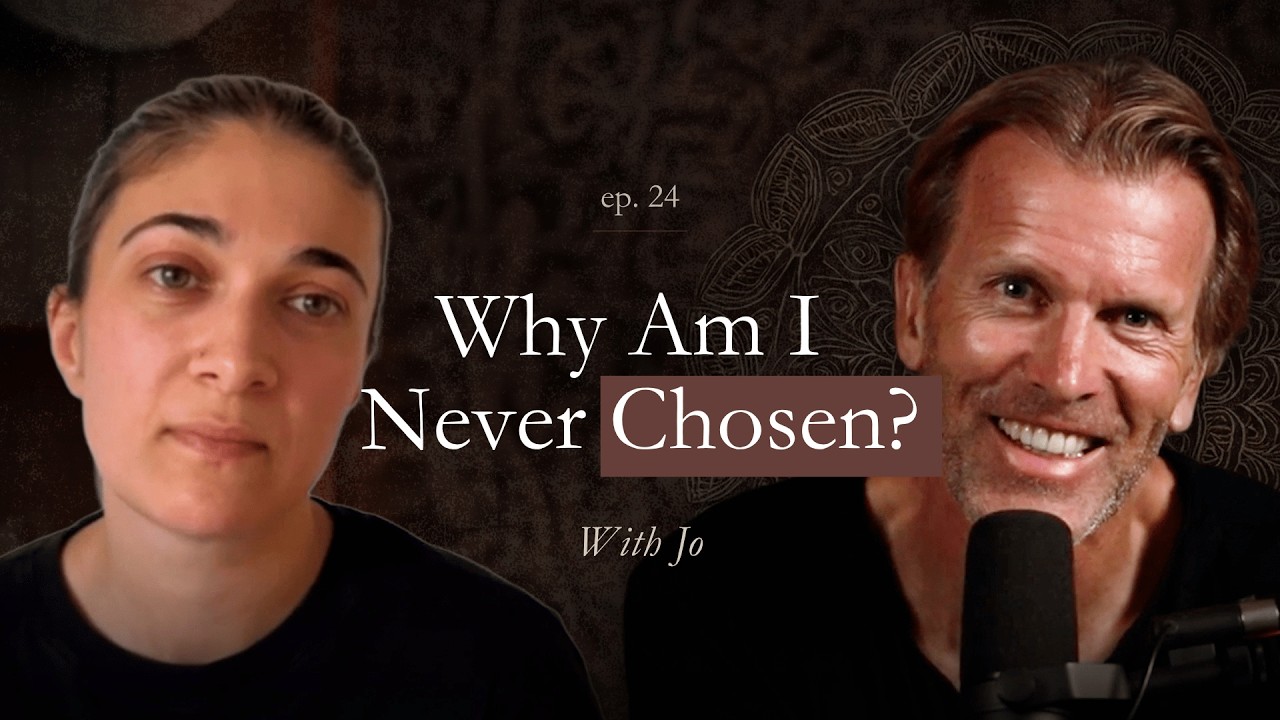
Self-worth is not earned through productivity, status, or conformity—it is inherent in being alive. From early childhood, most people internalize the false belief that love and acceptance must be achieved through behavior and performance. This core wound drives suffering, substance use, and existential anxiety. True spiritual evolution is the process of shedding everything that is not authentically you, recognizing that you are a unique expression of life worth honoring simply by virtue of existing. Honoring this inherent value in yourself and others is the deepest access to what it means to be fully human.
Peter Crone begins with a striking observation: when a newborn enters the world, they receive unconditional reverence. A baby contributes nothing measurable to the household—no rent paid, no job, no productivity—yet they are treated with profound respect and love. "There is this reverence for life because of the pure possibility that now is available to that human being" (0:22). The newborn is honored simply for being, not for doing.
Yet somewhere between infancy and adulthood, this shifts. Crone identifies a critical moment: "Something was said, something was witnessed, that made us think as a human being that now I have to do something beyond what I was previously doing" (0:48). A parent's disappointed look, a sibling's achievement, a teacher's comment—some signal reaches the child that they are no longer enough as they are. From that point forward, the child begins to believe that love and acceptance are conditional, earned through correct behavior and performance.
"We start to redefine who we are, we start to manipulate our behavior because now we have this incessant desire to be loved and accepted because fundamentally we don't feel we are just by being who we are" (0:72). This is not a character flaw; it is a logical adaptation to perceived scarcity. If love is conditional, the young person reasons, then I must earn it.
Crone is clear: "That to me starts the journey of suffering for a human being" (0:83). When self-worth becomes contingent on external validation, the person enters a treadmill with no finish line. There is always another achievement to pursue, another metric to optimize, another person to impress.
This suffering often manifests through substance use. Crone observes that people self-medicate to numb the persistent feeling of not-enoughness: "People will turn to substances. It might start with like alcohol, it could then lead into pot smoking prescribed drugs, heavier drugs" (0:90). Each substance offers temporary relief from the core belief that "who I am fundamentally is somehow not enough" (0:107).
But substance use is only one symptom. The deeper pattern is self-deprecation. "Currently human beings are sort of designed to look at themselves through this self-deprecating perspective" (0:98). This is not accidental—it is culturally reinforced through messaging about productivity, status, net worth, and social media presence. The person learns to measure themselves by external metrics and to judge themselves harshly when they fall short.
Crone identifies conformity as "one of the greatest killers" (0:125). The reasoning behind conformity makes intuitive sense: if I fit into my community, my family, my tradition, my religion, then I will finally find the love and acceptance I crave. "We're under the impression that if I fit into my gang, to my community, to my family, to my tradition of my religion or whatever it might be, that's where I'm going to find love and acceptance" (0:128).
But conformity is a trap. The moment you suppress your unique nature to fit a template, you lose the very thing that has value: your singular, unrepeatable expression of life. Crone states bluntly: "But to me, it's quite the antithesis of the truth, which is no you are a unique expression of life. No one is like you. And true love is to honor that, to really nurture that" (0:138).
The alternative to conformity is not rebellion for its own sake, but rather fierce honoring of what Crone calls your "unique contribution." Each person is "a unique offering to the whole" (0:149). When you try to become like everyone else, you obliterate that offering: "But as soon as we try to become like the whole, we now lose that sense of unique contribution" (0:155).
Crone reframes inherent value in a way that bypasses all conventional measures. Your worth is not based on your bank account, your social media status, your job title, or your achievements. Instead, it rests on a single fact: "You are literally one in 8 billion" (0:170). The mathematics of existence grant you inherent value simply through being alive.
This is not abstract philosophy. Your existence is improbable and singular. There has never been anyone exactly like you, and there never will be again. That rarity alone is reason enough to treat yourself and every other human being with reverence.
"That to me is the real awakening to our inherent value that's inherent not based on our bank account or our status on social media. But by simple virtue of the fact that you are literally one in 8 billion" (0:164). This awakening is not something you earn or achieve—it is a recognition of what already is.
If inherent value is already present, what work remains? Crone defines spiritual evolution as a specific process: "The process of spiritual evolution that is available to us as human beings is to chip away everything that is not us" (0:177). This is not about adding something new or becoming someone different. It is about removing the false layers—the conditioned beliefs, the adaptive behaviors, the adopted identities—that obscure your authentic nature.
The spiritual path, from Crone's perspective, is one of subtraction, not addition. It is about unlearning the belief that you are not enough. It is about dissolving the strategies you developed to earn love and acceptance. It is about returning to the inherent reverence that was once afforded you simply for being alive.
"Being human is the opportunity to truly tap into something that is so powerful in understanding the real nature of life. That is the gift" (0:185). The gift is not a destination to reach through effort, but rather an access available here and now, once the obstructions are cleared.
The final piece of Crone's teaching ties individual worth to a larger vision of how to be human. If you recognize that every being is inherently valuable, you naturally move into a different relationship with life itself. "That is why honoring all beings and having this sense of reverence for life itself is the access to an experience of being human that to me can't be surpassed" (0:197).
This is not sentimental spirituality. Honoring life means seeing through the lens of inherent worth—in yourself, in your family, in strangers, in beings you dislike. It means treating the world and everyone in it as deserving reverence, not because they have earned it, but because existence itself warrants it.
"To really tap into the essence of what it means to be alive and to be human that is the real treasure" (0:206). The treasure is not something outside of you or in the future. It is available the moment you stop trying to become enough and recognize that you already are.
Consider the moment in your own life when you first felt you needed to be more or different to be loved. What was said or witnessed? How has that belief shaped your choices since then? Experiment with treating yourself with the same reverence that was once freely given to you as a child—not because you have earned it, but simply because you are alive. Notice what shifts when you stop measuring your worth by productivity, status, or achievement, and instead recognize it as inherent. Finally, ask yourself: What unique offering do I have that the world needs—something only I, in my singular way, can contribute? That question points toward both your authentic nature and your spiritual work.