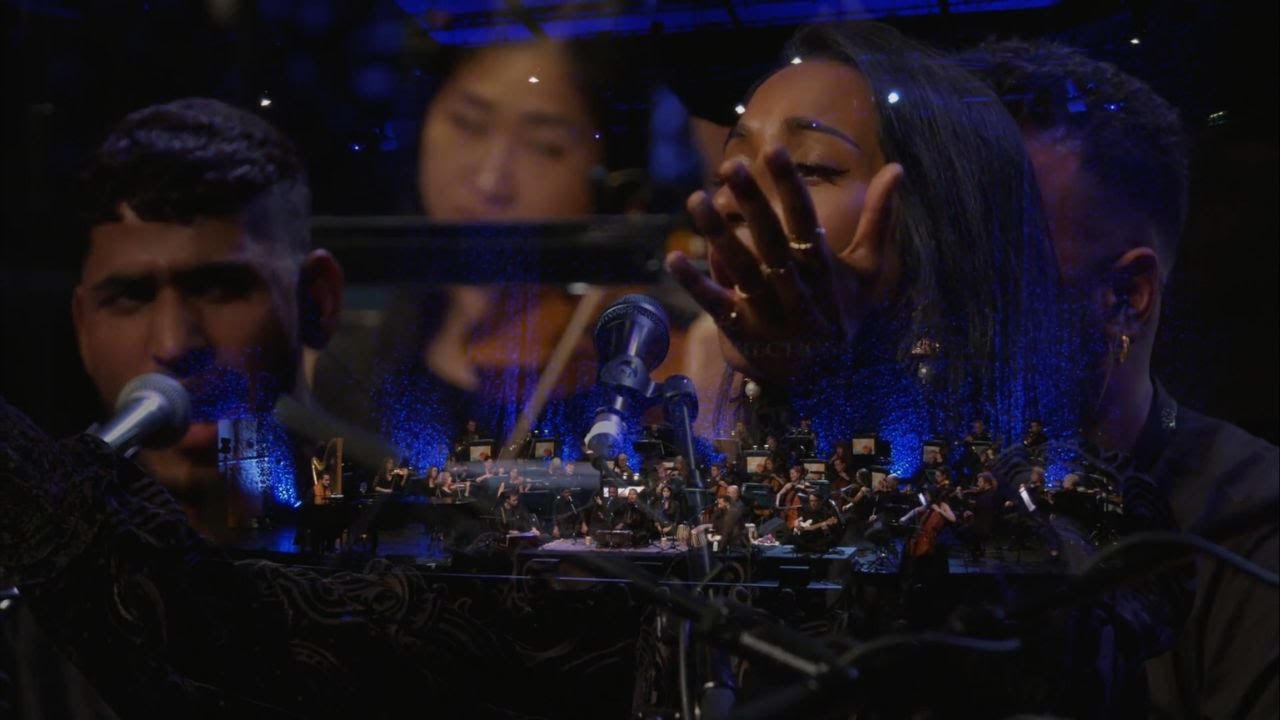
Rubaru is an original composition merging qawwali, orchestral arrangements, and mystical poetry that narrates the spiritual journey of Murshid Waqar Faiz in search of the Divine. The work explores the Sufi paradox: that the Creator whom the seeker searches for everywhere—in the skies, at holy sites—is actually found in the abode of the heart, in the immediacy of present experience. Through the metaphor of divine intoxication and the burning away of ego-boundaries (the veil), the piece traces the movement from alienation to union, from separation to the realization that there is "nothing but you" in direct, face-to-face encounter with the Beloved.
Rubaru is a contemporary experiential composition created for orchestra and qawwali troupe, combining the centuries-old Islamic devotional singing tradition of Qawwali with Western orchestral instrumentation. The Northern Film Orchestra, conducted by Melvin Tay, provides the harmonic and melodic scaffold, while Abi Sampa and collaborators perform the qawwali—the call-and-response, rhythmically intricate vocal style that has been central to South Asian Sufi practice since the 13th century. The arrangement, by Rushil, does not domesticate qawwali into Western forms; rather, it creates a dialogue between traditions, allowing the hypnotic repetition and emotional intensity of the qawwali to interact with orchestral swells and the tabla work of Amrit Dhuffer.
This is not a fusion project in the reductive sense. The orchestration serves the qawwali's primary function: to induce a state of mystical absorption (hal) in both singer and listener. The cello solo by Lydia Alonso and the stringed accompaniment mirror the elongation and microtonal inflection characteristic of classical qawwali, while the chorus—featuring singers like Sarthak Kalyani, Shridar Ramesh, Shahid Abbas Khan, and Jatinder Kwatra—sustains the antiphonal structure essential to the form. The result is a piece that honors qawwali's contemplative purpose while offering listeners who may be unfamiliar with the tradition an accessible entry point.
Murshid Waqar Faiz, a spiritual master (murshid) in the Sufi tradition, serves as the autobiographical anchor for Rubaru. The poem narrated in the qawwali is rooted in his lived experience of searching for the Divine. The opening refrain—"Waqar has wandered and searched for you from door to door"—establishes the template: a seeker who has engaged in conventional spiritual labor, moving from place to place, seeking God in established locations of holiness and religious practice (1:22, 1:44). This is not a criticism of such practices but rather a way of illustrating a central mystical insight: the external search, however sincere, ultimately points inward. Waqar's journey exemplifies the Sufi principle that the Divine is nearer than the seeker's own self, yet appears infinitely distant until the seeker's vision is clarified.
By using Waqar's narrative as the experiential foundation, Rubaru connects abstract theology to embodied seeking. His discovery—"I didn't find you anywhere but in the abode of my heart"—is not presented as doctrine but as hard-won realization (2:00, 2:24). The murshid's voice, in a sense, becomes the listener's guide through the same terrain of spiritual longing and eventual recognition.
The phrase "abode of the heart" (dil ki basti, in Urdu/Punjabi idiom) is a cardinal image in Sufi mysticism, particularly in qawwali. It refers not to the physical organ but to the spiritual heart—the seat of direct perception, the organ through which the Divine is experienced without the interference of conceptual thought or ego-driven narrative. In classical Sufism, the heart (qalb) is the innermost sanctuary where God's presence is continuously manifest, though veiled by the ego's preoccupations and worldly attachments.
When Waqar declares that he found the Divine nowhere else, the qawwali is celebrating a decentralization of religious authority: the sacred is not locked in temples, pilgrimage sites, or scriptural interpretation. It is intimately accessible, always available, yet hidden by the seeker's own distracted state. The poetic inversion—searching everywhere outward only to discover the sought-for beloved is interior—captures the Sufi paradox that governs much of the tradition's mystical practice. The qawwali's repetitive structure mirrors this paradox: the refrain "You will come to my home" (2:41 onwards) is both invocation and recognition, a calling-forth of what is already present.
Throughout Rubaru, the seeker is described as "the intoxicated one in love" (2:53, 2:57, 3:15 and recurring). This is not intoxication as confusion or loss of reason—it is a classical Sufi metaphor for the annihilation of the separate self in the presence of the Beloved. The phrase appears persistently, anchoring the emotional arc: the seeker is so overwhelmed by the experience of divine proximity that ordinary distinctions dissolve.
The intoxication deepens through specific conditions. The qawwali specifies: "You come when the heart is ignited in love" (3:48). This suggests that divine presence is not abstract or universal in availability—it comes in response to a particular intensity of longing, a burning of the heart that consumes the ego's defensive postures. Later, the metaphor becomes more violent and transformative: "Set the wilderness ablaze, remove the veil from yourself" (7:14, 7:20). The veil is not imposed from outside but is the seeker's own habitual self-image, the constructed identity that obscures the true nature of consciousness. The "wilderness" may refer to the untamed landscape of the psyche, the unconscious terrain where the ego defends itself.
By the climactic refrains, intoxication has become recognition: "You came in such a way that the heart said, 'There's nothing but you!'" (5:10, 5:18). The intoxication is not a state of emotional excess but of radical simplification—a return to the non-dual reality where only the Divine presence is real.
This refrain (6:29, 6:54 and repeating) marks a pivotal movement in the qawwali's meditation. Traditionally, seekers might look to the heavens, to transcendent realms, to escape from the material world in search of the Divine. The qawwali corrects this metaphysical direction: "I don't find you in the skies." This is not a negation of transcendence but a reversal of the hierarchy between transcendence and immanence. The Divine is not distant or inaccessible; it is immediate, present, "right in front of me" (6:34).
This realization is paired with the urgent, repetitive declaration "Nothing but you!" (6:35 onwards, building to sustained intensity). The qawwali's formal structure—the repetition, the building intensity, the orchestral swell—creates an experiential embodiment of this insight. The listener is not merely hearing about the discovery; the form itself enacts the overwhelming presence of the single reality the lyrics describe. The orchestra and tabla intensify as the voice pours this recognition again and again, suggesting that understanding the unity of all being is not an intellectual conclusion but an overwhelming direct perception.
The couplet "You are the sight, and I'm the one witnessing" (7:39, 7:49, 7:54) marks another layer of the Sufi path—the recognition that the distinction between subject and object, seer and seen, is itself illusory. In classical Sufi metaphysics, the Divine is often described as both the eye and the light by which the eye sees. When the seeker realizes "You are the sight," they acknowledge that their own capacity for spiritual perception is not their own possession but a manifestation of divine reality. Equally, "I'm the one witnessing" suggests that the witness-consciousness itself is a divine attribute channeling through the individual form.
This non-dual formulation does not deny the existence of the seeker's individual consciousness; rather, it relocates the source of that consciousness. The "I" that witnesses is not a separate, independent self but an appearance within the vastness of divine consciousness. The qawwali presents this not as abstract philosophy but as lived recognition, something that arrives through the burning away of egoic separation.
In the refrain "Sometimes at your Holy Kaaba, sometimes in my home, we mysteriously continue to meet" (8:21, 8:23, 8:27), the qawwali dissolves the boundary between the most sanctified site in Islam (the Kaaba in Mecca) and the intimate interior space of the seeker's home. This is a radical mystical democratization of sacred space. The Kaaba is the direction toward which Muslims turn in prayer (the qibla), the goal of pilgrimage, the focal point of Islamic devotion. Yet the qawwali insists that meetings with the Divine occur with equal validity—indeed, with equal mystery—in the seeker's own ordinary dwelling.
The word "mysteriously" (gumaan se, in South Asian idiom) is crucial. The meetings are not planned or controlled; they arise spontaneously. The Divine presence transcends institutional, geographical, and even intentional frameworks. For a seeker shaped by Sufi Islam, this is not a rejection of the Kaaba or institutional religion but a completion of their meaning. The external pilgrimage mirrors and converges with the inner journey toward the heart.
The Northern Film Orchestra does not accompany the qawwali in the conventional sense of musical accompaniment; rather, it mirrors and amplifies the qawwali's internal trajectory. The string swells correspond to moments of intense longing ("You will come to my home," 2:41). As the qawwali intensifies in emotional register—moving from the initial wandering search to the realized presence—the orchestration thickens, the tempo often accelerates, and the harmonic language becomes more saturated. The solo cello by Lydia Alonso performs a similar function to the classical qawwali's melodic soloist, extending phrases, bending notes in ways that suggest vocal inflection and emotional depth beyond mere lyrics.
The tabla, kept alive by Amrit Dhuffer's virtuosic playing, maintains the rhythmic framework and creates a sense of forward motion and urgency. The qawwali form itself—its relentless repetition of key phrases, its building intensity, its use of antiphonal dialogue—is designed to induce trance and direct mystical experience. The orchestration does not dilute this power; it extends it into the harmonic and textural domains, creating a multi-sensory immersion in the spiritual narrative.
Rubaru offers several entry points for deeper engagement. For those new to qawwali, the piece serves as an accessible gateway into a tradition that can initially seem intimidating in its complexity and emotional intensity. The orchestral scaffolding provides a familiar harmonic language that helps listeners remain anchored while the qawwali's formal patterns work on the nervous system. For those versed in qawwali, the composition extends the tradition into contemporary consciousness without compromising its spiritual purpose.
Listeners might explore the classical qawwali recordings of masters like Nusrat Fateh Ali Khan, Abida Parveen, and the Sabri Brothers to understand the lineage from which this piece emerges. The theologies embedded in Rubaru—the non-dual realization of divine immanence, the burning away of ego, the ultimate unity of existence—align with classical Advaita Vedanta, Christian mysticism, and Buddhist Madhyamika philosophy; comparative reading can deepen understanding. For practitioners, the piece functions as a meditation object; returning to it repeatedly can facilitate the states of absorption and direct recognition it describes. The work invites both intellectual appreciation and embodied practice, honoring the qawwali tradition's refusal to separate knowledge from transformation.