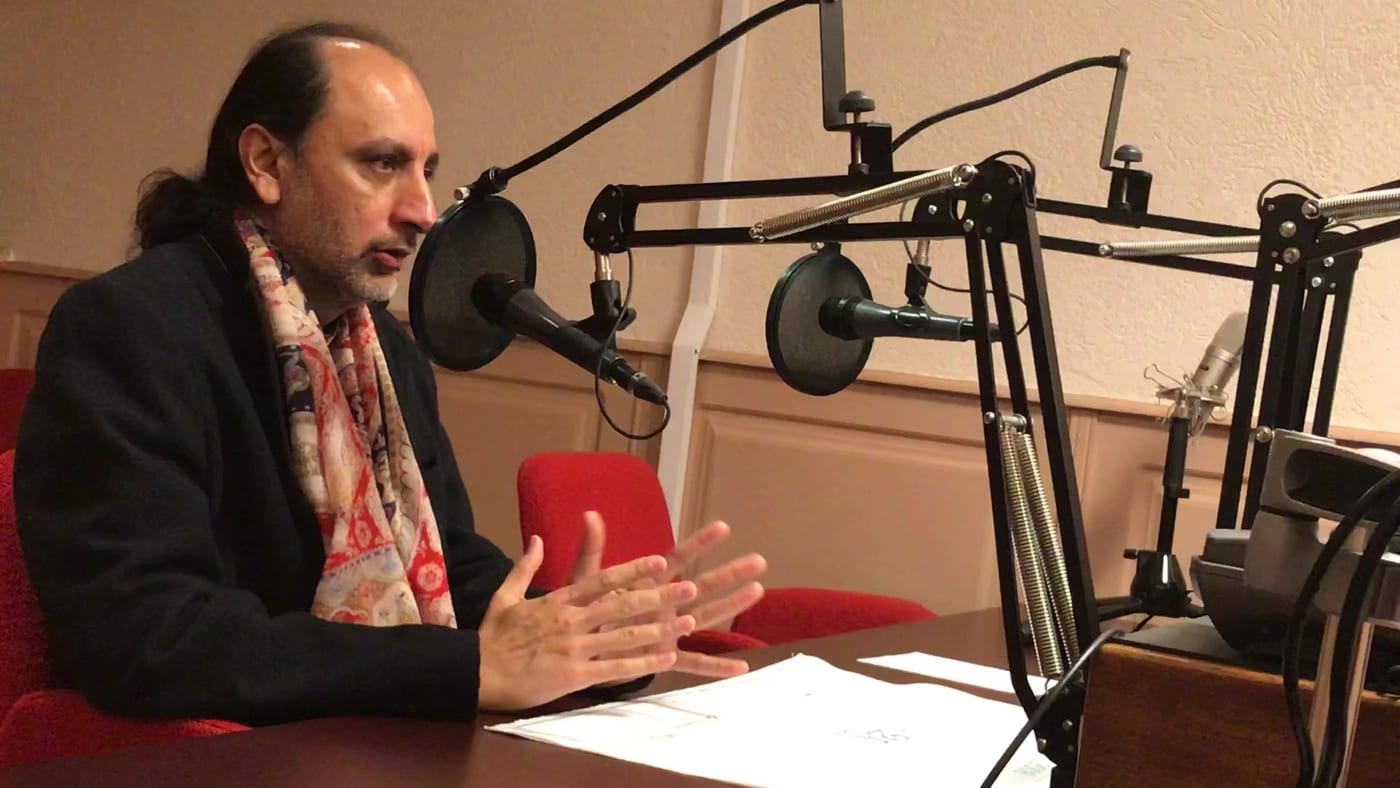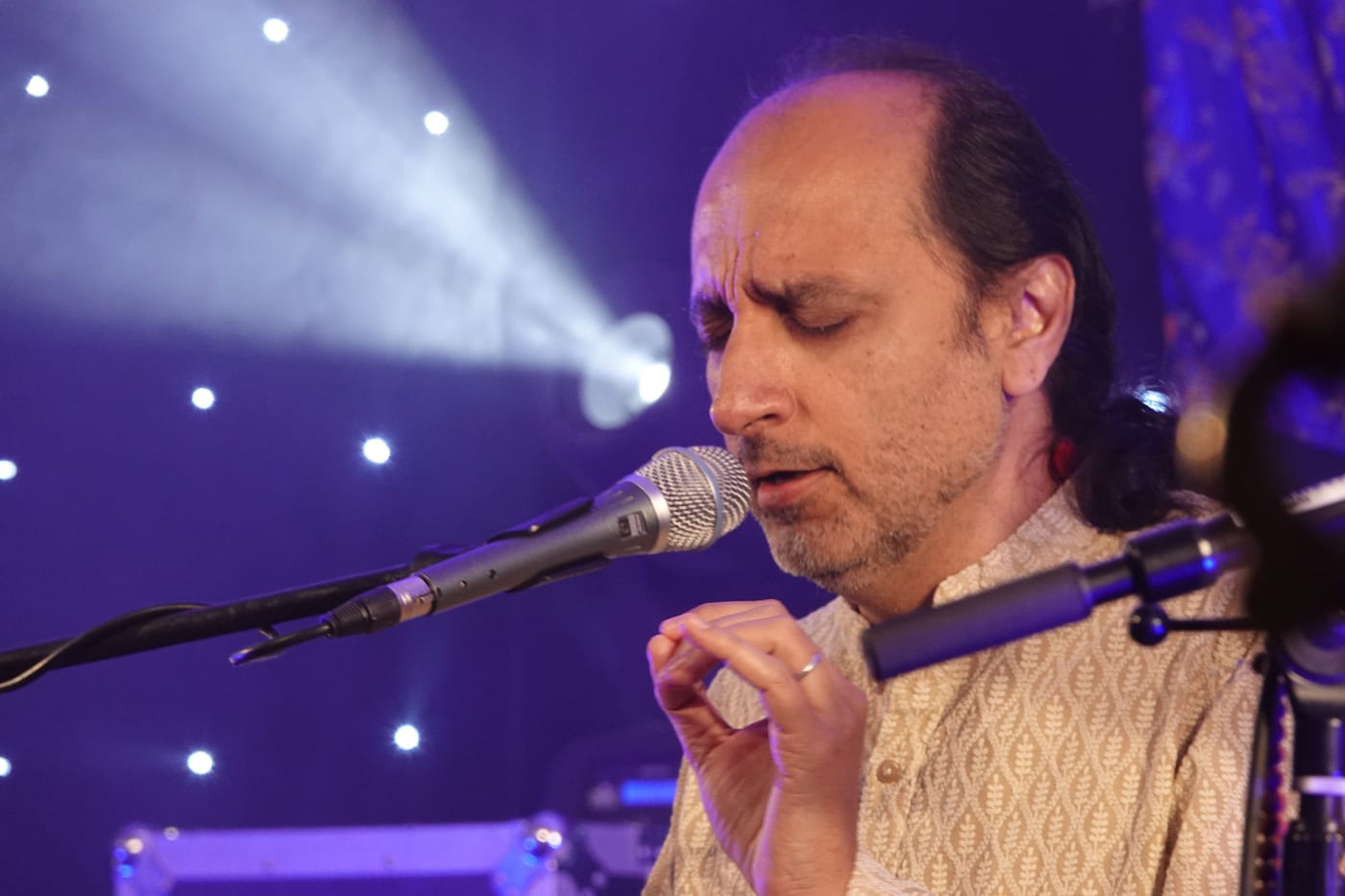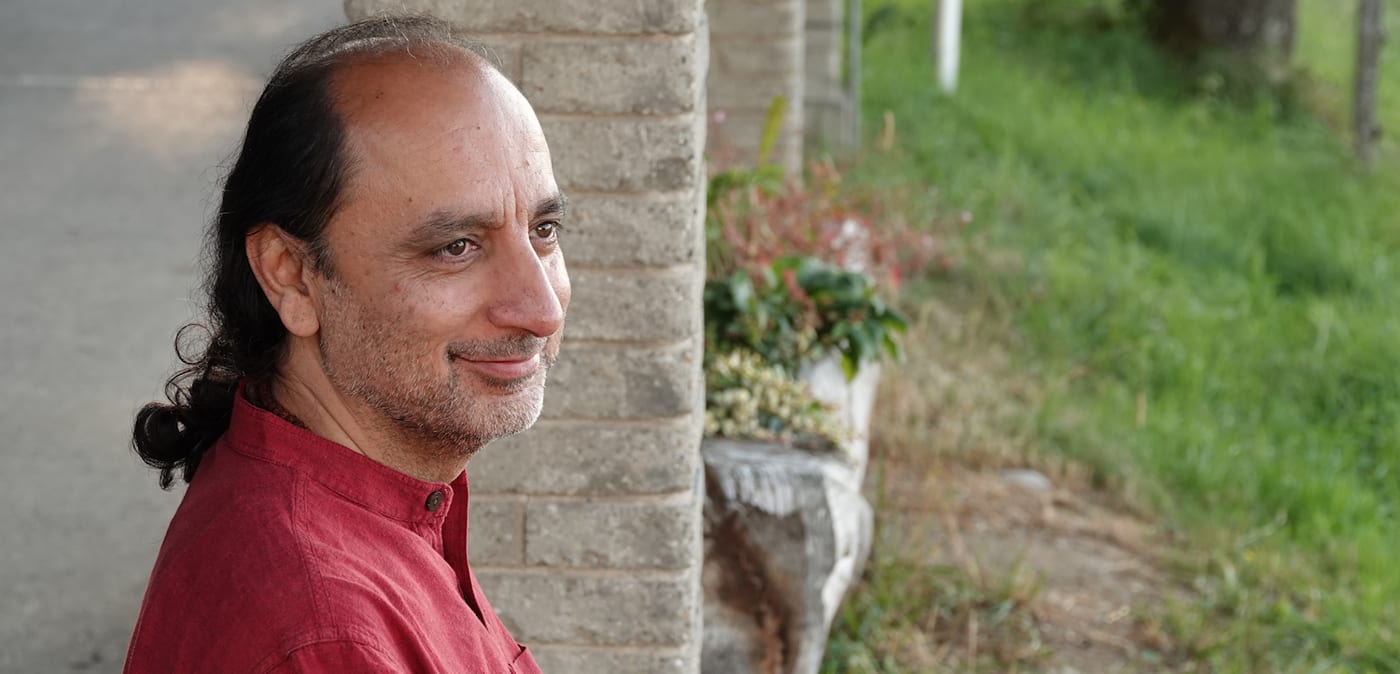

Manish Vyas comes from Gujarat, in western India, and he has learned and played Indian music since childhood. The record of his early years is thin: there are no documented teachers from that period, no named institutions, and no dates. What is clear is that music was not something he came to late. It was the ground he grew up on, and the technical fluency that listeners and reviewers notice in his later work, particularly on tabla and harmonium, rests on that early immersion.
He is a composer, singer and multi-instrumentalist. His voice and his tabla playing sit at the center of much of his recorded output.
Vyas's path moved from Indian music broadly to sacred and devotional music specifically: mantras, kirtan and other expressions of the ancient Indian tradition. The decisive relationship in his story is with his Master. He spent twenty years following this teacher, a long apprenticeship by any measure. At the end of it, he says, the Master told him he was ready to share what had been passed to him.
The bio does not name the Master or a specific lineage, and it would be a mistake to supply one. What it does reveal is the shape of the relationship: years of devotion and study before any authorization to teach. That sequence helps explain the way Vyas talks about his role. He calls himself "just a humble postman," someone who carries a message rather than composes it. Whatever one makes of the metaphor, it is a modest framing for an artist with a substantial body of work.
Vyas's central focus is the intrinsic power of sound, known as naad yoga. In this understanding, sound is more than ornament or accompaniment. It is a medium of practice and transformation. His work treats mantra, chant and raga as living disciplines rather than as pleasant textures for a "world music" playlist.
His own descriptions of his work are wide-ranging. His site lists him as teacher, conductor, podcaster, publisher, blogger, film-maker, producer and presenter of Indian culture. That list is unusually broad, but it points to a consistent impulse: he wants the context around the music, the stories, the science and the cultural memory, to travel with it.
Reviewers describe music that blends Indian pop, folk and poetry and that ranges from dance-floor beats to relaxation, always rooted in Indian tradition. Prem Joshua of Germany has praised his rhythm and melody, and Spuren Magazine in Switzerland has noted his voice and his mantras.
His catalogue is organized into albums and collections that each open a different door into Indian sacred sound:
- Vedic Invocations, which draws on Sanskrit invocation.
- Yoga of Chanting, aimed at chanting as practice.
- Sattva, Shivoham and Salaam e Sufi, which span devotional and Sufi-inflected territory.
- Healing Ragas Collection, which turns to the raga as a vehicle for healing and calm.
- Sufi Splendor, which reaches toward the devotional music of Sufism.
His 2026 album is Devas and Devis, the most recent entry in the catalogue.
Beyond recordings, Vyas is the featured musician in True World of Mantra, an independent documentary filmed across India. The film explores the science of authentic sound and calls for its cultural preservation. His participation fits the larger shape of his work, which is as concerned with keeping a tradition intact as with performing it.
Vyas teaches and performs around the world. He gives concerts, workshops, private and online lessons, and yoga-festival appearances, and he leads retreats. The retreats combine sacred music, mantra, kirtan, pranayama, meditation and stories from India. They are explicitly not courses and give no certificates, which is a telling detail. The emphasis is on experience and transmission, not credentialing. His retreats have taken place in Switzerland, France, Holland, Spain and the Bahamas.
He began conducting them only after those twenty years with his Master, and that timing matters to how the retreats are framed. They are offered as an act of passing something on, not as the launch of a personal brand.
Today Vyas is working across several fronts at once: new recordings, with Devas and Devis arriving in 2026; live performance; online and private lessons; retreats; and the broader educational and media work his site describes. His Spotify following, about 39,000 listeners, suggests a devoted audience rather than a mass one, which is the usual scale for devotional music that asks something of its listeners.
The current chapter looks less like a reinvention than a steady widening of a single idea. The same commitment to the power of sound shows up in the album, the retreat, the documentary and the podcast.
Vyas matters for a few connected reasons. First, he works in a space where sacred music is easily flattened into background ambience, and he insists on the tradition behind it. Second, his range is real: the same musician can make something suited to the dance floor and something suited to deep rest, without severing either from its Indian roots. Third, his work reaches people through several doors at once. A listener might find him through a streaming playlist, a yoga festival, a retreat in Europe or a documentary about the science of mantra.
His audience is largely international: seekers, yoga practitioners and listeners curious about Indian devotional music who want something grounded rather than decorative. For them, Vyas offers a figure who presents himself not as a guru but as a messenger, a postman delivering what he was given.
Whether that humility is a posture or a conviction is for listeners to judge, but the evidence of the work, two decades of apprenticeship, a catalogue built around specific traditions, and a retreat format that refuses certificates, points toward conviction. In a field crowded with quick credentials, Manish Vyas makes a case for the slow route.