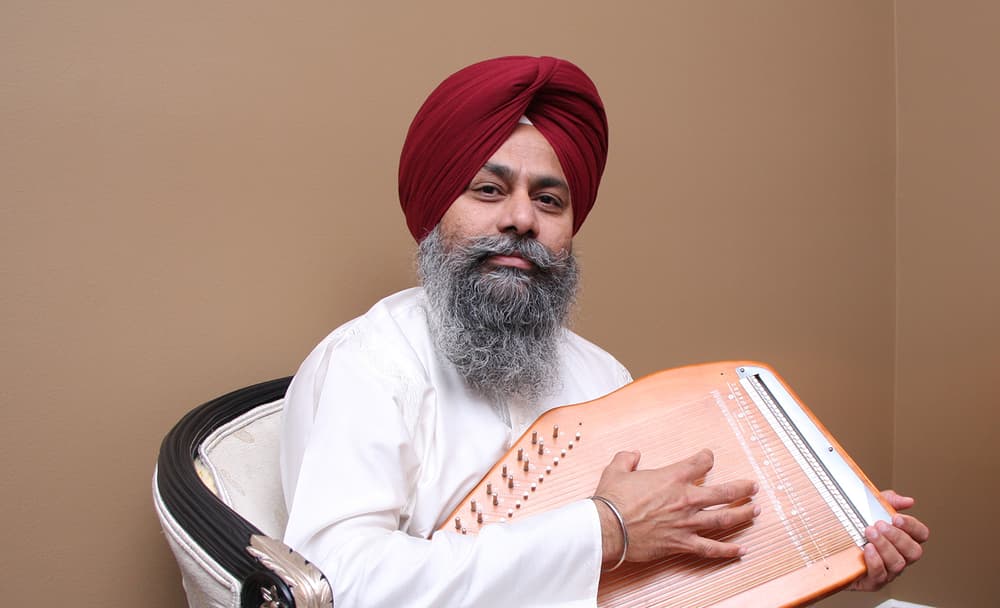
In this discussion of Sikh musicology, Professor Paramjeet Singh explains that Sikh gurus deliberately incorporated classical Indian ragas into the Guru Granth Sahib as a vehicle for spiritual elevation and salvation. However, the practice of gurbani sangeet (sacred Sikh vocal music) requires far more than technical mastery: it demands genuine humility, freedom from ego, proper vocal conditioning across the full range of the voice, and a disciplined understanding of the specific raga structures employed. Singh emphasizes that anyone can develop the capacity to sing devotionally, but only through dedicated study and practice—never through innate talent alone.
Why Did the Gurus Use Ragas for Spiritual Salvation?
The primary architectural decision to embed ragas within the Guru Granth Sahib was deliberate and purposeful. The Sikh gurus recognized that classical Indian musical structures—with their specific melodic frameworks, emotional resonances, and mathematical precision—could function as scaffolding for the human consciousness to reach higher states of awareness and ultimately merge with the divine. Ragas are not merely aesthetic choices; they are spiritual technologies. Each raga carries within it particular emotional and energetic qualities that, when engaged with proper intention, can guide the listener and singer toward transcendence.
The Central Problem: Ego and Musical Skill in Sacred Performance
Professor Singh identifies a profound tension that arises when trained musicians approach gurbani sangeet. When someone has mastered complex musical techniques—difficult rhythmic patterns, wide vocal ranges, intricate compositions—they often develop pride in those accomplishments. Singh notes that many performers who arrive at temples or gurdwaras (Sikh places of worship) begin to focus on displaying their musical prowess rather than channeling divine praise through music. They think: "I can sing what nobody else can sing. I can execute difficult beats. I can do things others cannot do." This pride becomes a spiritual poison. The ego, in other words, becomes a barrier to the very salvation the ragas are meant to facilitate.
The irony is sharp: skill without humility becomes performance rather than prayer. Entertainment replaces devotion. The musician becomes the center of attention instead of serving as a conduit for the message of the Guru Granth Sahib.
What Does It Mean to Remain Humble While Singing Sacred Music?
Singh advocates for a paradoxical stance. A singer must cultivate significant technical competence—good voice quality, command of the raga, proper phrasing, healthy vocal production—and simultaneously embody deep humility. The two are not contradictory; rather, they are complementary. A humble musician maintains self-respect without arrogance. When approaching gurbani sangeet, the internal attitude must be one of prayer, not performance. The singer should imagine themselves praying with the sangat (congregation) rather than demonstrating skills to them.
This is what Singh means when he says musicians must "be very humble every time" and "sing like we are praying." The focus shifts from "How will I impress people with my abilities?" to "How can I best serve this sacred message?" Humility does not mean pretending to lack skill; it means subordinating skill to purpose.
What Is a "Sick Voice" and Why Does It Matter?
Singh introduces a concept that may initially confuse: the "sick voice." He is not referring to laryngitis or physical illness, but rather to voices that have not been properly trained and conditioned. Many popular singers, Singh observes, carry vocal limitations throughout their lives without ever analyzing or addressing them. They compromise with their natural restrictions and never develop their full vocal potential. A sick voice is one with a limited range—perhaps able to sing only in the high register, or only in the middle, or only in the lower depths—without the ability to move freely across the entire vocal spectrum.
For classical gurbani sangeet or any serious musical practice, voice must be healthy—meaning the singer must develop command across the full three octaves (low, middle, high). This is non-negotiable. A performer cannot properly execute a raga if they cannot access all the notes required by that raga's structure. Singh makes an important analogy: "If you are working in a restaurant, you have to make proper food. Even if you are making food at home, you have to make proper food." Whether singing professionally or for personal spiritual practice, the standard does not change.
How Do You Develop a Healthy Voice?
Singh's pedagogical approach is systematic and accessible. The first step is to train the entire vocal range. Students—whether they are six years old or seventy—begin by working on scale exercises across the full voice, establishing what Singh calls "hardcore discipline in the voice system." This foundation work is not optional; it is the bedrock upon which all later musical training rests.
Only after developing a healthy, flexible voice should a student begin to study specific ragas. If the goal is gurbani sangeet, the student must then learn the particular raga (or ragas) in which they intend to sing compositions from the Guru Granth Sahib. This means mastering all the characteristic phrases, the emotional contours, the historical background, and the specific rules of that raga. Singh notes that there are many ragas within the Guru Granth Sahib—Kalyan is one example—and once a student truly learns one raga deeply, they can sing hundreds of compositions within that framework. The learning is cumulative and transferable.
Can Anyone Really Learn to Sing?
Singh firmly rejects the myth of innate musical talent. In Western culture especially, there is a persistent belief that some people are "born with" the gift of voice while others are not. Singh's experience contradicts this. He comes from a musical family and has studied music extensively, but he emphasizes that study and practice are what develop musicianship, not genetics or birthright. Every human being, Singh asserts, has music inbuilt within them. The task is to systematically bring that music to the surface through education and disciplined practice.
This democratization of musical learning is deeply aligned with Sikh philosophy, particularly the teachings of Guru Nanak Dev Ji, which emphasized that spiritual knowledge and capacity are available to all people regardless of social status or background. Singh's approach to music instruction mirrors this ethical principle: anyone with commitment can become a skilled singer and, more importantly, can use that skill as a path toward enlightenment.
What Are the Initial Steps for Someone Starting Out?
For a beginner who wishes to sing gurbani sangeet or any classical music, Singh recommends a clear progression:
- First: Work on vocal health and range. "Delete the sickness from your voice." Develop ability to sing across the full three octaves—down, middle, and high.
- Second: Master the scale (thaat or raga framework) properly. Become comfortable with all the notes and their relationships.
- Third: Choose the specific raga (or ragas) you will focus on. Learn not just the notes, but the phrases, the background, the character, and every detail of that raga.
- Fourth: Begin to compose and sing within that raga, maintaining the internal attitude of prayer and devotion rather than performance.
Singh emphasizes: "Don't go for a lot. Learn small but learn properly." The path is one of depth, not breadth. A singer who masters one raga completely gains far more than someone who dabbles in many.
The Integration of Discipline and Spirituality
What emerges from Singh's teaching is a vision of gurbani sangeet that refuses to separate technical excellence from spiritual intention. In contemporary music practice, these are often treated as separate domains: classical voice training happens in one place; spiritual practice happens elsewhere. Singh insists they are inseparable. Vocal discipline is itself a spiritual discipline. The work of training the voice is the work of purifying the instrument through which divine praise flows.
The ragas function in this integrated framework as both musical structures and spiritual technologies. They are rules—mathematical and emotional frameworks—that guide the singer's consciousness. But rules alone are insufficient. The singer must approach the raga with humility, understanding that the music is not theirs but belongs to a centuries-old tradition and, ultimately, to the divine source.
Where to Go From Here
If you are drawn to gurbani sangeet or Sikh sacred music, begin by finding a qualified teacher who understands both the technical and spiritual dimensions of the practice. Start with foundational vocal training—work on your full range and develop flexibility across your entire voice. Study the history and structure of at least one raga deeply. As you progress, maintain the internal orientation of prayer and service rather than performance and ego. Remember that anyone can develop this capacity through committed study and practice. The raga is not a performance vehicle; it is a spiritual pathway. Your voice, properly trained and humbly offered, becomes an instrument for expressing the profound wisdom contained in the Guru Granth Sahib and for guiding your own consciousness—and that of your listeners—toward higher states of awareness and unity with the divine.


