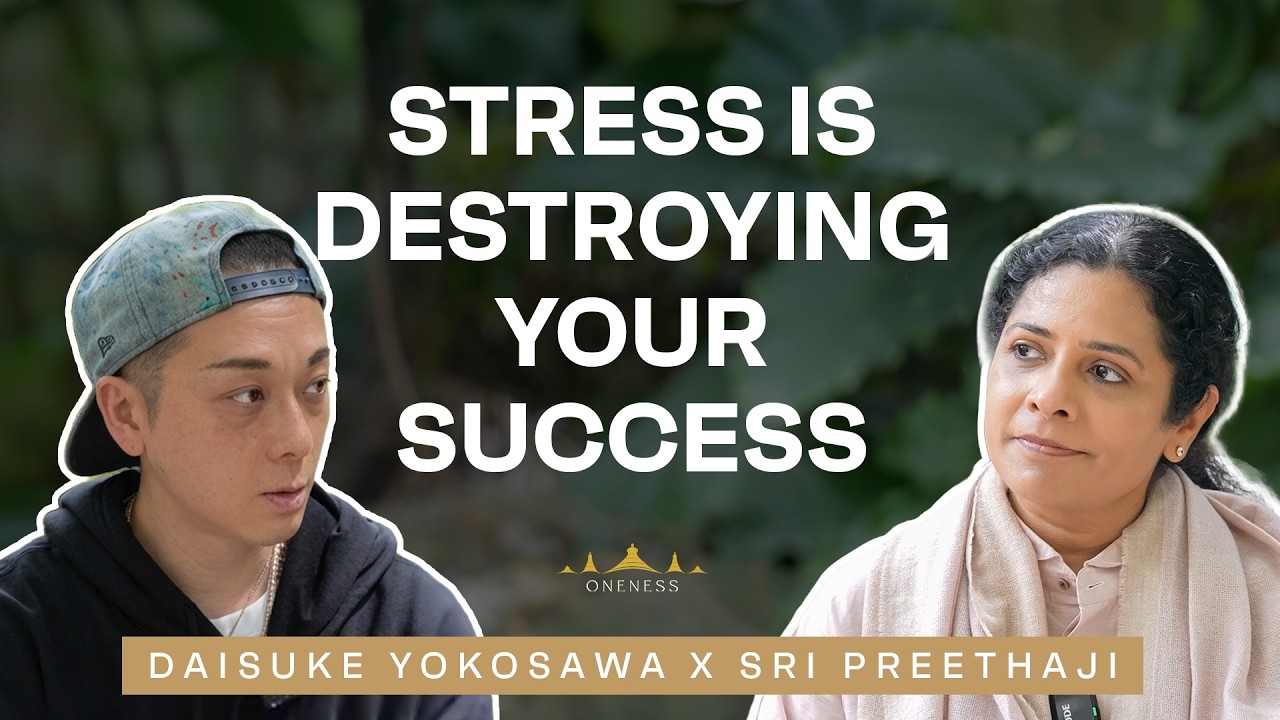
Behind external success often lies silent stress, anxiety, and an exhausting dependence on achievement for self-worth. Sri Preethaji and Sri Krishnaji of the Oneness Movement demonstrate how experiencing oneness—a direct recognition of interconnectedness with all life—fundamentally rewires the relationship with success, wealth, family, and identity. Rather than rejecting achievement, this approach dissolves the neurological and psychological patterns that make success feel like an obligation, transforming how someone experiences both abundance and peace.
The Hidden Cost of Success-Driven Living
The promise of success—financial security, status, recognition—carries an unspoken burden. The pursuit often masks internal struggle: the constant measuring of self against external benchmarks, the fear of losing what has been achieved, the sense that one's worth depends entirely on continuing to perform. This dynamic creates what can be described as a hidden tax on the nervous system. The mind remains in a low-level alert, always scanning for threats to status or security, always calculating the next milestone.
Sri Preethaji and Sri Krishnaji point to a paradox at the heart of conventional success-driven culture: the person who "succeeds" may feel less peaceful than someone with fewer external achievements. Wealth accumulates, but worry does not decrease. Family relationships may suffer because attention is directed toward external validation rather than genuine connection. The body remains tense. The baseline sense of okayness never arrives, no matter what is accomplished.
What Is Oneness and How Does It Dissolve Achievement Anxiety?
Oneness, as taught in the Oneness Movement, is not a philosophical concept but a lived experience—a direct perception of the fundamental interconnection between self and all of existence. It is the recognition that the boundary between "me" and "other" is conceptual, not ultimate. This experience is not merely intellectual; it involves a shift in how the nervous system perceives reality and responds to circumstances.
When someone experiences oneness, the neurological basis for stress-driven ambition begins to dissolve. If one truly perceives that all of life is fundamentally one, then the ego's project of separating oneself through achievement becomes less compelling. There is no one to compete against; there is nothing fundamentally separate to pursue. This does not mean becoming passive or rejecting ambition—rather, action arising from this understanding has a different quality. It is not driven by fear of lack or hunger for validation. It emerges from a place of wholeness already present.
Oneness and Wealth: A Transformed Relationship
One of the most immediate ways people notice change is in their relationship with money and material security. When success is the primary source of identity and safety, wealth becomes psychologically loaded. Losing it feels like losing self. Gaining it never feels like enough because the underlying anxiety about worthiness remains.
Sri Preethaji and Sri Krishnaji teach that when oneness is experienced, wealth becomes a natural byproduct of living rather than the goal itself. Money may still flow, perhaps more freely, because the neurosis around it has relaxed. Action toward creating abundance is no longer contaminated by desperation. The person can receive wealth without it distorting their sense of self, and can face financial loss without it shattering their peace. This is not renunciation—it is freedom within engagement with the material world.
Family Relationships Beyond the Achievement Lens
Success-driven individuals often bring the same pressure-based mentality into family life. They may expect family members to perform, achieve, and validate their own choices. Relationships become transactional: valued for what they contribute to one's status or emotional needs. Children feel the weight of parental expectation. Partners compete for attention with career priorities.
The Oneness Movement's approach addresses this directly. When oneness is realized, relationships are no longer primarily about what the other can do for you or what you can prove through them. Genuine presence becomes possible. Each family member is encountered as an expression of the same interconnected whole, not as a means to affirm the self. This does not require abandoning responsibility or care—rather, care flows naturally from recognition of shared being. The person who experiences oneness often reports that family relationships become simultaneously easier and deeper, with less projection and more authentic connection.
The Body's Release: From Chronic Activation to Baseline Peace
Achievement-oriented living keeps the nervous system in a chronically elevated state. The amygdala is active, scanning for threats. Cortisol remains slightly elevated. Sleep is interrupted by mental planning. The body has learned to associate peace with reaching the next goal—a promise that, by definition, never arrives while the goal is still in the future.
Sri Preethaji and Sri Krishnaji point to oneness as a direct intervention at the neurological level. When the perception of separation collapses, even temporarily, the threat-detection system relaxes. There is no enemy. There is no lack fundamentally present. The body learns that it can be at ease without having earned that ease through achievement. Over time, with practice and deepening experience, this becomes the baseline. Peace is no longer conditional on external circumstances.
Success Without Suffering: Integration Rather Than Rejection
An important aspect of the Oneness Movement's teaching is that this path does not ask people to reject worldly life or achievement. The transformation is not about poverty or withdrawal—it is about changing one's internal relationship to engagement with the world.
Someone living from oneness may continue to build a business, pursue a career, or accumulate resources. The difference is that these activities are no longer fueled by desperation or the need to prove something. They may actually become more effective because the person is thinking clearly, not from a place of anxiety. Decisions are wiser because they are not filtered through the lens of personal threat. Relationships with colleagues and clients improve because genuine presence is possible. Paradoxically, releasing the stranglehold of achievement-hunger often leads to greater actual success—but success that does not consume the person's peace.
How Oneness Addresses the Core Wound Beneath Ambition
At the root of relentless achievement-seeking is often a childhood wound: the sense that love was conditional on performance, or that one's fundamental okayness was in doubt. The Oneness Movement's approach addresses this directly by establishing an experience of unconditional okayness that is not dependent on doing anything. Oneness reveals that existence itself is a gift, not something to be earned.
This is not therapy work alone, though it can integrate with therapeutic process. It is a recognition of a truth that bypasses the entire achievement treadmill: that you already belong, you are already enough, you are already held within something infinitely larger and more fundamentally real than your accomplishments. From this ground, the driven seeking for proof through success naturally releases.
Where to Go From Here
If the relationship between success and suffering resonates, exploring the Oneness Movement's teachings and practices offers a concrete path. The organization provides meditations, retreats, and programs specifically designed to facilitate direct experience of oneness. These are not purely intellectual pursuits—they are meant to be embodied realizations that reorganize how the nervous system perceives and responds to life. For those carrying the silent stress of achievement-driven living, the possibility of genuine peace that does not depend on reaching the next milestone represents a fundamental shift in what it means to thrive.