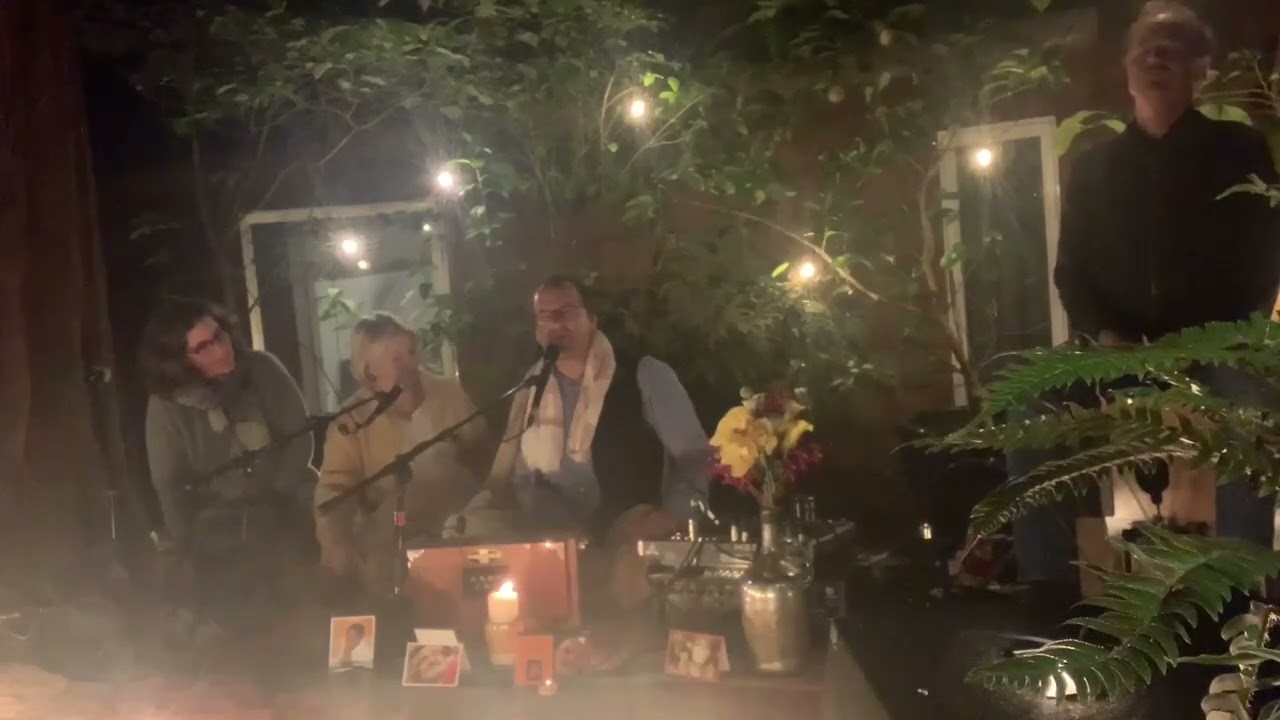
"O Todo Divino Entre Nos"—Portuguese for "The Divine All Among Us"—names something at the heart of kirtan practice: the recognition that the sacred doesn't belong to us individually, but moves through all of us together. Released in April 2014 on Yoga Soundtracks, Volume 1, the track brings together Ben Leinbach, Jai Uttal, Prajna Vieira, and Manose in a four-way collaboration that illustrates how kirtan has evolved beyond solo performance into something more like an ensemble art form, where multiple practitioners serve as one vehicle for an invocation.
Kirtan is call-and-response chanting, often built around Sanskrit mantras or devotional invocations, that emerged from Hindu and Sikh spiritual traditions. For centuries in South Asia, kirtan was a communal practice—a village would gather, a musician would begin a sacred phrase, and others would echo it back, layering voices and devotion into something that belonged to the room rather than to any single person. In the past two decades, this ancient form has been woven into the fabric of Western yoga practice. It appears at the end of classes, at festivals, in recordings designed to support meditation and asana practice. It has become recognized as a legitimate form of devotional singing that doesn't require theological agreement or religious background from participants—only genuine attention and a willingness to join the sound.
What makes kirtan distinct from other spiritual music is precisely this democratic quality. A chanter doesn't need training or experience to participate. The form itself—repetition, call-and-response, Sanskrit syllables that carry centuries of use—creates structure. The job of the musician leading kirtan is not to perform for an audience, but to hold a container that invites others into participation. In this sense, the singer functions less as a soloist than as a facilitator; the real music happens in the collective voice. This is why recordings of kirtan can feel different from other devotional music—they are not asking you to admire the musician's technique, but to add your own voice to an invocation that predates any individual singer.
Multi-artist kirtan collaborations occupy a particular place in this landscape. When one musician leads, the dynamic is hierarchical and clear: there is a guide and there are followers. The leader's voice carries the primary responsibility. When four artists collaborate on a single piece, as they do on "O Todo Divino Entre Nos," the question changes fundamentally. Who is leading? Who is supporting? What emerges when multiple experienced practitioners—each with their own relationship to the material, their own musical training, their own spiritual lineage—choose to come together to sing the same words, to invoke the same names?
The answer lives in the space between them. A four-person kirtan collaboration requires a kind of musical trust that goes beyond technical competence. Each artist must be willing to step back, to create silence where their voice could fill it, to trust that the others will carry what needs carrying. This is not the architecture of a typical ensemble, where instruments have distinct roles (violin here, cello there, drums underneath). In kirtan, everyone is singing the same thing, which means success requires both conviction and surrender—you must know exactly what you're offering while remaining completely open to what the others contribute.
"O Todo Divino Entre Nos" offers a direct answer to these questions of leadership and collaboration. It names the divine as shared, as "between" rather than "within"—suggesting that the sacred isn't something each of us possesses individually, but rather something that exists in the space of communion itself. This is the fundamental promise kirtan makes: that when we chant together, something emerges that wasn't there before, something that belongs to all of us and to none of us. A title like this, in Portuguese, also signals something about the spiritual music community itself—that it has become genuinely international, that practitioners and musicians move across languages and traditions, bringing this ancient form into new contexts and geographies.
Ben Leinbach is known in the world of spiritual music as a percussionist and producer who has worked extensively with kirtan artists and world music ensembles. His presence on a recording signals both musical sophistication and a commitment to serving the spiritual intention rather than pursuing virtuosity for its own sake. Jai Uttal has become a central figure in bringing kirtan and devotional singing into Western yoga communities, recognized for decades of dedicated practice and teaching in this form. Prajna Vieira and Manose complete the ensemble, each bringing their own musical and spiritual training to the recording, contributing voices and presence to a shared invocation.
The fact that this piece appears on Yoga Soundtracks, Volume 1 positions it within a specific functional context. Yoga soundtracks serve a different purpose than concert recordings or studio albums meant for listening. They exist to support yoga practice—to create sonic space for movement and breath and inward attention. When a teacher plays music during a yoga class, that music is meant to be almost invisible; it should drop the student into a state of focus without the student noticing the moment the ordinary world fell away. Yoga soundtracks, if they work well, are felt rather than heard.
What does it mean to record devotional music for this purpose? It means the musicians must balance intensity with restraint, must create something that can hold a room's practice without drawing that practice back out toward entertainment. A four-person kirtan collaboration recorded specifically for yoga soundtracks faces this challenge multiplied: each artist must trust the others completely, must understand that stepping back is not less important than stepping forward, must serve the shared invocation rather than stand forward in it as an individual. The album itself represents a trend in the early 2010s toward creating dedicated sonic spaces for yoga and meditation—recognizing that how we practice our physical asana is inseparable from the quality of attention we bring to it, and that music can either support or fragment that attention.
The release date—April 2014—places this recording at a specific moment in the evolution of kirtan in the West. By 2014, kirtan had moved from niche practice to something recognizable within mainstream yoga spaces. Albums and soundtracks were becoming common. But the collaborative form was still relatively fresh; it wasn't yet the default to bring multiple established artists together on a single track. That this recording exists, that it has accumulated over 69,000 views on YouTube, suggests both that there was genuine hunger for this kind of work and that these four musicians understood how to deliver it—how to create something that serves practitioners rather than displays individual artistry.
If you're drawn to kirtan as a practice, begin with listening rather than singing. Notice what happens when you hear multiple voices invoking the same sacred name. Pay attention to the moments of silence between phrases, the places where the music seems to breathe and hold space. If you practice yoga, consider attending a class that includes kirtan, or seek out recordings from this period—the early 2010s produced a rich body of kirtan collaborations as the form was finding its place in Western studios and homes. Listen to how different musicians approach the same mantras. Notice whether you feel invited to join or held at a distance. Consider what "the divine all among us" means as an actual experience rather than a poetic phrase. That's where the real work lives—not in understanding kirtan intellectually, but in discovering what your own voice adds to the collective sound.