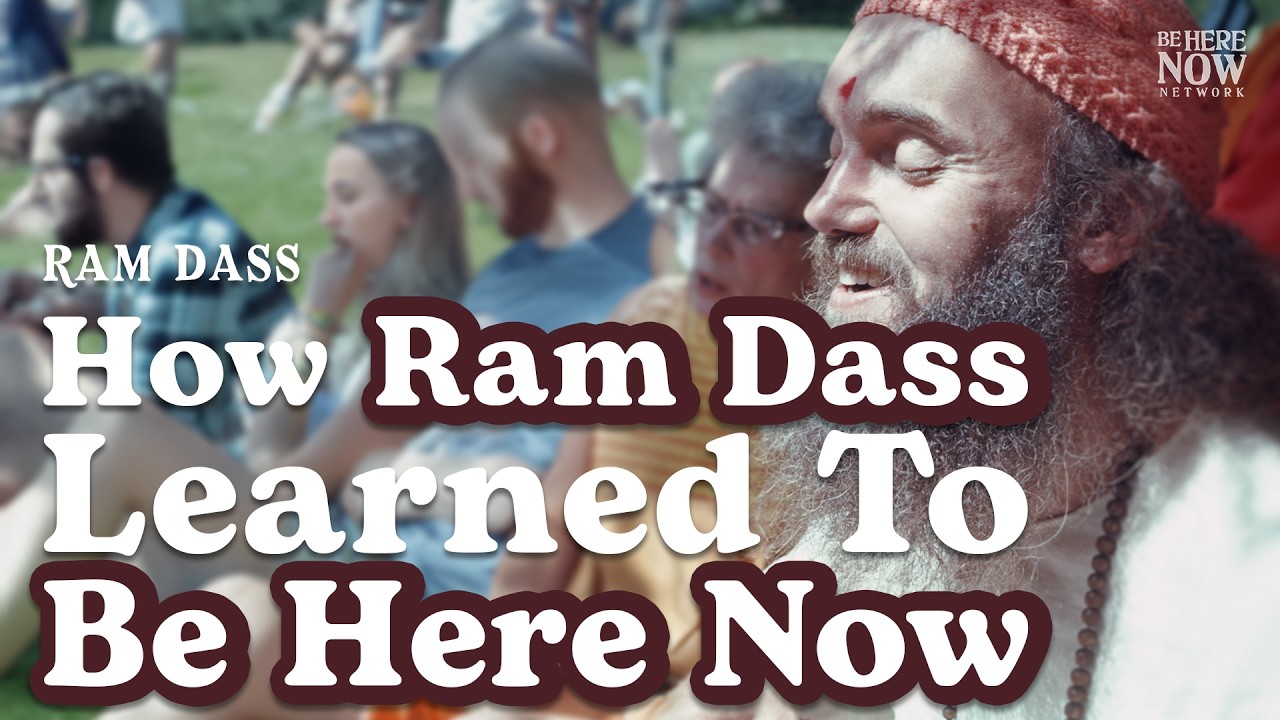
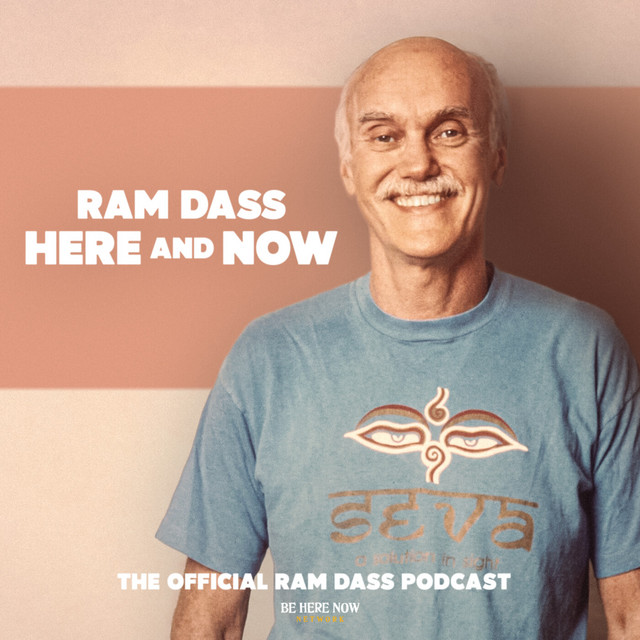
Across five decades, Ram Dass articulates a vision of love not as romantic feeling but as a spiritual path of the heart. He moves from describing love as immersion (falling into a bathtub of love) to outlining its developmental stages, from ego-based attachment to boundless devotion. Central to his teaching is a paradox: methods for loving don't work unless they trap you, and the deprivation model that keeps us hungry must be replaced by an abundance model. Love is both the deepest teaching and the deepest trap—and this is precisely why it works.
What is love in the spiritual sense?
In 1969, Ram Dass recounts a pivotal LSD experience in which he encountered what he calls the true nature of love. Rather than defining love as emotion or relationship, he describes it as immersion—a falling into "a bathtub of love." This image is deceptively simple: it suggests not grasping or doing, but rather being submerged, surrounded, held. Love, in this framing, is not something one falls into romantically with another person. It is a state of consciousness itself.
He places this insight in relation to his guru, Meher Baba, whom he describes as "the personification of pure love." This is significant: Ram Dass is not talking about love as a feeling between two people, but as a manifestation of being—a way a realized being relates to existence itself. The path of the heart, then, is not about finding the right partner or perfecting your relationship. It is about reorganizing your consciousness to align with love as the fundamental nature of reality.
What are the stages of falling in love?
By 1979, when addressing the Christian Community of San Francisco, Ram Dass had systematized his understanding into distinct developmental stages. He emphasizes that "when you really fall in love, it just opens and opens and opens, and you just don't know where to hold on anymore." This escalation is crucial. Love is not static; it is kinetic, expanding, vertiginous.
The predicament he identifies is that lovers become unmoored. The ego has structured the world in a particular way—with boundaries, safe spaces, controlled outcomes. Love obliterates this architecture. Each stage deepens the dissolution of the self's defenses. What starts as attraction becomes surrender becomes vastness. This is why, he suggests, the path of the heart is devotional by nature. Devotion means giving up control, and in that giving up lies both terror and liberation.
How does conditional love keep us trapped?
By 1986, Ram Dass addresses what he calls "conditional love" and the "deprivation model." This model is the operating system most humans inherit: the belief that love is scarce, that you must earn it, that it can be taken away, that there is never enough. The deprivation model is built into the nervous system from childhood—every moment a parent withheld love, every moment attention was conditional on performance, the message was encoded: love is not your birthright; it must be secured.
From this model emerges conditional love: you love someone if they meet your needs, if they make you feel good, if they do not threaten your ego. This is not actually love; it is transactional exchange. The spiritual work, Ram Dass argues, requires a fundamental shift: "You change from the deprivation model to the model there's an abundance of [love]." In an abundance model, love is not something you must acquire or protect. It is something you have access to, something you can give freely because it is not running out.
This shift is not intellectual. It requires reconditioning the nervous system, rewiring years of scarcity programming. The path of the heart demands that you grieve what you did not receive and then recognize that what you sought outside was always already available within. Love becomes not something you get from another person, but something you recognize, amplify, and share.
What does it mean that methods are traps?
In the 1990s, Ram Dass turns to the I Ching and describes human beings as "hungry ghosts" prone to addiction—particularly addiction to the methods of love. A method is a technique, a practice, a way to cultivate or reach a state. Meditation is a method. Visualization is a method. Mantra is a method. And here is the paradox he articulates: "all methods are traps" and yet "the bizarre thing about methods is they don't work unless you get trapped."
This is not a dismissal of practice. It is something far more sophisticated. Methods do not work through intellectual understanding or passive belief. They work because they structure attention and intention in such a way that you become absorbed in them. You forget yourself in the practice. In that forgetting, the ego's defenses relax, and something else can emerge. But the moment you realize you are "using" a method—performing it, checking whether it is working, wondering if you are doing it right—the trap dissolves and the method becomes ineffective.
The spiritual path, especially the path of the heart, is thus inherently paradoxical. You must commit fully to a method while knowing that methods are ultimately illusory. You must use the raft to cross the river and then leave it behind. But you cannot leave it behind until you have fully entered it. This is why Ram Dass speaks of being trapped: real transformation requires that you stop examining the method and simply be the method. Love works the same way. You cannot love conditionally while simultaneously calculating whether it is safe to do so. You must fall in completely.
What is the relationship between love and abundance?
Implicit throughout Ram Dass's teaching is a reframing of what abundance means. In the deprivation model, abundance is having enough of what you want. In the abundance model he proposes, abundance is recognizing that the fundamental nature of existence is generous, overflowing, self-renewing. Love is not quantifiable. There is no fixed supply. The more you give, the more available it becomes. This is not metaphorical; it is an actual shift in perception and nervous system response.
Someone raised in the deprivation model may have learned that showing love makes you vulnerable, that giving too much will exhaust you, that you must guard your emotional energy. These beliefs are protective—they kept you safe when you were small and dependent. But they also keep you locked in a condition of underlying fear. The abundance model, by contrast, is based on recognition: there is more love available than you could ever give, more than you could ever exhaust. The more you access it, the more real it becomes.
This is not Pollyannaism. Suffering exists. Loss exists. Betrayal exists. But these are not evidence that love is scarce. They are part of the landscape through which love moves. The path of the heart is not a path that avoids pain; it is a path that moves through pain without collapsing into despair or contraction. It is a way of loving that includes everything, because the heart is not fragile—it is vast.
What makes the path of the heart devotional?
Throughout these teachings across decades, Ram Dass consistently points toward the devotional nature of the heart's path. Devotion is a specific orientation: it is not faith (belief in something), but rather a surrendering of the will to something recognized as larger, wiser, more beautiful than the ego. The object of devotion need not be a person or deity. It can be love itself, reality itself, the unfolding of existence.
What makes devotion powerful is that it bypasses the reasoning mind. The ego loves to figure things out, to maintain control, to understand before committing. Devotion inverts this: it commits before understanding. It says yes to the opening even when the mind is terrified. This is why Ram Dass speaks of the predicament—when you really fall in love, you don't know where to hold on anymore. There is nothing to hold onto. You are in freefall. And in that freefall is liberation.
The devotional path of the heart is thus a training in trust. It is learning to trust that the dissolution of the ego's boundaries is not death but awakening. It is discovering that the love you feared would destroy you is actually what sustains you. This cannot be believed; it can only be lived.
Where to go from here
Ram Dass's teachings across these five decades offer a map for moving from ego-based attachment through the stages of love toward unconditional devotion. The immediate work is twofold: First, notice the deprivation model in operation in your own nervous system. Where do you believe love is scarce? Where do you love conditionally? Where do you withhold because you fear running out? Second, begin to experiment with small acts of unconditional giving—not martyrdom, but genuine generosity—and observe what happens in your nervous system when you release the outcome. Does contraction follow, or expansion? These observations are not theory; they are data about your own consciousness.
The longer work is the cultivation of a consistent practice that traps you in devotion. This might be meditation, mantra, service, or a contemplative relationship. The practice matters less than your willingness to be trapped by it, to let it reshape your sense of self and other. As you deepen this work, you may find that the boundaries between "you" and "love" become increasingly porous. This is the point. The path of the heart ultimately dissolves the one who seeks into the love that was always the real seeker.