SportsCampFinder

Browse All Camps

Find the perfect camp for your athlete

camps

Basketball Camps
Soccer Camps
Baseball Camps
Football Camps
Volleyball Camps
Lacrosse Camps
Multi-Sport Camps
Elite Training
Overnight Camps
Day Camps
Popular Destinations
BaliSedonaLos AngelesCosta RicaNew YorkSan FranciscoAustinMiamiJoshua TreeTulum
View All CategoriesView All Destinations

Explore All Features

Powerful tools to grow your events

Platform Features

Smart Dynamic Pricing
Ticket Categories
Assigned Seating
Abandoned Cart Recovery
Visitor Recovery
Donations & Sliding Scale
Affiliate Engine
Ticket Scanner
Coupon Codes
Custom Questions
Ticket Sharing
Upsells & Add-ons
Analytics & Reporting
Email Sequences
Waitlist / Notify / Remind
People & Places
Camp OrganizersCamp FacilitiesKnowledge BaseInspiration
View All FeaturesAbout Us
PricingBlog
Language
Saved events
Browse All Events

camps

Basketball CampsSoccer CampsBaseball CampsFootball CampsVolleyball CampsLacrosse CampsMulti-Sport CampsElite Training

Popular Destinations

BaliSedonaLos AngelesCosta RicaNew YorkSan Francisco

People & Places

Camp OrganizersCamp FacilitiesKnowledge BaseInspiration

Platform Features

Smart Dynamic PricingTicket CategoriesAssigned SeatingAbandoned Cart RecoveryVisitor RecoveryDonations & Sliding ScaleAffiliate EngineTicket ScannerCoupon CodesCustom QuestionsTicket SharingUpsells & Add-onsAnalytics & ReportingEmail SequencesWaitlist / Notify / Remind
View All FeaturesAbout Us
PricingBlog
Log inParents & athletesCamp directors
  • Browse all camps
  • Basketball Camps
  • Soccer Camps
  • Baseball Camps
  • Football Camps
  • Volleyball Camps
  • Lacrosse Camps
  • Multi-Sport Camps
  • Elite Training
  • All sports →
  • Orlando
  • Los Angeles
  • New York Metro
  • Dallas / Fort Worth
  • Chicago
  • Phoenix / Scottsdale
  • Atlanta
  • Denver
  • Seattle
  • Boston
  • Houston
  • Philadelphia
  • San Diego
  • Minneapolis / St. Paul
  • All Cities →
  • List your camp
  • Camp director dashboard
  • Pricing
  • Coaches & academies
  • Online registration & payments
  • Waivers & medical forms
  • Check-in app
  • Family messaging
  • Waitlist & notify
  • Camp marketing
  • Reports
  • All features →
  • About SportsCampFinder
  • Camp guides
  • Help Center
  • Contact
  • Careers
  • Press
  • Terms of Service
  • Privacy Policy

Camps

  • Browse all camps
  • Basketball Camps
  • Soccer Camps
  • Baseball Camps
  • Football Camps
  • Volleyball Camps
  • Lacrosse Camps
  • Multi-Sport Camps
  • Elite Training
  • All sports →

Destinations

  • Orlando
  • Los Angeles
  • New York Metro
  • Dallas / Fort Worth
  • Chicago
  • Phoenix / Scottsdale
  • Atlanta
  • Denver
  • Seattle
  • Boston
  • Houston
  • Philadelphia
  • San Diego
  • Minneapolis / St. Paul
  • All Cities →

For Camp directors

  • List your camp
  • Camp director dashboard
  • Pricing
  • Coaches & academies

Features

  • Online registration & payments
  • Waivers & medical forms
  • Check-in app
  • Family messaging
  • Waitlist & notify
  • Camp marketing
  • Reports
  • All features →

Company

  • About SportsCampFinder
  • Camp guides
  • Help Center
  • Contact
  • Careers
  • Press
  • Terms of Service
  • Privacy Policy
SportsCampFinder
© 2026 SportsCampFinder. All rights reserved.
Inspiration

Kirtan Beyond Tradition: How Western Musicians Reshape Chanting

Dave Stringer
Dave Stringer
Feb 6, 2015
9 min read
Watch · 8

Dave Stringer describes an unlikely path into kirtan—hired by an ashram to edit videos after appearing in someone's meditation—and how a year and a half in India taught him yoga philosophy while nine-year-olds taught him chanting. The real struggle began when his Western impulse to express individuality collided with the Eastern principle of dissolving ego into collective sound. Rather than abandon either tradition or innovation, Stringer brought professional Western musicians into the kirtan world, expanding the musical form while wrestling with institutional gatekeepers, the tension between harmony and unison, and what it means when people mishear mantras and find their own spiritual meaning in the mistake.

Read · 6 sections

How Did a Hollywood Worker End Up as a Kirtan Singer?

Stringer's entry into kirtan reads like spiritual accident. He was working in Los Angeles when someone he had helped find a job called with an unusual proposal: an ashram in India needed a video editor and filmmaker. The woman told him she had meditated on who to recommend—and he appeared in her vision. "That seemed preposterous and ridiculous to me but at the same time strangely compelling," Stringer recalls. He accepted, expecting a short assignment. Instead, he spent a year and a half at the ashram, initially editing spiritual talks by various teachers into condensed versions for yoga beginners. This work gave him an intensive education in yoga philosophy and tradition, positioning him as the "perfect person to digest that" material precisely because he had no prior expertise to unlearn.

During this time, Stringer also taught at a village school the ashram operated. An old harmonium sat in his classroom, and the nine-year-old students—all fluent in Sanskrit chants—became his first teachers. "Basically a bunch of nine-year-olds taught me kirtan," he says, "which was kind of an unorthodox way of dealing with it but a very joyful one." This unconventional training grounded him in the felt experience of chanting before he encountered the doctrinal and institutional dimensions that would later create friction.

What Happens When Western Musical Ego Meets Eastern Dissolution?

The ashram eventually invited Stringer to participate formally in group chanting, and this is where the real education—the difficult one—began. He encountered a fundamental philosophical opposition: "In Eastern music the idea is to get rid of yourself. In Western music the idea is to express yourself." Ecstatic traditions in the West celebrate the soloist, the individual voice, harmony singers in choirs. But in Indian music, particularly kirtan, the goal is the opposite. "You're asked to completely give up, you know, me, mine, and any need of individual expression. The idea is to join your voice into a much bigger oneness."

For Stringer, trained unconsciously in Western musical values, this collision created constant friction. He kept breaking into harmony—a natural instinct in Western gospel and soul traditions—only to encounter resistance. Indian music has no concept of harmony in the Western sense; the aesthetic principle is that voices merge and blend rather than layer into chords. "To break into harmony it seems perfectly spiritual," Stringer notes wryly, "so we had to deal with a certain tension."

Beyond musical differences, Stringer encountered what he calls "the church lady"—"a universal fact of like all spiritual organizations." This is the institutional gatekeeper, usually given some authority but little actual knowledge or attainment, charged with enforcing rules. No matter what you do or how you progress, Stringer observes, "you're going to have to tangle with the church lady who no matter what you do is going to tap you on the shoulder and say well currently this is not the way that we're doing it." For him and others, this dynamic brought up deep material. "It's not a pretty process," he says. At one point, he recalls, there was "a volcano of rage about every restriction that I was put in." Yet he also understood the ashram's purpose: "What the ashram was trying to do was to train me to serve the chant, and that was a beautiful thing. The outcome of that was beautiful. The process of that was extremely messy."

Why Did Stringer Invite Professional Western Musicians Into Kirtan?

While still in India, Stringer had begun imagining how to advance the art of kirtan itself. "From an Indian perspective they already kind of had their style. I had to come back to Los Angeles to start to propel that style along." Rather than try to perfect the traditional form, he chose a different path: he invited professional Western musicians—friends who stood outside the yoga world—to collaborate on kirtan music.

Most of these musicians knew no Sanskrit and had no yoga background. But they brought something essential: familiarity with gospel, funk, and soul traditions—musical forms that were, like kirtan, participatory and ecstatic. Stringer used this common ground to reconceive kirtan. "We started to conceive of kirtan as another form of gospel or funk or soul, one that was participatory." This move was radical because it foregrounded a different set of values: musicianship, arrangement, groove, and the Western idea of expression—things the ashram had asked him to transcend.

At first, Stringer apologized to professional musicians for the simplicity of kirtan. But as he examined it more closely, he realized it was far more demanding than he initially suggested. "When you start to look under it, it's a very elastic and very challenging musical form, particularly the way that I practice it." The chants speed up over time, which means musicians must continuously rearrange the piece to maintain musical interest. Western drummers, for example, are trained to lock into a groove and hold it steady. But in kirtan as Stringer practices it, "the whole idea is to move the groove and to keep changing it." This created what he calls "a very interesting problem" for excellent musicians accustomed to different rules.

The result: by bringing professionals into the studio and on stage, Stringer created a challenging experience "for everybody." He hopes he has "done something to expand the musical lexicon of kirtan in the process," though he acknowledges it is "hard to say" what the long-term impact will be.

What Is the Role of Meaning in Mantras?

One of Stringer's most provocative observations concerns what mantras actually mean. "It's hard to say what these mantras mean, and in fact they're meant to take us beyond a place of meaning," he explains. This intentional elusiveness attracts him: "Their nonsensical quality is one thing that attracts me to them." Mantras work through sound and vibration, not through semantic content. "There are things that can't be conveyed perfectly by words," Stringer notes.

This insight shapes his approach to lyrics. His first album, Brink, includes wordless passages—not invented language, but "a spontaneous outpouring." People write him regularly claiming to know the exact words he sang in these sections, asking what he meant by particular phrases. His response: "I didn't write any words. You're reporting back to me on the words that you heard in your own head." Rather than insist on correct pronunciation or interpretation, Stringer asks a deeper question: what if the "mishearing" is itself the point?

He considers a provocative compositional strategy: release wordless recordings first, collect what people think they heard, then record new versions using the words listeners projected onto the sound. This would be "another way of composing things," one that honors the imagination and inner experience of the listener rather than enforcing doctrinal precision.

What Does It Mean When Someone Mishears a Mantra?

Stringer recounts a telling example. Someone heard "Ganesha" (the elephant deity invoked for removing obstacles) as "gonna party on." Rather than dismiss this mishearing as a failure of devotion, Stringer asked himself: "What am I supposed to say to that? How am I supposed to touch that? You can't say that's wrong because this person was having a great experience." The person who heard "gonna party on" had their own spiritual opening; the person singing "Ganesha" had theirs. Both are valid.

This non-dogmatic stance disturbs some practitioners. "I realize some people are probably thinking that I should be, you know, my God, he's not terribly devotional about this." But Stringer responds from both Buddhist and yogic standpoints. The Zen saying "if you meet the Buddha on the road, kill him" suggests attachment to forms can become an obstacle. From yoga, the real work is not perfection of external technique but the quality of surrender you bring to whatever you're doing—whether it's a pose in asana or singing in a room full of people.

Where to go from here

Stringer's experience suggests several directions for anyone exploring kirtan or sacred music practice. First, understand that the collision between Western and Eastern values in chanting is not a problem to solve but a creative tension to explore. The impulse to express individuality and the goal of ego-dissolution need not be enemies; instead, they can generate new forms.

Second, recognize that institutional gatekeeping—the "church lady" phenomenon—exists in all spiritual communities and is worth examining rather than simply resisting. The ashram's intention to train Stringer to serve the chant was beautiful; the messy process of discipline and restriction had real value, even if it provoked rage.

Third, consider what happens when you invite trained musicians from outside a tradition into sacred practice. Rather than diluting authenticity, this can expand the musical and spiritual vocabulary available to practitioners. The tension between tradition and innovation mirrors the tension between ego and dissolution—worth holding rather than resolving.

Finally, Stringer's stance on mishearing and misinterpretation raises a crucial question for any contemplative practice: Is the goal to enforce correct understanding, or to create conditions where each person's interior experience is honored? There may be no single answer, but the question itself is worth sitting with.

Comments

Loading the conversation…

Transcript

[0:00] I found myself being a kirtan singer

[0:03] because I was hired by an ashram to go

[0:05] to India and make some videos for them

[0:07] and I got that job because I appeared in

[0:11] somebody's meditation which is maybe the

[0:13] weirdest job interview ever I got a call

[0:15] from somebody saying hi do you remember

[0:18] me it was somebody I had helped get a

[0:20] job for and she said you know I was with

[0:24] a particular Guru in India and they

[0:26] needed to hire somebody to come and make

[0:28] some videos for them

[0:31] and they asked her if they knew anybody

[0:33] in Hollywood who should come and she sat

[0:36] to meditate and that person was me so

[0:38] that seemed Preposterous and ridiculous

[0:40] to me but at the same time

[0:43] strangely compelling so I ended up in

[0:46] India for what turned out to be a year

[0:48] and a half editing videos and mostly

[0:52] what they gave me to do were Talks by

[0:54] different teachers and I was asked to

[0:57] condense those down into short versions

[0:59] for people who were beginners to yoga

[1:01] which I was so I was kind of the perfect

[1:03] person to digest that and I found at the

[1:05] end of a year and a half I'd fully taken

[1:08] in a lot of information about

[1:11] uh the ideas and traditions of yoga and

[1:14] was able to you know speak back about

[1:16] them in a knowledgeable way as I began

[1:19] to get involved in the music

[1:21] of of chanting uh the first experience

[1:25] that I had is that uh aside from editing

[1:28] films for the ashram I was teaching

[1:30] school in the Village School that they

[1:32] operated and there was an old harmonium

[1:34] there and so I had a lot of free time to

[1:37] play around with it and the children

[1:39] that I was teaching knew a lot of chance

[1:41] we would sing every day in school and

[1:44] basically a bunch of nine-year-olds

[1:46] taught me Cureton which was kind of an

[1:49] unorthodox way of dealing with it but a

[1:51] very joyful one as word got around in

[1:54] the ashram that I could sing and play

[1:56] they started to invite me formally to be

[1:58] involved in the chants and that's when

[2:01] the trouble started

[2:03] um

[2:05] it's a principle of Eastern music it

[2:08] seems in opposition to Western music

[2:10] that you

[2:12] in eastern music the idea is to get rid

[2:14] of yourself

[2:16] in western music the idea is to express

[2:18] yourself and our ecstatic Traditions

[2:22] here honor you know The Soloist the

[2:25] individual uh the harmony singer in the

[2:28] choir Etc and uh in Indian music and

[2:31] particularly in cure time you're asked

[2:33] to completely give up you know me mine

[2:36] and any need of individual expression

[2:38] the idea is to join your voice into a

[2:41] into a much bigger Oneness and uh and so

[2:45] to express the intention of of of the

[2:48] Divine or what is a unifying force for

[2:51] us to do that is liberating but it's

[2:54] also very excruciating when you first

[2:56] are involved in it because you have all

[2:58] these Western impulses of things that

[3:00] you want to do in ways that you want to

[3:01] express yourself I for example kept

[3:03] breaking into Harmony and they kept

[3:05] being offended by that you know and um

[3:08] because Indian musical tradition doesn't

[3:11] have a concept of Harmony the idea is

[3:13] that everybody merges in and out of this

[3:16] one whereas Isis singing gospel choirs

[3:19] and so to break into harmony it seems

[3:21] perfectly spiritual so we had to deal

[3:24] with a certain tension and I kept

[3:27] encountering what I would call the

[3:28] church lady who I think is a universal

[3:30] fact of like all spiritual organizations

[3:33] this is a person who um is somehow

[3:36] charged with uh given some Authority

[3:39] although

[3:40] precious little actual knowledge and

[3:43] whatever your attainments are whatever

[3:45] your issues are you're going to have to

[3:46] tangle with the church lady who no

[3:48] matter what you do is going to tap you

[3:49] on the shoulder and say well currently

[3:50] this is not the way that we're doing it

[3:52] and um

[3:54] for me and for many other people that

[3:56] brings a lot of stuff up you know it's

[3:57] not a pretty process and I understood

[3:59] that what the ashram was trying to do

[4:01] was to train me to serve the chant and

[4:04] and that was a beautiful thing

[4:06] um the the outcome of that was beautiful

[4:09] the process of that was extremely messy

[4:12] a lot of things came up and there was

[4:14] one point in time when I think it was

[4:15] just a volcano of Rage about every

[4:17] restriction that I was put in a lot of

[4:19] the time when I was living in India part

[4:21] of what I was wrestling with is I had a

[4:23] lot of ideas about how I wanted to

[4:25] advance the art of kirtan and um from an

[4:30] Indian perspective they already kind of

[4:31] had their style I had to come back to

[4:33] Los Angeles to to start to propel that

[4:36] style along I've always had friends who

[4:38] were professional musicians who were

[4:40] standing outside of the yoga world and

[4:42] it it felt very natural at the beginning

[4:45] to just invite them into my process

[4:47] usually they're interested in different

[4:49] forms and most of them didn't know a

[4:52] word of Sanskrit but I would say hey why

[4:54] don't you come sing on this thing and

[4:55] they were interested we started to

[4:57] conceive of kirtan as another form of

[5:00] gospel or Funk or Soul one that was

[5:03] participatory and so to have singers

[5:05] that already had that feeling

[5:08] involved also in advance The Narrative I

[5:12] used to apologize to people thinking

[5:14] this was really simple you know to my

[5:16] professional musician friends going oh

[5:17] you know it's just it's just keraton you

[5:19] know

[5:20] uh but the thing is when you start to

[5:22] look under it it's a very elastic and

[5:24] very challenging musical form

[5:25] particularly the way that I practice it

[5:29] the chance speeds up over time and which

[5:32] means that every time it comes around

[5:34] the musicians are challenged to arrange

[5:37] the piece a little bit differently to

[5:39] propel the musical interest along and

[5:42] drummers for example in the west are

[5:45] trained to hold the lock into a Groove

[5:47] and hold it yet in kirtan the whole idea

[5:50] is to move the groove and to keep

[5:51] changing it so I found that a lot of

[5:53] really excellent drummers saw this as a

[5:56] very interesting problem because it was

[5:58] outside of their realm of experience so

[6:00] as it turned out by asking professionals

[6:02] to play on my records and play in my

[6:05] bands

[6:06] um it turned out to be a challenging

[6:09] experience for everybody and I hope that

[6:11] I've done something to expand the

[6:15] musical lexicon of Puritan in the

[6:18] process

[6:19] it's hard to say what these mantras mean

[6:22] and in fact they're meant to take us

[6:24] Beyond a place of meaning so they're

[6:26] nonsensical quality is one thing that

[6:29] attracts me to them

[6:31] there are things that can't be conveyed

[6:34] perfectly by words and there's also it's

[6:37] interesting to see what people get from

[6:39] it I can understand why not to print the

[6:41] lyrics

[6:43] um if you're singing with a certain

[6:45] amount of Freedom what those actual

[6:47] words are can be blurred anyway and what

[6:50] shows up in people's minds is possibly

[6:53] more interesting my first record Brink

[6:55] has a number of things on it that are

[6:57] wordless and uh they're not so much an

[7:01] invented language as a just a

[7:02] spontaneous outpouring and then people

[7:04] write me all the time you know like with

[7:07] the words they think that I'm saying and

[7:09] wondering if this is you know what did I

[7:11] what was I thinking when I wrote that

[7:13] and you know it's funny to write them

[7:15] back and say well actually I didn't

[7:16] write any words you're you're reporting

[7:18] back to me on the words that you've

[7:20] heard in your own head

[7:22] um

[7:23] have you even thought about taking songs

[7:25] a second step this way first putting

[7:27] things out without lyrics then seeing

[7:30] what people think they heard and then

[7:32] recording them again using the words

[7:34] that people thought they heard in what I

[7:36] was singing you know it that may be

[7:38] another way of composing things but I

[7:41] realized at first you know that some

[7:44] people would be offended that people

[7:45] weren't singing the mantras absolutely

[7:47] correctly but yet this person heard

[7:51] gonna party on

[7:53] and had an awesome experience from it

[7:56] what what am I supposed to say to that

[7:58] how am I supposed to touch that you know

[8:00] you can't say that's wrong because this

[8:03] person was having a great experience you

[8:05] know he was singing gonna party on and

[8:08] that took him some place somebody else

[8:10] would be singing ganapatio and that

[8:12] would take them somewhere else too I I

[8:14] realize some people are probably

[8:15] thinking that I should be you know my

[8:17] God he's not terribly devotional about

[8:19] this you know

[8:21] um through which I guess I would respond

[8:22] you know from a Buddhist standpoint if

[8:24] you meet the Buddha on the road you know

[8:26] kill him

[8:28] um the point here

[8:30] from a from a yogic standpoint is to

[8:34] keep turning everything over never to

[8:36] accept Orthodoxy and um but to see what

[8:39] happens in your experience I can't say

[8:41] what any particular pose in in Asana

[8:45] means but I could find it meaningful the

[8:48] process of being in it it doesn't matter

[8:50] what these chants means what matters is

[8:54] is how you give yourself to it in the

[8:56] experience that you derive from it my

[8:59] work as a singer is to invite and excite

[9:03] and propose and Propel a little bit but

[9:07] ultimately to surrender to this organism

[9:09] that I've created you know

[9:11] um I start with a band of musicians that

[9:13] are accompanying me but I end up with a

[9:16] room full of people that are singing

[9:17] with me until there's no more audience

[9:19] left and we're all just in the band I

[9:22] find that night after night to be an

[9:25] exciting thing because there's nothing I

[9:27] can ever take for granted about it I

[9:29] mean every every night it's a new

[9:31] painting

Dave Stringer
ArtistDave Stringer

Dave Stringer is a kirtan artist and music teacher who bridges Indian raga traditions with American gospel and folk idioms. His albums and workshops have helped introduce Bhakti de…

View profileWebsite
Explore Topics
KirtanMantraDevotionEgo-dissolutionWestern-music

Got Questions?

Frequently Asked Questions

In Western music, the goal is to express individual talent and creativity. In Eastern music, particularly kirtan, the goal is to dissolve individual ego and merge your voice into a collective oneness, serving a larger spiritual or unifying force. This fundamental difference creates tension when Western musicians first encounter chanting traditions.
Yes, but not without friction. Stringer brought professional Western musicians into kirtan by framing it as participatory like gospel and soul. However, they had to learn that kirtan requires continuous musical evolution—speeding up, changing grooves, rearranging—rather than holding a steady lock, which is Western drum training. The collision creates both challenges and innovations.
No. Stringer argues that mantras are partly designed to take you beyond the realm of meaning, and their 'nonsensical quality' attracts people. When someone mishears a mantra and has a spiritual experience, that's not a failure—it's evidence that the sound works independently of semantic precision.
Stringer's term for the institutional gatekeeper found in nearly all spiritual communities—someone given authority but little actual knowledge or spiritual attainment, who enforces rules by saying 'this is not the way we do it here.' Tangling with the church lady brings up deep material and is a universal challenge in group spiritual practice.
He was hired by an ashram to edit videos after appearing in someone's meditation—an unusual 'job interview.' During a year and a half in India, he learned yoga philosophy through editing spiritual talks and learned to chant from nine-year-old schoolchildren, before encountering formal training that forced him to surrender his Western musical impulses.
Stringer proposes an experimental approach: release wordless recordings, collect what people think they heard, then record new versions using the words listeners projected. This would honor people's inner experience and imaginative engagement rather than enforcing doctrinal correctness.

Continue Reading

More from Dave

View All
Govinda Jaya Jaya: A Sacred Chant Reimagined
Inspire

Govinda Jaya Jaya: A Sacred Chant Reimagined

Dave Stringer samples a devotional classic with vocalist Sheila Nicholls. A meditation on the enduring power of kirtan.…

1 min read
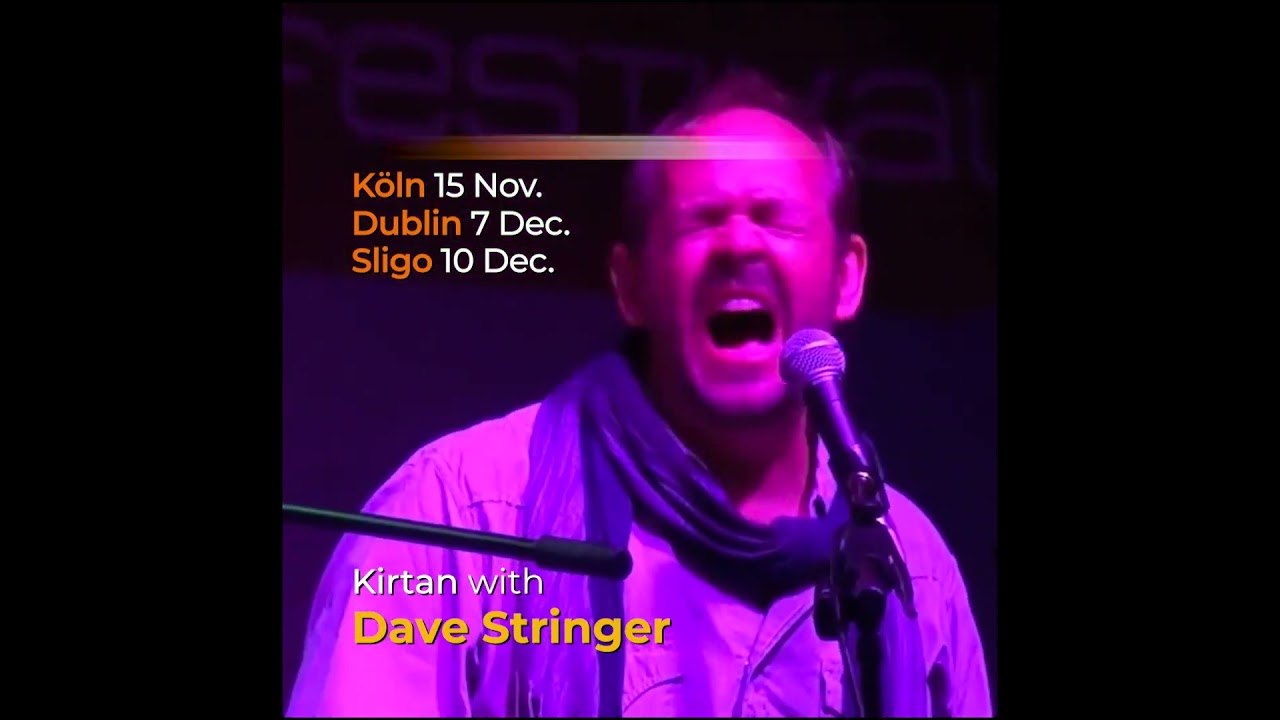
Dave Stringer Kirtan Tour Germany & Ireland Nov–Dec 2025
Inspire

Dave Stringer Kirtan Tour Germany & Ireland Nov–Dec 2025

Dave Stringer announces kirtan performances across Germany and Ireland in November and December 2025. Join devotional singing events in Berl…

1 min read
Chanting as Home Base: Faith, Thought, and the Restless Mind
Inspire

Chanting as Home Base: Faith, Thought, and the Restless Mind

Krishna Das explains why chanting steadies a restless mind, how faith grows from lived experience, and what "vote" we really have over the t…

1 min read
Bhaja Mana Radha Govinda Kirtan: Meaning and Practice
Inspire

Bhaja Mana Radha Govinda Kirtan: Meaning and Practice

A seven-minute London kirtan of the maha-mantra Bhaja Mana Radha Govinda, unpacked: its meaning, its call-and-response form, and the New Yor…

1 min read

Keep exploring

Continue your journey

More wisdom and gatherings from across the BrightStar directory.

More Articles

Browse the full library of teachings, interviews, and guides.

Back to all articles →

Teachers & Artists

Explore the lineages, musicians, and guides of the conscious world.

Explore artists →

Find an Event

Kirtan, retreats, sound baths, breathwork, festivals — happening soon.

Browse events →