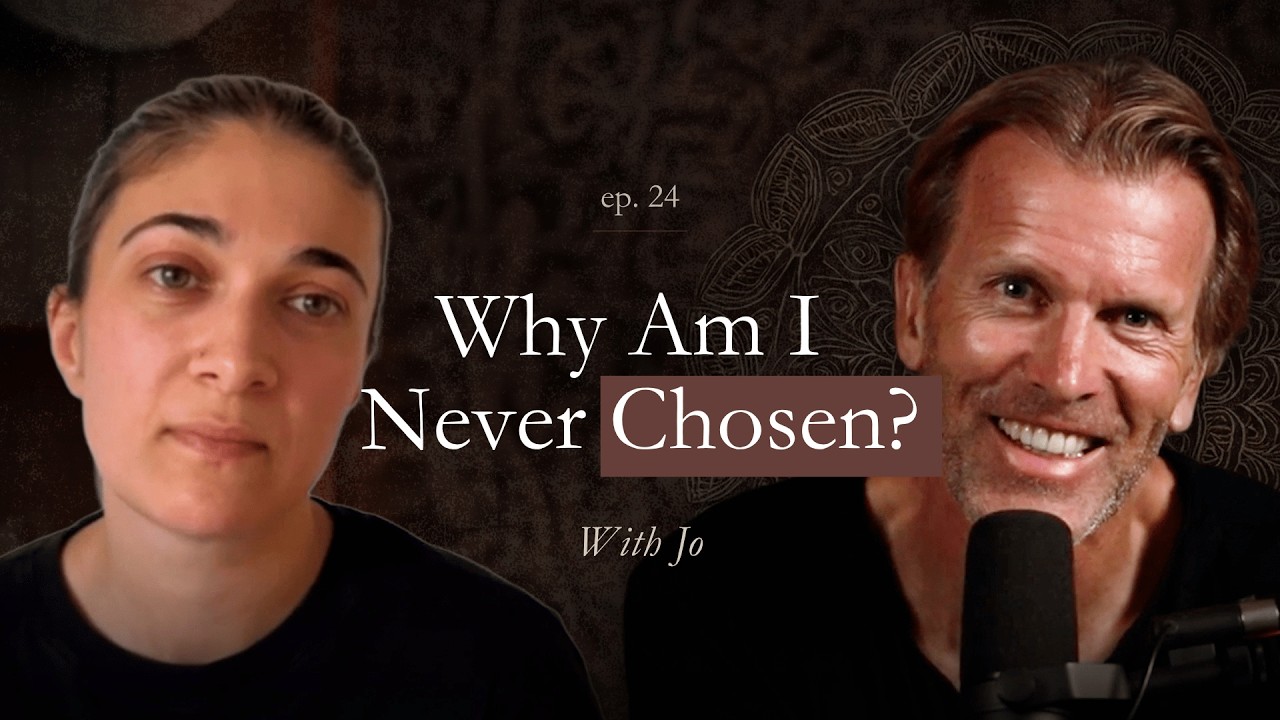
In this session, Peter Crone works with an adopted woman experiencing multiple physical symptoms—a cyst in her wrist, a mass in her uterus, and a sty in her eye—to uncover the unconscious belief driving their manifestation. Through dialogue, the root emerges: a core story of being "not wanted" stemming from adoption. Crone reveals how beliefs about inadequacy, fear, and rejection don't just affect psychology—they directly shape the body's tissue, creating physical accumulation where emotional space has contracted. The session demonstrates that healing requires shifting the story we unconsciously tell ourselves, which then allows the body to reorganize itself.
Why Life Delivers What Your Beliefs Tell You to Expect
Crone opens the talk with a reframe that anchors the entire session: the idea that you are "a soul" and that "life literally curated everything for you." This isn't fatalism or resignation—it's a shift from victim consciousness to what he calls a "spiritual" orientation. Most people, he explains, operate from the default assumption that they are victims of circumstance. Someone cuts them off in traffic, a boss treats them poorly, and the narrative becomes: "The world is doing this to me, so I must control the world to stay safe."
But Crone inverts this logic. If you hold the belief that you are "inadequate, not enough, not loved, not safe," then life becomes an orchestra of threat. Everything is a potential threat because the underlying story is: I need to defend against a hostile world. Flip that frame, and suddenly: What if life is curating events specifically for my liberation from the illusions that trap me? In that case, even painful, unwanted, or inconvenient events become information—feedback designed to help you see what you're unconsciously believing about yourself.
This shift has profound implications. Crone describes realizing he is "the luckiest human being on this planet" not because everything works out as he wants, but because an intelligence superior to his personal desires knows what he needs to discover his "true nature of freedom, love, and possibility." The world is no longer an enemy; it becomes a mirror.
How Resistance Creates Physical Accumulation in the Body
When the woman presents her symptoms—a sty, a cyst, and a mass—Crone doesn't treat them as separate medical problems. Instead, he asks her what she's missing or not seeing. She responds: "I'm not missing anything; there's something extra." This seemingly small distinction opens the doorway to understanding.
Beneath the physical accumulation, Crone listens for the emotional story. What emerges is fear—specifically, fear of not having a child of her own. An oncologist has recommended biopsy and possible surgical removal of the uterine mass. But Crone doesn't focus on the medical protocol; he goes deeper into the belief structure.
The woman is adopted. When Crone asks what it means to be adopted, she initially gives a neutral answer, but he pushes: "What's another word for saying that?" The word arrives: not wanted. There it is. A post-it note she's been unconsciously wearing her entire life: "I'm not wanted."
Now the somatic logic becomes visible. Crone asks: "For a woman who lives in the world believing she's not wanted, how commensurate would that be with someone being the channel for a child?" In other words, if the core belief is I am not wanted, I am not a safe container for life, I have no space—then the body begins to fill that emotional emptiness with physical matter. The uterine mass, the wrist cyst, the sty—they are not random. They are the body's literalization of the belief: There is no space here, so I will fill it.
This is not metaphorical thinking. Crone illustrates with a story from an event in Austin: a woman with a retinal dysfunction where part of her retina was detaching. When she realized her unconscious belief was that "the future is not safe for me," her anatomy began to reorganize—literally pulling away from the structure that would allow her to see forward. The body obeys the belief. And when the belief shifted, the physical pattern reversed.
The Role of Resistance in Perpetuating Symptoms
Crone addresses what happens when we resist our physical symptoms. The woman says she wants the lump gone, that she doesn't want it. Crone points out that resistance itself is the problem. When you resist something, you are in relationship with it—and that relationship, born of tension, is exactly what perpetuates it.
He invites a radical shift: instead of "I don't want the lump," what if the stance became "I love my cyst, I love my mass"? This isn't denial or spiritual bypassing. It's a shift in the energetic relationship to the symptom. Resistance contracts; allowing expands. In contraction, the body locks in the pattern. In allowing, there is spaciousness—and spaciousness is where reorganization can happen.
Crone explains: "When you resist something, what happens? You contract with it. You're in a relationship of tension with it." That tension is the very mechanism that keeps cells accumulating, inflammation rising, tissue stagnating. But when you stop resisting—when you allow the symptom to be—something shifts. The cells begin to breathe again. New cells are born; old cells die. The body returns to its natural flow.
The Body Speaks the Language of Belief
Central to Crone's framework is the principle that your anatomy cannot lie. It is literal. If your unconscious belief is "I am not a safe space" or "I am not wanted," your body cannot have a space—it must fill it, close it, harden it, or shut it down. The body is always expressing, through tissue and symptom, what the mind unconsciously believes about worthiness, safety, and capacity.
This explains why standard medical interventions, while sometimes necessary, don't address the root cause. If the belief remains—if the woman still lives as "not wanted"—then even surgery or medication is like treating a symptom while the fire still burns. The body will find another way to express the same belief through a different symptom.
Crone's invitation, therefore, is not to reject medicine but to work simultaneously on the belief layer. He asks the woman to consider: What if you came to see yourself as fundamentally wanted? What if your very existence—your capacity to hold life, to be a channel for another being—was proof of your worthiness? That shift in narrative doesn't cure anything magically. But it removes the unconscious instruction that has been telling the body to accumulate, contract, and close.
Why Unconscious Stories Drive Life Until Brought to Awareness
Crone quotes Carl Jung: "Until the unconscious is brought to consciousness, it will drive your life and you'll call it fate." This is the thesis of the entire work. The woman didn't consciously decide to grow a mass or develop a cyst. But her unconscious belief—planted in her as an adopted child, reinforced through decades of subtle and overt messages—was running her life like an autopilot program.
The session is an act of bringing that program into the light. Once the belief is named—once she can articulate "I'm not wanted"—it loses its invisible power. She can then choose: Do I continue to run this program, or do I revise it? Do I define myself by that adoption story, or do I tell a different story?
Crone emphasizes that this is not blame. The woman isn't guilty for developing symptoms. The belief was absorbed, not chosen. But now that it's conscious, responsibility becomes possible. She can work with the belief, question it, and allow a new narrative to emerge.
The Function of Holding Space in Healing
Crone speaks directly to the function of the gathering itself—the "container" of safety that allows unconscious material to surface. He says: "Until the unconscious is brought conscious, it will drive your life." But bringing the unconscious to consciousness requires a space where it's safe enough to be vulnerable, to cry, to feel the grief and fear underneath the symptom.
He expresses gratitude to the audience for "holding space for one another" and for showing up. He describes this space as therapeutic in itself—not because he is performing healing on anyone, but because in being witnessed, heard, and held without judgment, people naturally bring their blind spots to awareness. "This is healing in action," he says.
This is crucial: the work is not Crone healing the woman. The work is a safe container in which she can access her own knowing. He is the facilitator of her own wisdom. And as her unconscious belief becomes visible, she can feel, integrate, and eventually release it—which is when the body can reorganize.
Where to Go from Here
If you resonate with this framework, several practices follow. First, notice what your body is expressing. Physical symptoms are not random; they are messages. Ask: What belief am I unconsciously living? What story am I telling about myself that my body is reflecting back to me?
Second, practice awareness without resistance. Notice where you are contracting against symptoms, emotions, or life circumstances. What happens if you shift from "I don't want this" to "I'm willing to understand what this is showing me"?
Third, examine the stories you inherited—especially around worthiness, safety, and belonging. If you were adopted, abandoned, rejected, or made to feel inadequate, that story may be running in the background. Bringing it to consciousness is not about blame; it's about choice.
Finally, seek or create spaces where you can be truly heard and held. Whether through therapy, spiritual community, or trusted relationships, the work of bringing the unconscious to consciousness happens best in a relational container where it feels safe enough to be vulnerable. That safety itself begins the healing.