
Rodney Yee's name belongs to yoga more than to the record shelf, so this piece starts with what is documented. The public record gives no album titles, no discography, no instrumentation, no named tempo or vocal style. It lists a Spotify presence in the yoga genre with about 4,400 followers, and it says the work is "mainly visual and instructional rather than audio-led." Any description of synthesizers, harmoniums, or sung mantra would be invention. What can be described honestly is the sound of the teaching, and where that sits next to conscious music.
The recorded output is primarily teaching-based, so the central sonic material is a voice giving instruction. The record describes that instruction as careful verbal cueing: attention to how a pose is organized "from the feet upward," repeated alignment reminders, and a deliberate, unhurried pace. Sessions are described as studious rather than performative.
Texture follows from the method. Iyengar-derived practice holds poses, sets alignment, and uses blocks, straps, and bolsters, so the audio of a class is built from pauses, small corrections, and breath. Restorative and yoga nidra sessions ask for little physical effort and lean on stillness and breath awareness, so they are the ones most likely to work as listening experiences. Whether any of them carry musical backing is not stated, and this piece does not guess.
The bio places Rodney Yee in the Iyengar tradition, the method associated with B.K.S. Iyengar. The foundation was built at The Yoga Room in Berkeley and the Iyengar Institute of San Francisco, with teachers Donald Moyer, Manouso Manos, and Ramanand Patel. Over four decades the inquiry widened into pranayama, meditation, and yoga nidra.
This is not a bhakti, kirtan, or mantra lineage. The record notes that students hoping for a devotional framework with chanting or ritual may find the material "more anatomical and secular than expected." Anyone expecting call-and-response singing should adjust their expectations. The stated aim, peace, is approached through practical tools rather than doctrine.
Rodney Yee's distinctive offering is a way of speaking about the body. The path ran through high school gymnastics, philosophy and physical therapy studies at U.C. Davis and U.C. Berkeley, and professional dance with the Oakland Ballet Company and the Matsuyama Dance Company of Tokyo. That background gives the instruction a body-mechanics vocabulary many yoga teachers lack. Where other conscious-music figures contribute a melody or a chant, Rodney Yee's contribution is a cadence of precise, patient cueing that turns the body into an object of ongoing inquiry and then widens toward mind.
The reach of that voice came through media. Yoga Journal calendar appearances in 1989 and 1991 launched a video career under Healing Arts and later Gaiam, and a 2000 appearance on Oprah helped carry yoga into mainstream American homes.
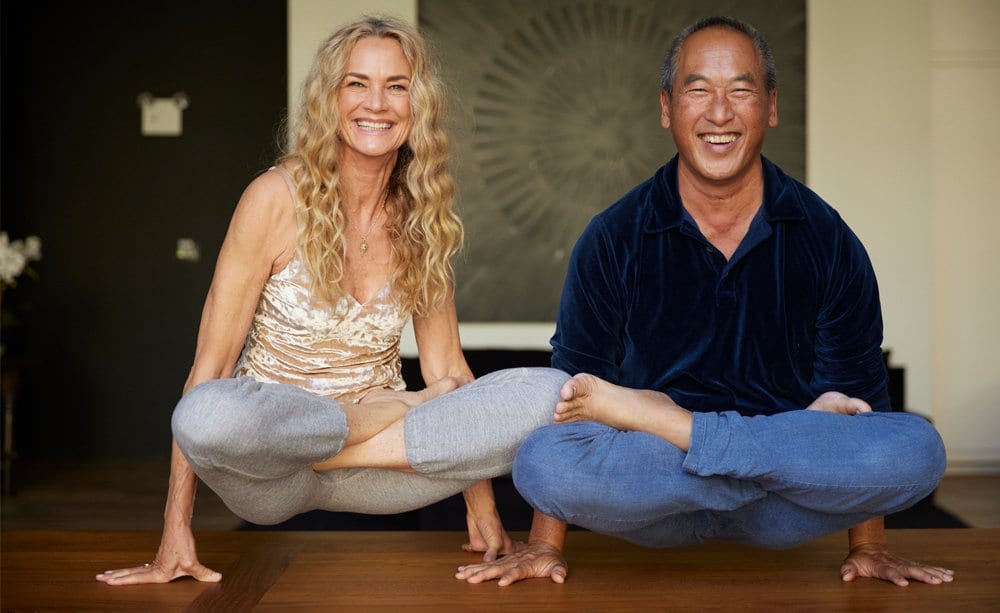
The verified collaborator is Colleen Saidman Yee, a yoga teacher and Rodney Yee's wife, with whom there has been a partnership since 2003. They co-lead workshops, retreats, and teacher trainings and co-direct Urban Zen's integrative therapy program. They teach together in Sag Harbor, New York, at her studio, Yoga Shanti, and the record notes that the two bring different emphases to the same practice, so students hear two voices. In 1987 Rodney Yee also co-founded The Piedmont Yoga studio with Richard Rosen and Claire Finn. Those are studio and teaching collaborations, not musical ones, and no musician collaborators are documented.
Start by verifying what is actually available. The Spotify listing exists, but no album or streaming link is documented, so check before assuming content. The official site, rodneyyeeyoga.com, hosts the on-demand library, which is the core of the recorded work.
For a first listen, choose a gentler session. Restorative and yoga nidra classes are the most natural entry, since they involve stillness and breath awareness and little exertion. The beginner's guide, Where to Start with Rodney Yee: A Beginner's Guide, is the suggested map.
Several things may surprise a listener arriving from music:
- The pace is measured, and poses are held longer than flow classes would hold them.
- The voice explains rather than incants. Expect anatomical detail, not devotional language.
- Props matter, so a block, a strap, and a folded blanket improve a home session.
- Value accumulates through repetition. The record recommends treating the recordings as a practice syllabus rather than a one-time listen.
Live options exist too: a retreat at Menla Retreat and Dewa Spa in Phoenicia, New York, on October 30, 2026, and two sessions at Kripalu Center for Yoga & Health in Stockbridge, Massachusetts, on January 29, 2027, at 2:00 PM and 7:30 PM. Dates can change, so confirm with the venue.
Conscious music is often sorted into devotional chant, ambient meditation scores, and sound-healing work. Rodney Yee sits at its edge, in the guided-practice corner where spoken instruction does the work that melody does elsewhere. The nearest neighbors are teachers whose recordings function as practice companions, not as albums to be played for their own sake.
That position is a real tradeoff. Listeners seeking a sonic world to disappear into will not find one documented here. Listeners who value a precise, calm instructional voice, one grounded in Iyengar alignment, dance, and physical therapy study, will find something rarer: a recorded presence that teaches attention. For anyone wanting a full account of the life behind it, the biography piece, Who Is Rodney Yee? Life, Work, and Legacy, is the companion read.