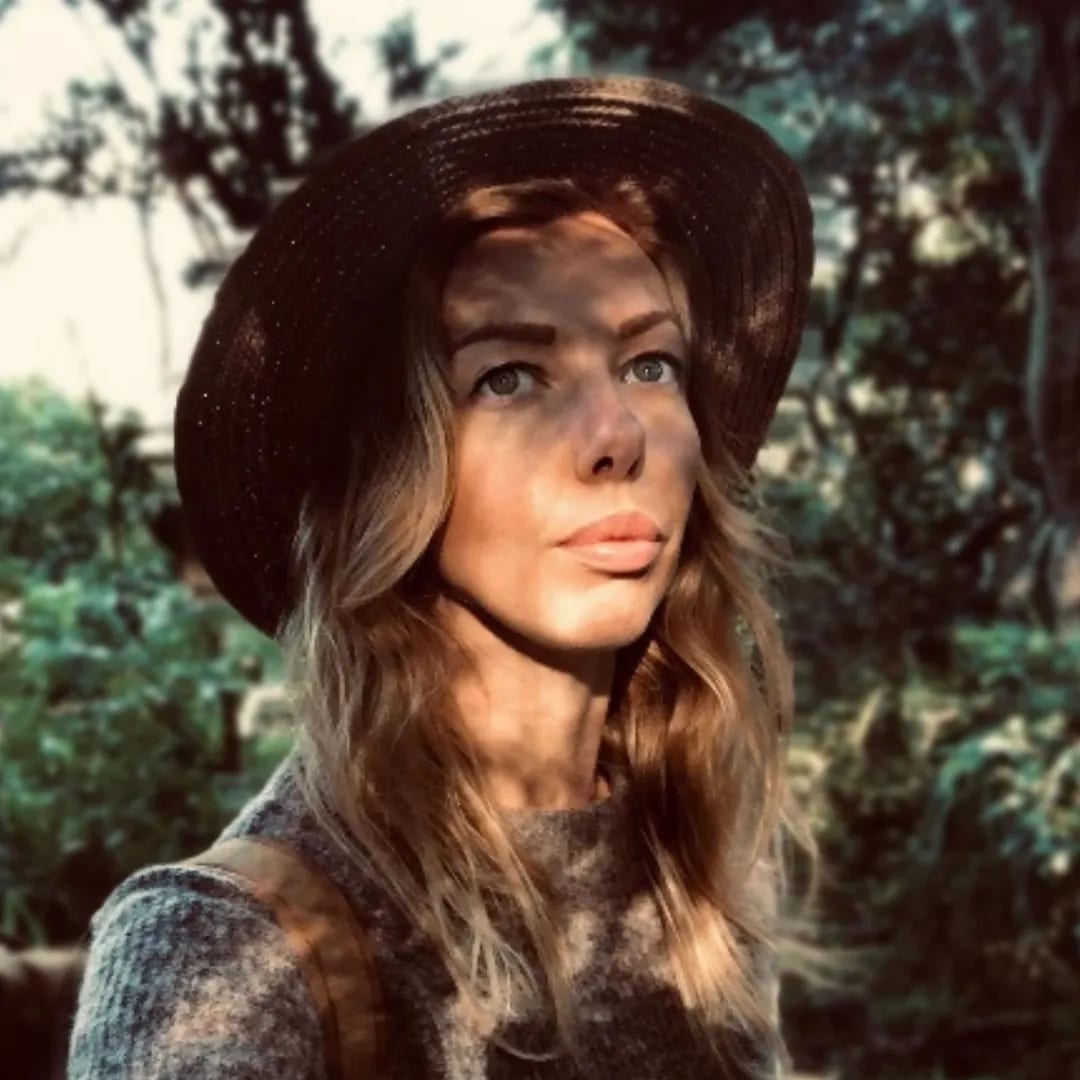

Sez Kristiansen is a poet, nondual meditation guide, and writer whose work gathers three threads that rarely sit together: embodied nonduality, deep ecology, and recovery. She is also known as a breathwork facilitator, though that description captures only one of the ways she works. Across books, guided meditations, essays, and poems, she returns to a single, quietly radical proposition: that healing is less a matter of becoming someone new than of remembering what has never been missing.
It is a gentle idea, but it comes from hard-won experience. Her work does not arrive from a distance, offering wisdom from a place of untroubled calm. It comes from someone who has lived through addiction, trauma, and depersonalisation, and who found that the usual language of self-improvement could not hold what she was discovering.
Sez Kristiansen was born and raised in Southern Africa, with Nordic roots. Beyond that, the public record is spare, and she is not a writer who builds her work around biographical detail. What does emerge, consistently, is the shape of her early relationship to the world: a deep connection with the natural landscape, a love of wandering, and a lifelong inquiry into what it means to belong.
That question of belonging runs beneath much of what she has since made. For someone whose heritage spans continents, and whose own inner life at times felt disconnected from the body and the world around it, belonging is not an abstract theme. It is a question that is asked with the whole of one's life, and her work can be read as a long, patient attempt to answer it.
Kristiansen's path into her current work was not a straight line from curiosity to expertise. It ran through addiction, recovery, trauma, and depersonalisation, the sense of being estranged from one's own experience, as though watching life from behind glass. These were not subjects she studied; they were conditions she lived in.
What distinguishes her account is where that experience led. Rather than settling into the familiar project of fixing a broken self, she moved beyond traditional self-improvement altogether, into what she describes as a lived exploration of wholeness, embodiment, and consciousness. The shift is subtle but significant. Self-improvement assumes a deficit; her work begins from the possibility that nothing essential was ever lost. Recovery, in this view, becomes less about repair than about return.
Kristiansen's central contribution is her insistence that nonduality, often presented as a rarefied philosophical view, is something to be felt in the body and in the natural world. Her work invites people to rediscover what is already here beneath striving and self-judgment: a deeper intimacy with themselves, with the living earth, and with life itself.
This integration matters. Nondual teachings can drift toward abstraction, and recovery culture can sometimes remain focused on the self as a project. Deep ecology, for its part, can feel removed from personal healing. Kristiansen draws the three together, suggesting that the wound of separation, from the body, from others, from nature, is one wound, and that remembering our belonging addresses all of it at once.
Nature, by her own account, remains her greatest teacher, and her writing carries that sensibility: attentive, unhurried, and more interested in presence than in prescription.
Kristiansen is the author of several books. The best known is Healing HER, which has reached more than 80,000 readers worldwide, a considerable audience for work grounded in poetry, reflection, and lived experience. Her other titles include Story Medicine and Whole In The Body, the latter pointing directly to her emphasis on embodiment as the ground of healing.
Her guided meditations on Insight Timer have been listened to more than 500,000 times, a measure of how her voice has traveled into people's daily lives, into mornings, sleepless nights, and difficult moments. Her music-platform presence, with roughly 27,800 followers on Spotify, reflects the same pattern: an audience that finds her through listening rather than through spectacle.
She also writes a newsletter on Substack, where essays offer a more sustained space for her thinking. Together, the poetry, meditations, books, and essays form a body of work in which each form does different labor: poems that distill, meditations that guide, essays that explore.
At present, Kristiansen continues to work across these forms, offering poetry, meditation, and essays that invite people back toward themselves. Her facilitation of breathwork sits alongside her writing and guiding, another doorway into the body's intelligence. Her Substack provides an ongoing record of her thinking, and her recorded meditations remain widely accessible to listeners around the world.
Her current work does not appear to be a departure from earlier themes so much as a deepening of them: a continued turn toward simplicity, toward the idea that what we are seeking is not somewhere ahead of us.
Kristiansen reaches people who are often poorly served by conventional wellness language: those in recovery, those living with the aftermath of trauma, those who feel numb or detached from their own lives, and those who sense that the pursuit of constant self-betterment has become its own kind of suffering. For these readers and listeners, her message offers relief without false promises. It does not ask them to become more; it asks them to stop leaving.
She also belongs to a growing movement of writers and teachers who link inner healing to ecological belonging, recognizing that how we relate to ourselves and how we relate to the earth are not separate questions. In an era marked by both personal fragmentation and planetary crisis, that connection feels increasingly necessary.
It would be premature to speak of Sez Kristiansen's legacy as settled. Her work is still unfolding. But the outlines are already visible: a body of writing and practice that treats recovery as a path to wholeness, treats the body as a site of wisdom, and treats nature as a teacher rather than a backdrop. Her enduring offering may be the simplest one: a reminder, delivered with honesty and tenderness, that belonging is not something to be earned. It is what remains when the striving falls away.